
A small group of protesters gathered outside of the Mexican Consulate in downtown San Bernardino to protest the kidnapping/disappearance of 43 student-teachers from a rural area in the state of Guerrero.

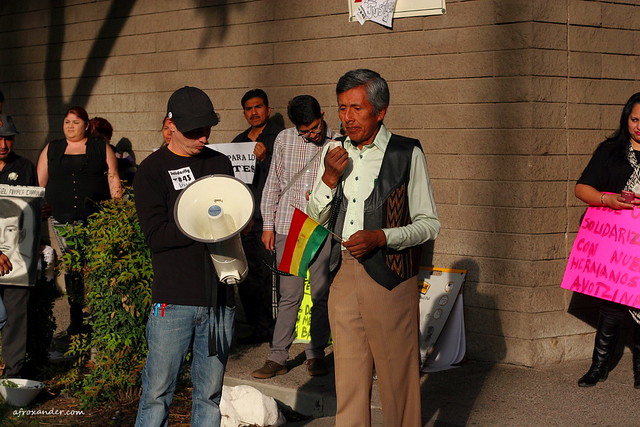
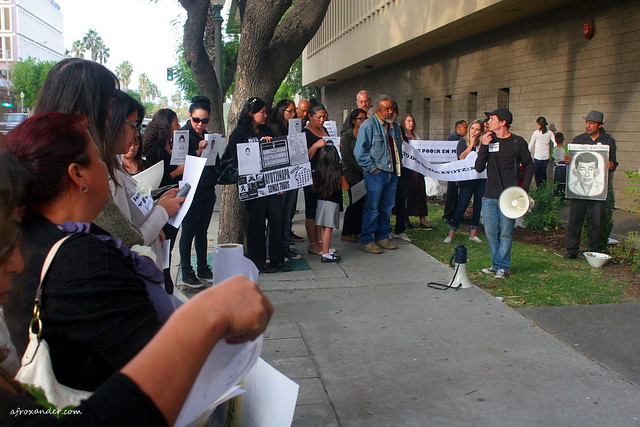
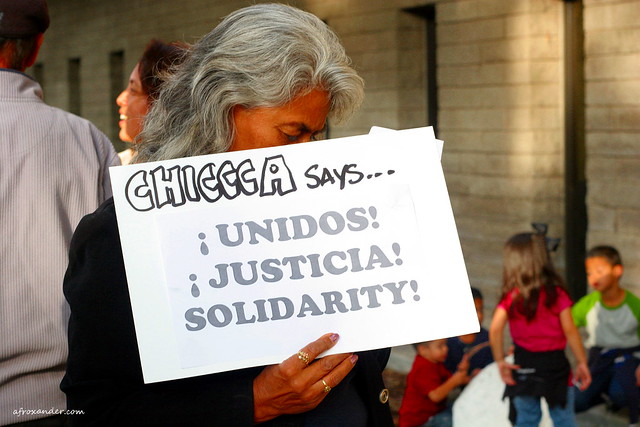
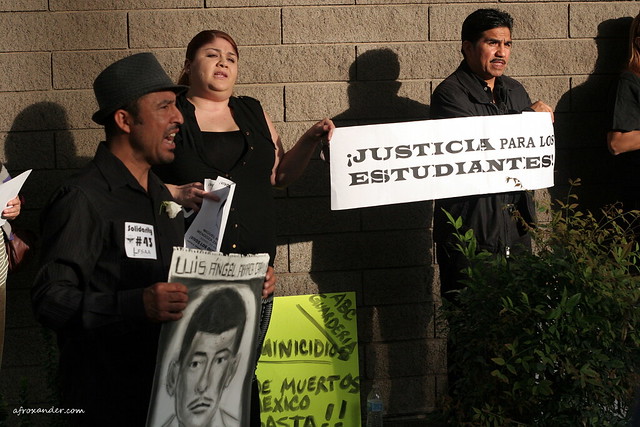
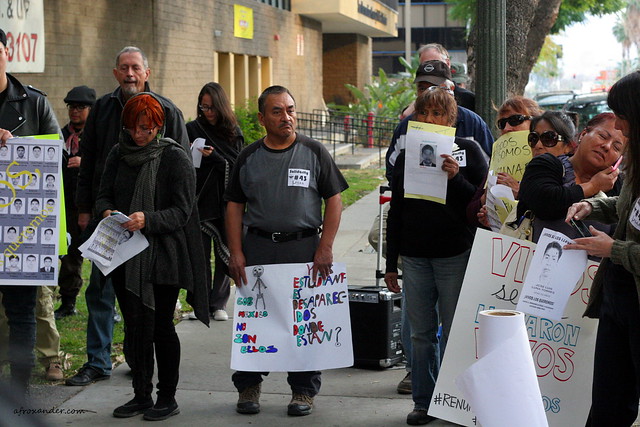
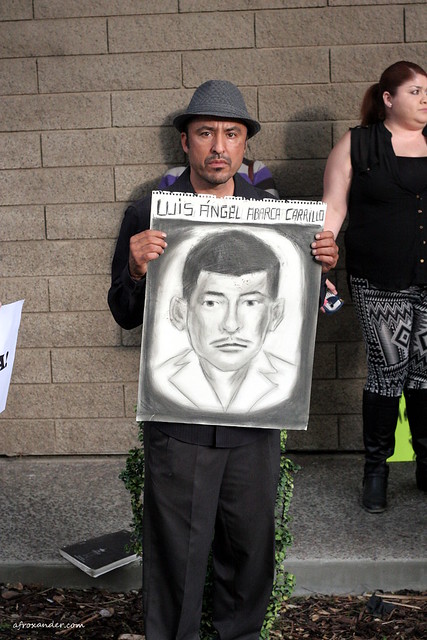
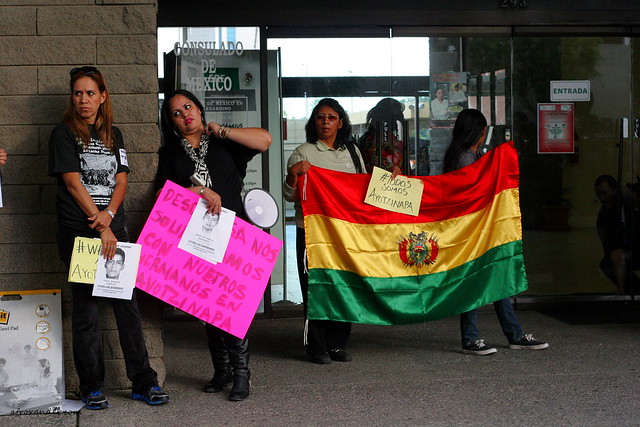
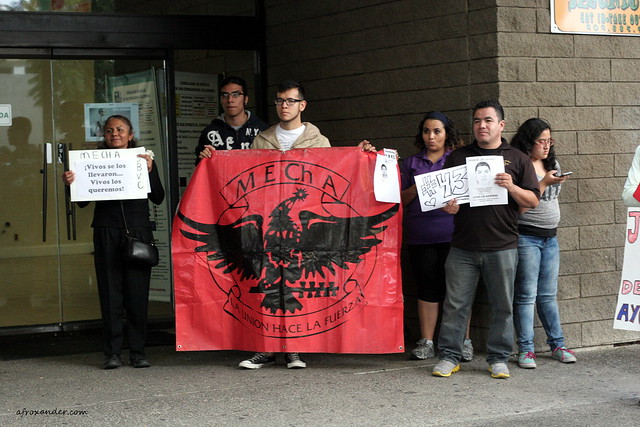
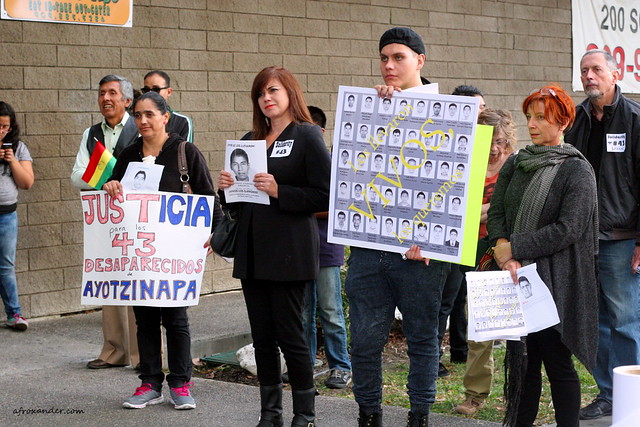
A small group of protesters gathered outside of the Mexican Consulate in downtown San Bernardino to protest the kidnapping/disappearance of 43 student-teachers from a rural area in the state of Guerrero.
The World Cup is less than two weeks away and I’ve found myself neck-deep in compelling and insightful stories/articles about the event, the sport, and host nation Brazil.
I’m going to share my favorites in this post. Bookmark this link because I’ll be updating it with new stories as I come across them.
Nearly every story about the drug war in Mexico begins with or eventually mentions statistics on the number of persons killed as a result of it. Far too little of them, however, consider the effects of the drug war on those who survive and continue to live through it.

The issue is widespread across the entire country especially in areas such as Ciudad Juarez which have been wracked by violence, kidnappings, extortion, etc. more than most.
As Miriam Wells of Insight Crime points out:
One challenge that Mexico will likely face in the coming years is assessing the true extent of the psychological toll left by the drug war. Asides from enduring kidnappings, gun battles, and other very public displays of violence, many Mexicans must deal with the question of what happened to friends and relatives who have disappeared. The Attorney General’s Office has estimated that over 26,000 people were reported missing between 2006 and 2012.
A story in Al-Jazeera describes the mental toll on medical staff in hospitals and rehabilitation clinics in Juarez but also mentions how the drug war (a.k.a. narco war) has orphaned many children:
“Mental problems really started growing in Juarez three years ago,” says Pastor Jose Antonio Galvan, who runs a mental rehabilitation clinic on the city’s dusty outskirts.
He estimates that 300,000 people in Juarez are facing mental or spiritual illnesses.
“For every person who is executed here, 40 people, including friends and family members, are affected by the ripples,” says Galvan, describing the stress residents face.
Ten thousand orphans are victims of the narco war, he says. Ninety per cent find refuge with other family members, but the remainder become “the next generation of hit-men and criminal minds”.
Galvan explained the situation in Juarez in greater detail in a story in the Colorado Statesman:
In the last two years, there have been roughly 7,500 murders. That means that there are tens of thousands of survivors — family and friends — who are in mourning. In addition, thousands of orphans live on the streets or in tapias or abandoned houses. “They are children of sadness, of hate,” El Pastor says. Since they have no education, no work skills and no family support, they are easily recruited into the dozens of gangs that make Juárez so dangerous.
US News published a story on the mental effects the war, as well as poverty, and how it affects children in Juarez:
Researchers looked at the mental health of children and teens living in El Paso, Texas, and Ciudad Juarez, Mexico, in 2007 and again in 2010. All of the children were Mexican or Mexican-American and lived in homes below the poverty level. None had a history of diagnosed mental illness.
The psychosocial and behavioral scores of the children in El Paso did not change significantly between 2007 and 2010. However, the children in Ciudad Juarez showed significant increases in social problems, rule- breaking and aggression scores over the study period.
…
“There is cumulative harm to the mental health of children from the combination of collective violence attributed to organized crime and poverty,” study author Marie Leiner said in an AAP news release.
Ruben Villalpando of La Jornada published a story government research that discovered that 22,000 junior high/middle school students suffer from post-traumatic stress disorder caused by the drug war.
Adicionalmente, más de 22 mil estudiantes de secundaria sufren de estrés postraumático por el duelo de haber perdido a un familiar de forma violenta, presenciar una balacera, pasar por una escena del crimen o escuchar relatos similares.
***translation
Additionally, more than 22,000 junior high students suffer from post-traumatic stress caused by the pain of losing a loved one to violence, by witnessing a shootout, passing by the scene of a crime, or listening to stories of such events.
Studies into this topic are necessary not only to completely understand the effects of the war but also, and more importantly, how to better assist those hurt by it.
Since I wrote about the drug war in Mexico last year (see here and here), I’ve discovered more independent journalists who devote their time to covering drug war-related events in Mexico. One of these journalists is K. Mennem, creator of the Hell On Earth blog. His blog provides analysis of headlines from the drug war plus delves into aspects of the drug war’s cartel culture not covered by other sites, such as his story about Nuevo Laredo’s Boy’s Town.
I swapped a few e-mails with Mennem to learn more about his work and blog. Below is a brief exchange we had about his work and blog.

Let’s talk about your journalism background. How long have you worked as a journalist? Where have you been published/are published? Why did you decide to become a journalist?
I do not come from a formal journalism background. My college degree is in business, but I traveled to Mexico frequently with international study groups during college. I started my blog in 2009. The original plan was to write about various global events that are not covered by main stream media. My whole intent was to help bring to light the horrible things that occur daily in our world, yet these are often ignored by the public. I write routinely for the San Diego Reader, my blog of course, and guest spots on various blogs and websites from time to time. I have recently had an increase of interest from universities and politicians on my work. Doing work for these type of groups is currently in the making. I decided to start into journalism after I finally realized how much time I was spending on reading, researching, traveling, and talking to people about these issues. In most ways it had already engulfed my life before I even realized it. I am also an insurance agent. I sell local and international policies to businesses and private customers. I am the marketing director and international sales agent for an agency my brother owns. The flexibility with this job has allowed me to make both of my careers work.
Tell me about Hell On Earth blog. Where/how did you come up with the title? What is your interest in following/investigating narcotrafficking/drug war in Mexico?
The title for my blog came from the original concept of the site. Writing about the “Hell on Earth” that is unknown to many. As the Mexican cartel wars raged on, my blog eventually became focused on issues there. The drug war across the Americas has always been my focal point, but I decided to completely focus on it for the time being. I have always had strong ties to Mexico. I still travel to Mexico when possible. My passion for the country and its people compelled me to write about events often ignored in the United States. The ugly truth is that the U.S. is causing this chain reaction of events by its huge appetite for narcotics. My interest into following these events were naturally drawn in because of my interest in Mexico. I have friends on both sides of the law, friends on both sides of the border, and have spent considerable time along the border. These things have helped me develop into what I do.
How can mainstream media outlets improve their coverage of the drug war in Mexico?
Mainstream media needs to elaborate more on events happening, and not just give short summaries. Almost everything happening is directly tied to the United States, but you can not tell that by reading one paragraph a week in the newspaper. National news stations pick up on stories whenever it is the hot thing to do, but most often it is only when a U.S. citizen is a victim of a crime in Mexico or on the border.
Spanish magistrate Baltasar Garzón continues to sit on the opposite side of the bench inside Spain’s supreme court. Garzón, lauded globally as a defender of human rights, is currently defending himself in his second trial where he is accused of breaking an amnesty law passed in 1977, two years after dictator Francisco Franco’s death, that prevents any probe into Franco-era crimes via a general pardon.

Judge Garzón launched a probe in 2008 into the disappearances of over 100,000 persons while Franco was in power. Family members of the victims have spent years, some even decades, trying to discover where their loved ones were buried.
From The Telegraph UK:
The first witness, Maria Martin, recalled how in 1936 when she was just six, her mother was one of three women and 27 men shot dead and their corpses dumped into a mass grave on the side of a road.
Supported by a Zimmer-frame and speaking in a voice cracked with emotion, the 81-year-old said her family had fought to recover the remains of her mother for a proper burial ever since.
“Until the day he died in 1977 my father wrote to the local authorities to try to recover the body. They told him: ‘Go away, leave us in peace or we will do to you what we did to her’,” she told the Supreme Court.
Garzón first appeared in court last week to defend himself from allegations that he’d overstepped his jurisdiction when he authorized police to wiretap conversations between lawyers and their clients in what’s known as the Gürtel case. The case involves charges of corruption against members of the Partido Popular, which currently holds power in Spain.
A date for the third case, which centers around allegations that Garzón dropped an investigation against the president of Banco Santander in exchange for payments for a course sponsored by the bank at New York University, has not been set yet.
El Pais has a detailed analysis of each case.
Garzón became famous worldwide in 1998 when he ordered the arrest of Chile’s former dictator Augusto Pinochet for crimes against humanity. Pinochet was extradited from London to Santiago, Chile where he lived under house arrest during his trial. The arrest led to “the Garzón effect” throughout Latin America.
That was just the first in a number of high-profile cases he led including:
Garzón risks losing his role as Investigative Magistrate for up to 20 years if he is convicted in any of the trials.
Below is a lengthy interview Garzón gave to Democracy Now:
The past week was an exciting and busy one as I covered a handful of interesting events for Remezcla and LA Weekly (all links in the photos).
First up, I made my way to the King King in Hollywood for BMI‘s Otoño Alternativo Latino Showcase featuring a number of up-and-coming Latin artists:


I made my way out to the Nokia Theatre on Friday night to catch legendary Mexican Rock group Caifanes perform:

The next day, I met thousands of protesters outside of L.A.’s city hall:

And on Sunday, I had a brief discussion about neuroscience and video games with Henk Rogers of the Tetris company following the 2nd Annual Tetris Championship:

Javier Garza Ramos, editor-in-chief for Mexican newspaper El Siglo de Torreon, wrote a piece for the Columbia Journalism Review that covers on a topic I touched on briefly in a previous post.
The following excerpt comes from Writing The War On Drugs: Why do so few American papers report on the trade in their backyard?
For years the absence of stories about how drugs are moved and traded inside the United States has sparked my curiosity. Ten years ago, while a graduate student at the University of Texas at Austin, I did a content analysis of how several American news outlets portrayed the war on drugs in Mexico and in the United States. I uncovered two main narratives. The one about Mexico focused on government corruption, the cartels’ structure, their control of local law enforcement, and the way they move drugs across the country. The narrative about the US dealt mostly with drug addiction and stories about prevention and rehabilitation programs. Continue reading “Blood, Drugs and Hitmen Addendum: Javier Garza Ramos”
Drug cartels in Mexico who once operated in the shadows announced their entrance into mainstream society with a number of beheadings in 2006 that marked the beginning of a wave of unprecedented violence that still consumes parts of the country. Gun fights in broad daylight occur regularly in parts of Nuevo Leon, Michoacan and Chihuahua. Cartels have also moved on to methods more sadistic than beheadings via vats of acid and even a car bomb or two.

Much of Mexico continues to live normally despite the violence in some areas. Traveler extraordinaire Rick Steves celebrated the coming of 2011 in Mexico City with nary a hint of drug-related violence in sight. My relatives in the state of Jalisco continue to live in peace. My friends with families in Juarez, unfortunately, cannot say the same. They have suffered extortion and violence at the hands of cartels and corrupt law enforcement.
Most Mexican news organizations can’t or won’t cover the situation in-depth because of threats and attacks by cartels on their headquarters and journalists. U.S. news organizations can’t or won’t because it’s not in their interest to do so save for lazy, fear-mongering tales of spillover violence and anarchy.
So where do concerned citizens and interested parties turn to for accurate information and comprehensive analysis of events in Mexico? Read on after the jump to find out:
 Afroxander (aka Iván Fernández)