The schism that divides Major League Soccer commissioner Don Garber’s vision for the league (and the sport in general) and the sport’s too-often-forgotten-by-design history was on full display on September 25, 2024 thanks to a cup trophy double-header in the USA.
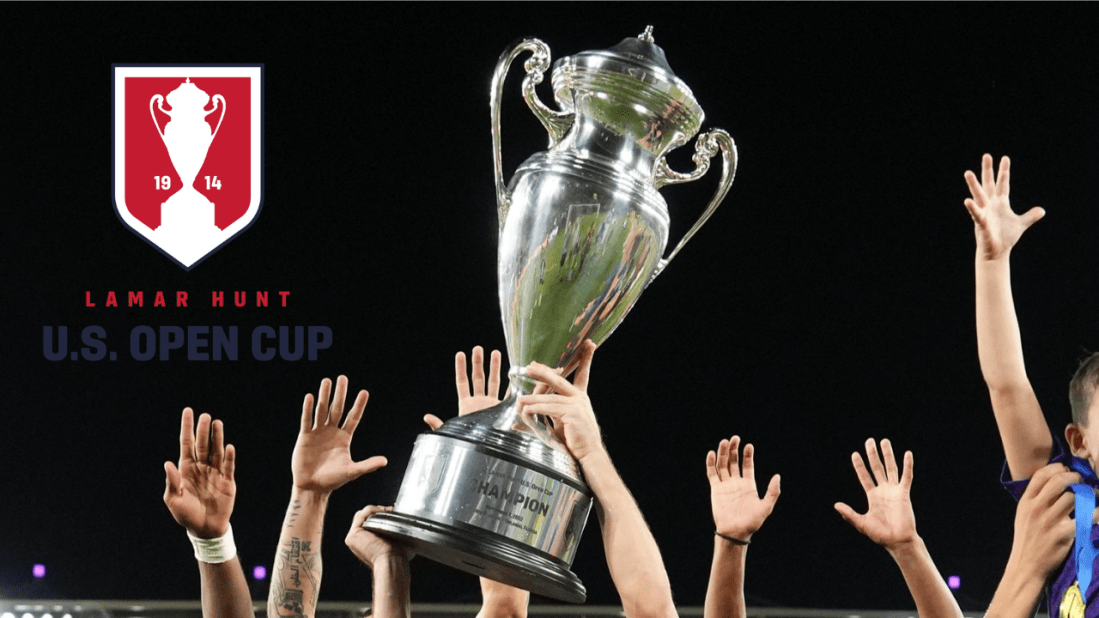
The day began with Club América of Liga MX lifting the Campeones Cup trophy after defeating the Columbus Crew of MLS. Hours later, Los Angeles FC lifted the US Open Cup title at home in an overtime thriller against Sporting Kansas City.
The former is one of the tournaments invented by long-running MLS commissioner Don Garber. The Campeones Cup pits the winner of Liga MX’s Copa de Campeones Cup and the MLS league winner. This one-off game spawned the separate, month-long Leagues Cup, which is an all MLS vs all Liga MX affair and the latest in big ideas of Garber’s lifelong escapades in US and CONCACAF (and soon-to-be global?!) soccer.
The antithesis to these ideas is the US Open Cup. Founded in 1913, the tournament has hosted US teams from every division and continues to do so today…and that’s in spite of Garber’s attempted meddling in all facets of US soccer.
It was around this time last year that MLS announced that it would not field any teams in the US Open Cup and would instead send in the MLS reserve sides to the tournament. The pushback was swift, but only eight of 29 MLS teams decided to continue competing as normal. The others were replaced by their MLS Next Pro counterparts.
How will they comply w/ Art.II.a.ii of US Soccer's Pro League Standards, which require DI outdoor leagues to play in all U.S. Soccer competitions for which they are eligible. Isn't the Open Cup a U.S. Soccer competition? Are they sending MLSNP rosters under the MLS teams' names? https://t.co/DbxCkodRdvpic.twitter.com/hUw0OSzpnz
I almost missed out on the Copa América this year. I attempted to sign up for a press pass as I normally do for a balompié tournament in the US. I say attempted because, unfortunately, the application page for credentials via CONMEBOL left me with more questions than answers I could provide to the ones listed on the request form.
As a friend of mine at ESPN noted: “dude it’s a mess lol – there’s gonna be mistakes and some angry people this summer haha.”
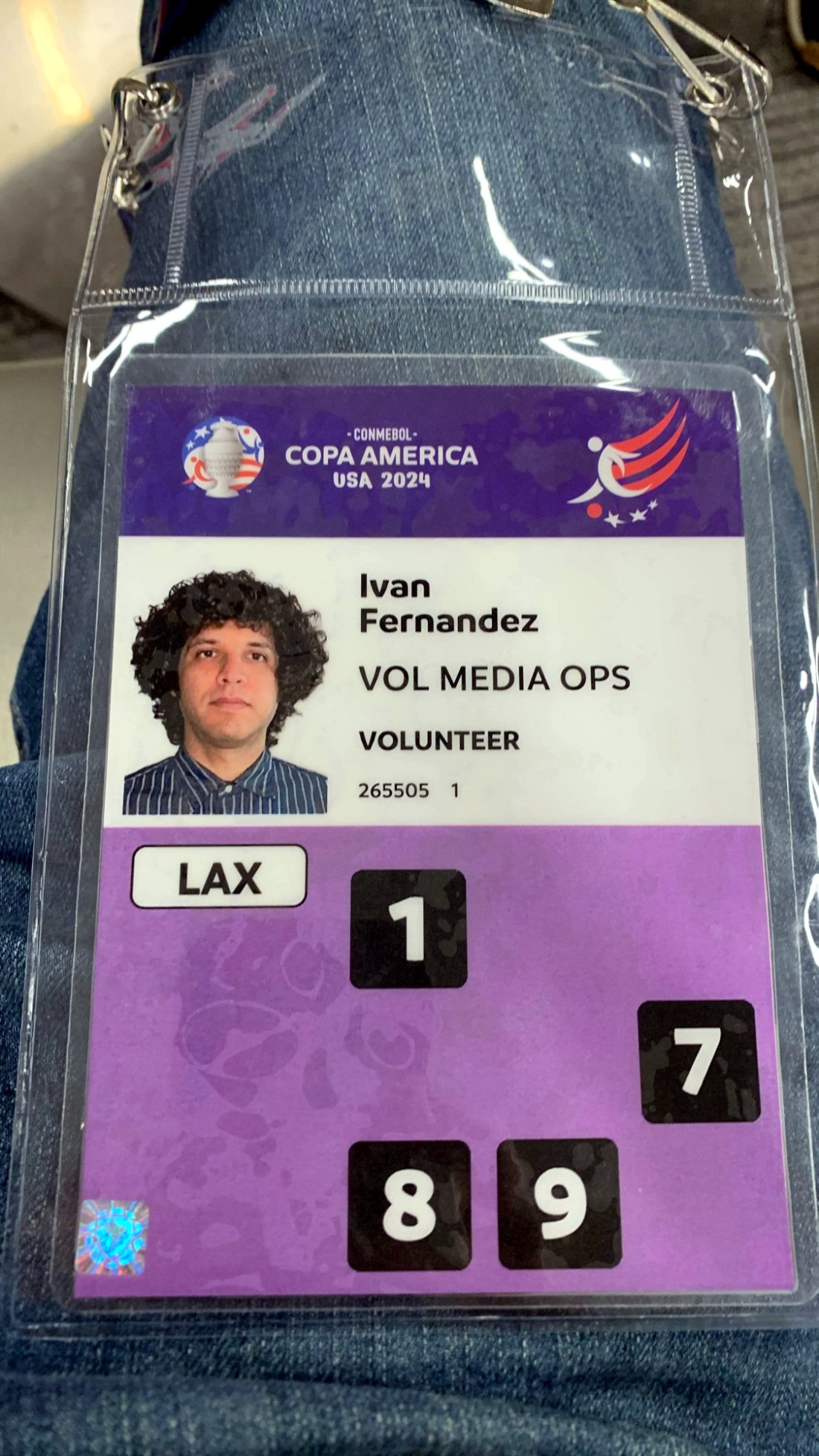
I witnessed the result of CONMEBOL’s questionable leadership first-hand, early-on in the tournament during my brief stint as an official volunteer for the Copa América 2024. A journalist friend of mine at the L.A. Times shared information on how to enroll as a volunteer at the tournament. It was my best chance to at least attend the two group stage games at SoFi Stadium in Inglewood.
View near VIP entrance 10 at SoFi Stadium, adjacent to the YouTube Theater.
The application for volunteers was mercifully easier to complete than the one for journalists. There were numerous categories listed for applicants to choose from depending on their skills and preferences. These were: Training Site, Competitions Support, Team Services, Antidoping, Security, International Relations, Commercial Operations, and Media Operations. The Media Operations option was divided into additional subcategories: mixed zone, conference analyst, press conference analyst, photo analyst, press conference support, and press tribune analyst.
For the latter, I wrote a list of establishments where one can eat and/or watch games in L.A. during the Copa América this summer. The list is based on each competing national team!
Have y’all heard about this guy named Messi? He’s pretty good at this soccer thing.
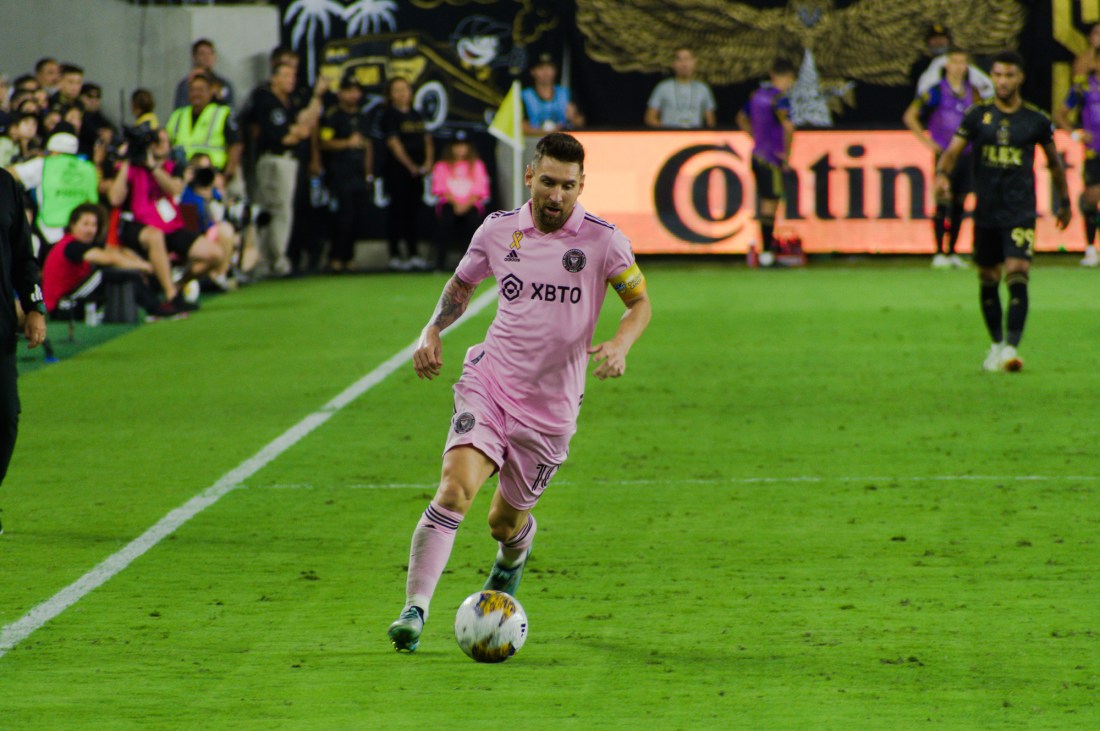
Messi and Inter Miami came to Los Angeles over the Labor Day weekend and I got to witness it first-hand for LA Taco.
EXCERPT:
Although Messi had already been presented to the Inter Miami faithful during a tropical storm more than a month ago and made his sporting debut in the Leagues Cup against historic Mexican club Cruz Azul, it wasn’t until this game in Los Angeles that the full-weight of the moment came to fruition.
The new iteration of Major League Soccer, with an assist from tech and media giant Apple, as the beacon leading the world into the 2026 FIFA World Cup and the main competition with Saudi Arabia and the Saudi Pro League for players, fans, and soft power, was officially here and shepherding the new age of modern football.
The Leagues Cup has finally come and gone after what felt like an eternity. I have plenty of thoughts about the Super League style tournament (and they’re not positive ones either) but I’ll save that for another day. For now, my hat-trick of articles (sponsored content, actually!) of coverage of three of LAFC’s four Leagues Cup games will suffice.
La Fiera dominated the Black And Gold across the two game stretch of the CONCACAF Champions League final. I put together a short piece & photo essay for LA Taco of the second & final leg hosted by LAFC this past Sunday June 3.
My latest article for KCET is available to read and enjoy. It’s a deep dive into Coras USA, aka Coras de Los Angeles, a local soccer team that existed for 50 years in southern California. The team was a cultural umbilical cord for Mexicans in Mexico and the US and later became a gateway for young players hoping to become professionals.
What began as a fun ritual for the weekend grew into a family legacy of community-building that lasted half a century. During its existence, Coras USA united working-class, immigrant families from Nayarit and other regions of Mexico in Los Angeles and provided youth players a pathway towards a professional career during its final years in the city of Riverside.
“Its original name is Deportivo Coras USA,” explained Lopez of the team founded by his father and uncles. “The first name that it had was Coras de Los Angeles. Along the years, it had a couple of name changes like Deportivo Nayarit [and] Deportivo Coras Nayarit. It’s always been Coras but it’s been known for Coras de Los Angeles because it branched out of Coras de Tepic.”
And that’s thanks to your truly! Yes, Howler has returned from the ashes in a web-only format for the time being and I was invited to write up a fun story about the most famous Welshman’s arrival to California.
For example:
[Imagine] Bale behind the steering wheel, his family in tow, checking his options on Google Maps as to whether he should take the 405 south to the 10 to the 5 or head further south on the 405 to the 91 to the 5.
As a historian I know that pointing to one thing as the ultimate source of something sounds silly and inaccurate, but I need you to believe me that this statement is probably more true than not.
Romeo Guzman
Courtesy Sybil Press
Author, historian and professor Romeo Guzmán offers the above bit of wisdom as the second introductory line to his latest publication: Pocho Blues. The chapbook is a short reflection of his own life as a Mexican-American raised in the US and in Mexico.
The body of work in literature and pop culture about & by Mexican-Americans is plenty and filled with successful and (too many!) unsuccessful portrayals of this particular diasporic group within the US. Perhaps it’s a sign of my age but I have grown accustomed to being let down by simplistic fables that boil down to the same lament of ní de aquí, ní de alla. I have reached a point where I physically brace myself before consuming any media related to the matter.
Pocho Blues fits into the successful side thanks to Guzmán’s creative talent as a writer and to his critical eye as a historian. He begins with the “ultimate source” that served as the catalyst for this work: the death of his grandfather in 2011 and the death of his father two years after. As the member of the family gifted with creative and academic muscles, he was tasked with providing the eulogies at both funerals.
It was this experience that sparked a desire to write stories that needed to be told. I think Pocho Blues tries to make sense of what it means to be a child of Mexican migrants and to provide a glimpse into a universe of Mexicans making their way through life on and off the soccer pitch.
Romeo Guzmán
These stories are collected in three chapters that run up to a short 48 pages, yet there is much that is said, shared and to be learned from in such a relatively short length.
The first story, “My Father’s Charrería, My Rodeo: A Paisa Journey” is centered on a belt buckle that belonged to Guzmán’s late father. The author claimed it as his own in his teens and concocted a romantic story of how his father rode his first bull to earn it. The truth of how he actually earned it came as a total surprise to Guzmán and it is this revelation that serves as a MacGuffin into an investigation of his family’s multiculturality via migration, the bracero program, rodeos and charrería.
Guzmán draws a thoughtful throughline from the horseback-riding colonists of Nueva España to the separate, but parallel, evolutions of the cowboy in Mexico and in the US, as represented by Vicente Fernandez and Clint Eastwood, to his father’s belt buckle, which he wore in many a failed attempt to fit in at numerous paisa parties.
The buckle, a mundane everyday object designed with a single specific utility, thus becomes a symbol of a “complex and nuanced narrative” linking Guzmán, his father, and his father’s father and their relationships with Mexico and the US.
Courtesy Sybil Press
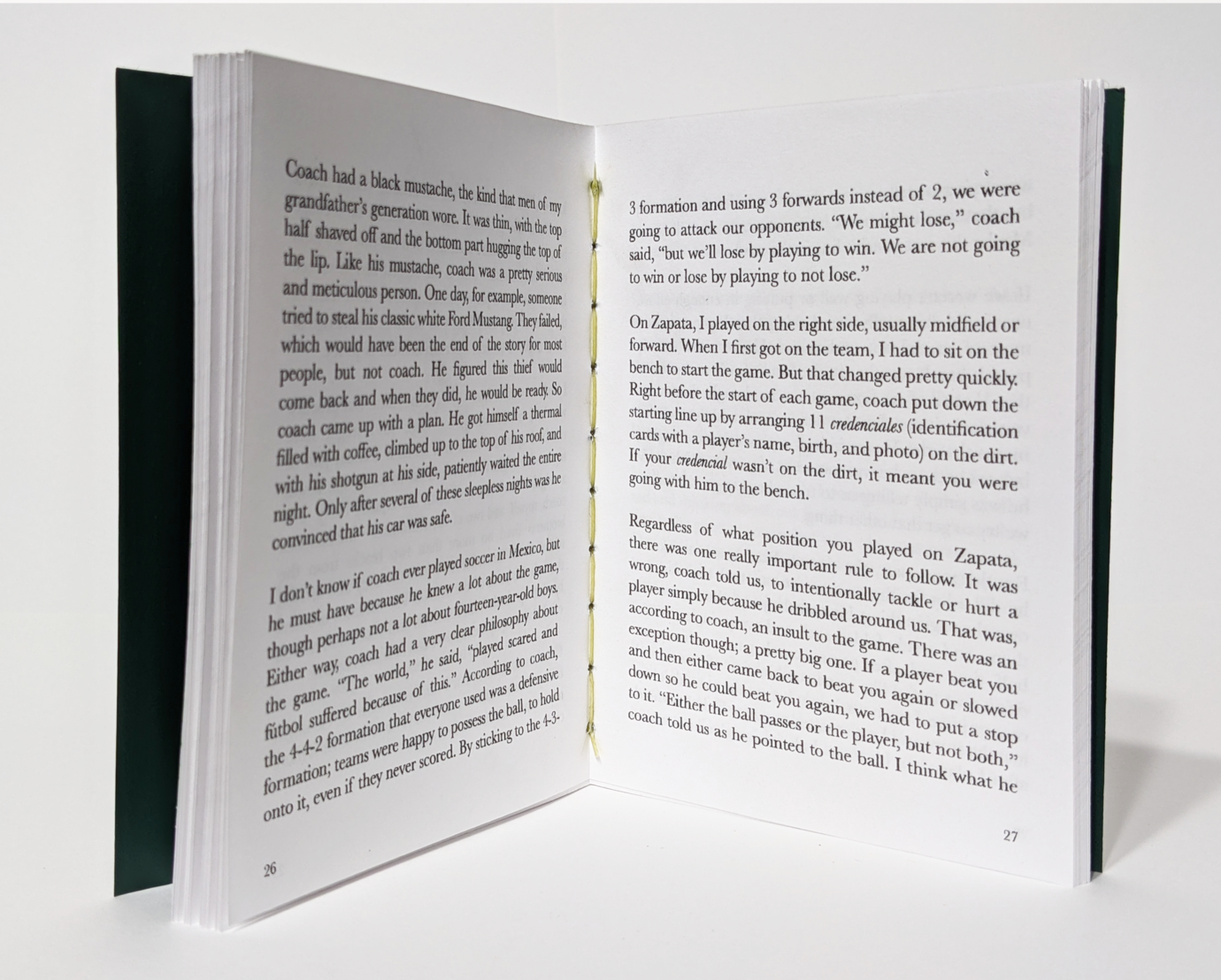
Soccer takes center stage in the second and third stories, “Team Zapata” and “Lobo”. The former finds Guzmán pondering on his days playing soccer as a teen with a neighborhood team called Team Zapata, before joining Chino Spirit in a different city. He tried to juggle playing at both, but ultimately elected to leave Zapata for Spirit. The anecdotes are humorous but the story ends on crushing terms.
While still at Zapata, the unnamed coach shared the terrible news that a teammate would no longer be joining them because he was fatally hurt defending himself after being assaulted. Some time after leaving Zapata, Guzmán learned that the son of his former coach, who also played on the team, was arrested and locked up in jail “for doing something he wasn’t supposed to.” The specific details of both events are never divulged.
With the death of his father, Guzmán’s connection to coach was also lost, leaving him with many unanswered questions.
A story like this typically draws insight from the actions on the field to provide a moral lesson off it, but Guzmán finds it difficult to do so. Perhaps, sometimes there are no larger lessons or deeper meanings in the stories of our lives; only “what-ifs” and a lifetime to consider what happened and what could have been otherwise.
Courtesy Sybil Press
The final story is named after Guzmán’s uncle Manuel who received the nickname Lobo for some unknown reason. Without revealing too much, suffice it to say that the man is quite a character. A cousin of Guzmán refers to him as Don Quixote at one point. Funnily enough, the oddball uncle ends up playing soccer at a park with his nephews who have just been challenged to play against a team of older paisas.
Guzmán and his cousins put up a good fight in their expensive cleats and modern jerseys emblazoned with the names of their favorite European clubs, but end up losing by a wide margin to older men dressed in “erzat jerseys” and “cheap rubber cleats.” The paisas had something he and his diasporic family members didn’t: the paisa hustle, which he recognized in his late father and other immigrant Mexican/Latino working-class men.
Their effort on the pitch mirrored their daily life and everyday struggles. Our fathers, at one point, were migrants, and paisas, too. They’d played soccer and done their fair share of balling on Santa Barbara’s soccer fields. We inherited their skills, but on this occasion at least, we forgot to incorporate the paisa hustle.
Romero Guzmán, Pocho Blues
Guzmán ends the story unable to shake the thought that he and his cousins have “lost something along the way.” It is never revealed what that “something” is or could be and, as a diasporic Mexican-American myself, I would not be surprised if that something has remained elusive to this day.
Reading Pocho Blues reminded me of one of my favorite quotes from the late scholar Stuart Hall, who described himself as the product of two diasporas:
Cultural identity…is a matter of “becoming” as well as of “being.” It belongs to the future as much as of to the past. It is not something which already exists, transcending place, time, history and culture. Cultural identities come from somewhere, have histories. But like everything which is historical, they undergo constant transformation. Far from being eternally fixed in some essentialised past, they are subject to the continuous “‘play”‘ of history, culture and power. Far from being grounded in mere “‘recovery”‘ of the past, which is waiting to be found, and which when found, will secure our sense of ourselves into eternity, identities are the names we give to the different ways we are positioned by, and position ourselves within, the narratives of the past.
There is plenty of diasporic content that traps itself within an identity without a sense of becoming. Rigid notions of identity have consistently plagued Mexican-Americanness within a struggle of seemingly eternal displacement voiced in the aforementioned aphorism of ní de aquí, ní de alla (admittedly, something I’m guilty of repeating in the past). Within this trap, a diasporic Mexican is doomed to never be their whole self, doomed to be split, 50/50, between two nationalities, cultures and countries, or, worse, doomed to be shunned by both, forcing the subject into a life of eternal cultural exile.
It would be a mistake to ignore the events and conditions that led to this specific identity formation. There was, and still is, a constant “othering” based on class, ethnicity and race that brought us to this point and there is no lack of literature and content on this subject. But it’s also a mistake to remain mired in the swamp of conflict at the heart of this particular duality. To do so would be to ignore the complex and nuanced narratives that provide said identity with its past and disconnect it from the multiple positions of the present that can provide shape to its future.
Guzmán’s Pocho Blues is refreshing to read because it isn’t a conflict between here or there. It is an understanding of here and there. It is a reconciliation between and acceptance of both as simply “being.”
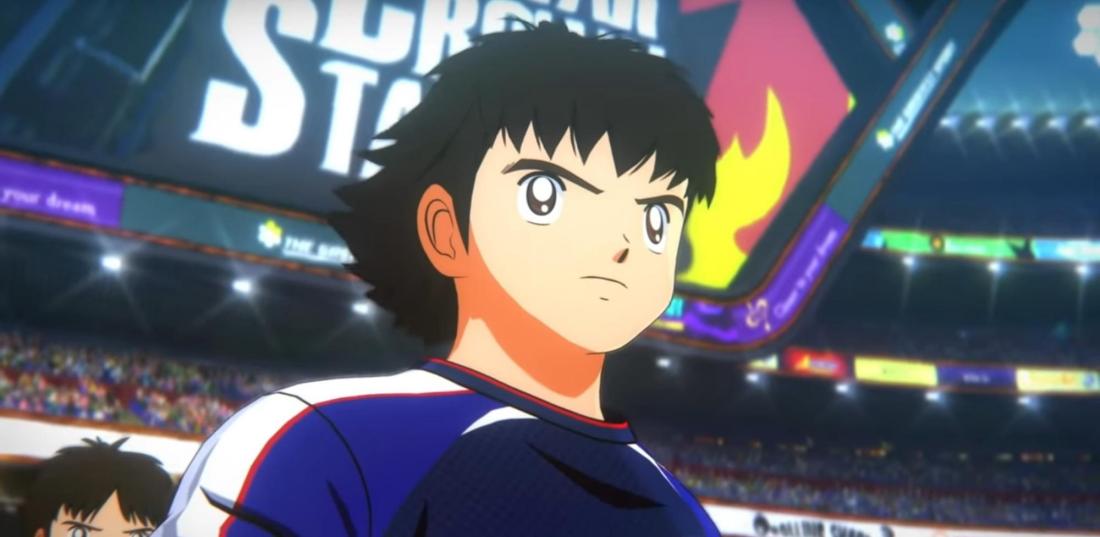
Captain Tsubasa, aka Oliver Atom, aka Los Super Campeones, made a long-awaited return to video game consoles last week with the release of Captain Tsubasa: Rise Of New Champions.
I haven’t gotten my hands on the game yet but I did take the time to dive into the history of the world beloved franchise featuring Japan’s most famous & fictional superstar athlete for Gamecrate.
Takahashi’s original manga series ended in 1988 with Tsubasa and the Nankatsu youth squad winning various youth tournaments, including the U-17 World Championship as a member of Japan’s national youth squad. The series ends with his decision to travel to Brazil to continue playing soccer.
Through various sequels, fans watch Tsubasa grow from aspiring pre-teen soccer hero to a globe-trotting professional adult soccer player. The first sequel, World Youth, featured Tsubasa joining Brazilian club Sao Paulo/F.C. Brancos and winning the FIFA World Youth Championship with Japan.
In Road To 2002, Tsubasa has moved to Spain to play for FC Barcelona/FC Catalunya, though he is temporarily relegated to the team’s B squad. He is reintegrated into the main team in time to help them defeat their eternal rivals, Real Madrid, in a thrilling 6 – 5 victory. The series continues with Golden 23 in which Tsubasa, still playing for Barcelona/Catalunya, also helps the Japan national team qualify for the Olympics.
The manga’s current run is titled Rising Sun and focuses on Tsubasa’s and Japan’s exploits in the Olympics where Japan has made it past the group stage and is facing off against Germany in the quarterfinals. One can assume that they’ll defeat Spain the semifinals and move on to win the final versus the winners of the quarterfinal matches between France, USA, Brazil, and Argentina.






 Afroxander (aka Iván Fernández)