El Guincho (real name Pablo Diaz-Reixa) is a solo artist originally from the Spanish Canary Islands (near the coast of Africa) and currently living in Barcelona whose popularity continues to skyrocket with every release thanks to his trademark sound: Space-Age Exotica, a potent cocktail mix of Electronic, Tropical, Bossa Nova and Pop music.
El Guincho. Photo courtesy Thomas Williams via The Guardian
Let’s dive in immediately with the song and (nsfw) video that made El Guincho the talk of the town last year:
My ‘fro and camera ventured into Old Town Pasadena for the annual Make Music festival. It reminded me of SXSW in Austin sans the Lone Stars.
Below are some of my favorite photos that I took. You can see them all at Remezcla.
La Santa Cecilia brought some positive vibes to the Luckman Stage. Photo by Ivan Fernandez.Carla Morrison was warmer than the sunshine. Photo by Ivan Fernandez.Hello Seahorse! performed tracks off their latest album. Photo by Ivan Fernandez.Tijuana Panthers rocked out in a mall plaza. Photo by Ivan Fernandez.The B-Side Players had as much fun as their audience did. Photo by Ivan Fernandez.
Don’t forget to check out my cameo in the video below (a few seconds in the beginning and the last minute or two at the end):
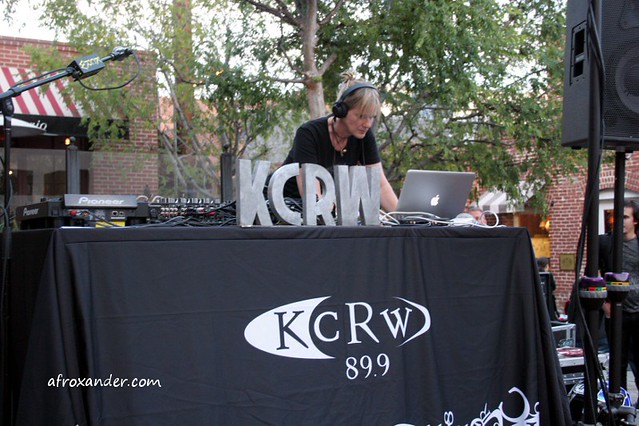
KCRW launched its first installment of its Summer Nights series in Pasadena with a concert by artist Diego Garcia this past Saturday. KCRW DJ Anne Litt introduced Garcia and his well-dressed backup band of musician friends to an adoring crowd that packed the European-style courtyard of the One Colorado shopping area.
The show, Garcia’s last in his week-long tour of California, covered every track off his freshly-released solo debut album, Laura, as well as a cover of The Kinks “This Strange Effect” for good measure. Amidst the setting sun and gentle breeze, Garcia poured his heart out as he shared the pain of lost love, the comfort and release provided by time and maturity and the triumph of love regained.
Head over to LA WEEKLY for my full interview with Garcia and concert review.
If you’re under 45-years of age, you might have little idea of who the great singer/songwriter/hellraiser Harry Nilsson was, but surely almost everyone has heard his biggest hits “Everybody’s Talkin’” (from the Midnight Cowboy soundtrack), “Without You” (a Badfinger cover given its devastating emotional impact by Harry’s plaintiff three octave vocal range, later recorded by Mariah Carey) and “Coconut” which was used in dozens of movies (normally during a drinking scene) and in more than one 7UP advertising campaign.
Many will recognize Nilsson’s “Coconut” from the ending credits to Reservoir Dogs:
The following excerpt comes from Writing The War On Drugs: Why do so few American papers report on the trade in their backyard?
For years the absence of stories about how drugs are moved and traded inside the United States has sparked my curiosity. Ten years ago, while a graduate student at the University of Texas at Austin, I did a content analysis of how several American news outlets portrayed the war on drugs in Mexico and in the United States. I uncovered two main narratives. The one about Mexico focused on government corruption, the cartels’ structure, their control of local law enforcement, and the way they move drugs across the country. The narrative about the US dealt mostly with drug addiction and stories about prevention and rehabilitation programs. Continue reading “Blood, Drugs and Hitmen Addendum: Javier Garza Ramos”→
Search for Capsula on the internet and you will find stories by music critics who all make the same observation: Capsula puts on a hell of a live show (as anyone who has been to SXSW these past three years can attest to).
Martin Guevara and Ignacio Villarejo of Capsula. Photo by Jay Janner/Austin American-Statesman
The band, featuring vocalist/guitarist Martin Guevara, vocalist/bassist Coni Duchess and drummer Ignacio Villarejo, is a Garage/Psychedelic Rock group based in Bilbao, Spain who came together in 1998 in their hometown of Buenos Aires, Argentina with the intent of following in the footsteps of their favorite musicians of the 60’s and 70’s: David Bowie, The Velvet Underground, The Who, The Rolling Stones, Pescado Rabioso and Manal.
I’ll be out of the country this July and living in Valladolid, Spain where I’ll be improving my Spanish writing and grammar skills at University of Valladolid. I’m going to mark the occasion with a number of posts about Spanish music groups beginning with:
El Aviador Dro y Sus Obreros Especializados (The Aviator Dro and His Specialized Workers, Aviador Dro for short) is an Electronic Pop group from Madrid whose musical style falls somewhere between Kraftwerk’s serious minimalism and DEVO’s deadpan kitsch.
Drug cartels in Mexico who once operated in the shadows announced their entrance into mainstream society with a number of beheadings in 2006 that marked the beginning of a wave of unprecedented violence that still consumes parts of the country. Gun fights in broad daylight occur regularly in parts of Nuevo Leon, Michoacan and Chihuahua. Cartels have also moved on to methods more sadistic than beheadings via vats of acid and even a car bomb or two.
Flag of Los Zetas by cartoonist Jose Hernandez (monerohernandez.com.mx)
Much of Mexico continues to live normally despite the violence in some areas. Traveler extraordinaire Rick Steves celebrated the coming of 2011 in Mexico City with nary a hint of drug-related violence in sight. My relatives in the state of Jalisco continue to live in peace. My friends with families in Juarez, unfortunately, cannot say the same. They have suffered extortion and violence at the hands of cartels and corrupt law enforcement.
Most Mexican news organizations can’t or won’t cover the situation in-depth because of threats and attacks by cartels on their headquarters and journalists. U.S. news organizations can’t or won’t because it’s not in their interest to do so save for lazy, fear-mongering tales of spillover violence and anarchy.
So where do concerned citizens and interested parties turn to for accurate information and comprehensive analysis of events in Mexico? Read on after the jump to find out:
I guess it was only a matter of time until chiptune fanatics remixed/converted Heavy Metal into chiptune/8-bit/bleepity-bloopity songs thanks to a little program called GXSCC, which converts MIDI files into MSX-like WAV files. Drag a MIDI file of Metallica’s “Battery” into the program and you get the following:







 El Aviador Dro y Sus Obreros Especializados (The Aviator Dro and His Specialized Workers, Aviador Dro for short) is an Electronic Pop group from Madrid whose musical style falls somewhere between Kraftwerk’s serious minimalism and DEVO’s deadpan kitsch.
 Afroxander (aka Iván Fernández)