Back in February, I spoke with artist Ernesto Yerena for an interview that appeared in Remezcla.
One interesting tidbit that I was unable to include in the article was a portion about the boxing match between Julio Cesar Chavez and Oscar de la Hoya in 1996. Yerena talks about how the fight exposed him to the complexities of identity among Mexicans on both sides of the US/Mexico border, which he lived near in El Centro, CA.
Back in October of 2013, the Los Angeles Latino International Film Festival (LALIFF) hosted its latest film festival in the heart of Hollywood.
One of the more controversial selections at the festival was the documentary Narco Cultura. The film covers the many aspects of Mexican culture in both Mexico and the US that have been affected by the rise of drug trafficking organizations including some that glorify the narco way of life.
There was a brief Q&A panel after the screening and festival co-founder Edward James Olmos took a few minutes to express his views on how the legalization of drugs could change society in a positive way citing Portugal as an example.
Sin Dios was a hardcore-punk band from Madrid, Spain that existed from 1988 – 2006. The group released eight original lp’s plus a handful of ep’s during those years that outlined their anti-fascist, anti-authoritarian and anti-capitalist anarchist beliefs.
The band wore its politics on its sleeve much the same way Morrissey wears his emotions as a badge of honor. The album titles say it all: Sin Dios…Ni Amo (No God or Masters), Ruido Anticapitalista (Anticapitalist Noise), Alerta Antifascista (Be Alert Antifascist), Guerra A La Guerra (Wage War On War), Solidaridad (Solidarity), Ingobernables (Ungovernable), Odio Al Imperio (Hatred Against the Empire), and Recortes De Libertad (Snippets of Liberty). The albums were packaged with booklets filled with commentary that explained the topics and themes behind the songs.
They followed the autogestion/worker self-management model were no one member held authority over the group and decisions were made and agreed upon democratically. As such, they operated without the aid of managers or agents. They self-produced and distributed all their works through their own label, Difusión Libertaria La Idea, or with the assistance of other independent anti-commercial labels such as PHC and Queimata. The band sold their albums at popular, rather than competitive, prices.
Sin Dios maintained dedicated groups of fans in Spain, Europe and Latin America despite its underground status (I’m talking pre-internet days). They also worked with a number of anarchist groups in other countries, most notably Mexico’s Juventud Antiautoritaria Revolucionaria (Revolutionary Antiauthoritarian Youth), who assisted the band in its tour of Mexico in 1999 as well as helped publish/distribute its albums in Mexico, and Brazil’s União Libertária da Baixada Santista – U.L.B.S. (Libertarian Union of Baixada Santista – libertarian in the original meaning of the word, anarchist liberty, not the modern Ron Paul/Mises redefinition), who the band supported via a benefit album.
No reason was given for the split in 2006 but the members announced they would continue their political activities via other means. It’s believed two of the members were, and possibly still are, also members of the Confederación Nacional del Trabajo (National Confederation of Workers).
The group’s library is also available as a free download/stream on its website. Click on an album then right-click a song title and select “save link as.”
Since I wrote about the drug war in Mexico last year (see here and here), I’ve discovered more independent journalists who devote their time to covering drug war-related events in Mexico. One of these journalists is K. Mennem, creator of the Hell On Earth blog. His blog provides analysis of headlines from the drug war plus delves into aspects of the drug war’s cartel culture not covered by other sites, such as his story about Nuevo Laredo’s Boy’s Town.
I swapped a few e-mails with Mennem to learn more about his work and blog. Below is a brief exchange we had about his work and blog.
Beneath this calm exterior...
Let’s talk about your journalism background. How long have you worked as a journalist? Where have you been published/are published? Why did you decide to become a journalist?
I do not come from a formal journalism background. My college degree is in business, but I traveled to Mexico frequently with international study groups during college. I started my blog in 2009. The original plan was to write about various global events that are not covered by main stream media. My whole intent was to help bring to light the horrible things that occur daily in our world, yet these are often ignored by the public. I write routinely for the San Diego Reader, my blog of course, and guest spots on various blogs and websites from time to time. I have recently had an increase of interest from universities and politicians on my work. Doing work for these type of groups is currently in the making. I decided to start into journalism after I finally realized how much time I was spending on reading, researching, traveling, and talking to people about these issues. In most ways it had already engulfed my life before I even realized it. I am also an insurance agent. I sell local and international policies to businesses and private customers. I am the marketing director and international sales agent for an agency my brother owns. The flexibility with this job has allowed me to make both of my careers work.
Tell me about Hell On Earth blog. Where/how did you come up with the title? What is your interest in following/investigating narcotrafficking/drug war in Mexico?
The title for my blog came from the original concept of the site. Writing about the “Hell on Earth” that is unknown to many. As the Mexican cartel wars raged on, my blog eventually became focused on issues there. The drug war across the Americas has always been my focal point, but I decided to completely focus on it for the time being. I have always had strong ties to Mexico. I still travel to Mexico when possible. My passion for the country and its people compelled me to write about events often ignored in the United States. The ugly truth is that the U.S. is causing this chain reaction of events by its huge appetite for narcotics. My interest into following these events were naturally drawn in because of my interest in Mexico. I have friends on both sides of the law, friends on both sides of the border, and have spent considerable time along the border. These things have helped me develop into what I do.
How can mainstream media outlets improve their coverage of the drug war in Mexico?
Mainstream media needs to elaborate more on events happening, and not just give short summaries. Almost everything happening is directly tied to the United States, but you can not tell that by reading one paragraph a week in the newspaper. National news stations pick up on stories whenever it is the hot thing to do, but most often it is only when a U.S. citizen is a victim of a crime in Mexico or on the border.
Spanish magistrate Baltasar Garzón continues to sit on the opposite side of the bench inside Spain’s supreme court. Garzón, lauded globally as a defender of human rights, is currently defending himself in his second trial where he is accused of breaking an amnesty law passed in 1977, two years after dictator Francisco Franco’s death, that prevents any probe into Franco-era crimes via a general pardon.
Baltasar Garzón. Photographer unknown.
Judge Garzón launched a probe in 2008 into the disappearances of over 100,000 persons while Franco was in power. Family members of the victims have spent years, some even decades, trying to discover where their loved ones were buried.
The first witness, Maria Martin, recalled how in 1936 when she was just six, her mother was one of three women and 27 men shot dead and their corpses dumped into a mass grave on the side of a road.
Supported by a Zimmer-frame and speaking in a voice cracked with emotion, the 81-year-old said her family had fought to recover the remains of her mother for a proper burial ever since.
“Until the day he died in 1977 my father wrote to the local authorities to try to recover the body. They told him: ‘Go away, leave us in peace or we will do to you what we did to her’,” she told the Supreme Court.
Garzón first appeared in court last week to defend himself from allegations that he’d overstepped his jurisdiction when he authorized police to wiretap conversations between lawyers and their clients in what’s known as the Gürtel case. The case involves charges of corruption against members of the Partido Popular, which currently holds power in Spain.
A date for the third case, which centers around allegations that Garzón dropped an investigation against the president of Banco Santander in exchange for payments for a course sponsored by the bank at New York University, has not been set yet.
Garzón became famous worldwide in 1998 when he ordered the arrest of Chile’s former dictator Augusto Pinochet for crimes against humanity. Pinochet was extradited from London to Santiago, Chile where he lived under house arrest during his trial. The arrest led to “the Garzón effect” throughout Latin America.
That was just the first in a number of high-profile cases he led including:
the conviction of former Interior Minister José Barrionuevo Peña for leading state-terrorist group Grupos Antiterroristas de Liberación (GAL)
many cases against members of Basque separatist group Euskadi Ta Askatasuna (ETA)
an investigation into whether the Bush Six ( Alberto Gonzales, John Yoo, Douglas Feith, William Haynes II, Jay Bybee, and David Addington) violated international law by justifying the use of torture at Guantanamo Bay
Garzón risks losing his role as Investigative Magistrate for up to 20 years if he is convicted in any of the trials.
Below is a lengthy interview Garzón gave to Democracy Now:
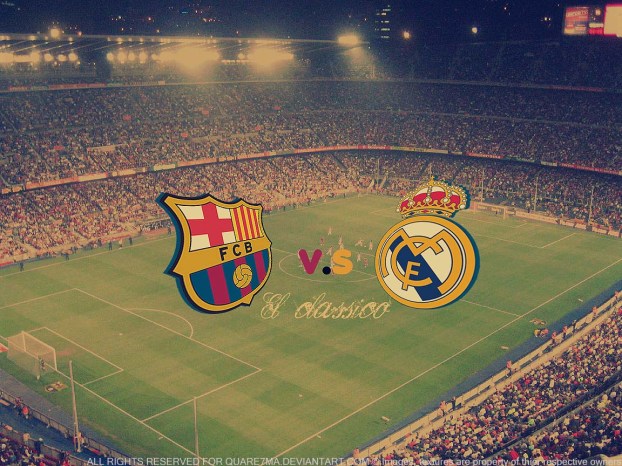
This Saturday’s match between FC Barcelona (Barça) and Real Madrid (Los Blancos) will mark the 216th/241st (official/friendly match tally) time the Spanish teams have faced each other on the field. The game is known as El Clásico (The Classic) or El Derbi Español and has grown to become the most watched, most anticipated and most intense rivalry in sports today.
More than just a game...
The rivalry exists thanks to a number of cultural, historical, and political reasons.
Real Madrid has always been seen as a symbol of Spanish pride and nationalism. Most Madridistas in Spain are Castilians who share relatively conservative political and social views. Most Real Madrid fans in Spain are loyal to the monarchy and continue to value monarchical traditions.
…
Culés {fans of Barcelona – Afro.} are very much opposite in political and social viewpoints. Most Catalans will never acknowledge that the city of Barcelona and all of the land that “was” Catalonia is Spain. Catalans prefer democracy to any kind of monarchical rule. They have more liberal political and social views; they see Catalonia as an unrecognized country.
Madrid is the capital of both Spain and the autonomous region of the Community of Madrid (Comunidad de Madrid) and holds the honor of being the country’s largest city. It became the capital in 1561 after Philip II moved the seat of the court from Seville to Madrid. Barcelona, Spain’s second largest city, is the capital of the autonomous region of Catalonia (Catalunya) in northeastern Spain.
Catalonia has a long history of defending itself against the suppression of its autonomy and its culture from monarchic forces beginning with the rise of the Kingdom of Spain in the 13th century culminating with the fall of Barcelona on September 11, 1714.
The 20th century saw a number of major developments in politics and sports in the country. FC Barcelona was established in 1899 (yes, technically that’s the 19th century but we’ll give it some leeway) and Real Madrid in 1902. King Alfonso XIII assumed power in 1902 and the Copa Del Rey (The King’s Cup) was established to celebrate his coronation. It was in this tournament that both teams met for the first time.
This will make more sense a few paragraphs from now
People protest the church of Scientology in the now famous mask.
The mask is modeled after Guy Fawkes whose face became famous the world over after the release of the Wachoski Bros. 2006 film V For Vendetta. The film is an adaptation of the graphic novel by the same name by Alan Moore and David Lloyd which centers on a mysterious figure named V who fights government oppression (as an anarchist in the book; as a freedom fighter in the film) while wearing the Fawkes mask.
Neither medium delves deeply into the story of real-life figure Guy Fawkes other than noting the rhyme associated with his exploits:
Remember remember the fifth of November
Gunpowder, treason and plot.
I see no reason why gunpowder, treason
Should ever be forgot…
The following issue then arises: what are we supposed to remember and why should it never be forgot? The answer lies within the life and exploits of Guy Fawkes.
And on Sunday, I had a brief discussion about neuroscience and video games with Henk Rogers of the Tetris company following the 2nd Annual Tetris Championship:
George Orwell would have been 108 on June 25th 2011 had he somehow managed to kick tuberculosis in the yarbles and been one of the lucky few who live past 98.
George Orwell
Orwell (born Eric Arthur Blair) was a writer who, after many years struggling as a bookshop clerk, freelancer, BBC radio host and columnist, came to fame after the publication of his last novel 1984, an anti-utopian/dystopian tale of a totalitarian future. The book introduced the public at large to Orwell’s long-held political views of anti-totalitarianism:
Every line of serious work that I have written since 1936 has been written, directly or indirectly, against totalitarianism and for democratic socialism, as I understand it.
To mark the occasion, I’ve chosen my favorite quotes from his fiction and non-fiction novels (that I’ve read) to highlight his views as they matured over the course of his life and work.
Lost in the hoopla of Cinco de Mayo was independent hip-hop star Sole‘s video premiere for “I Think I’m Noam Chomsky:”
Sole (real name Tim Holland), a founder of hip-hop label Anticon, recorded the track for his upcoming mixtape Nuclear Winter 2. The track is filled with enough political references to make Zack De La Rocha want to tell this cat to take it easy.
It’s easy to get lost among them all so, after the jump, is a brief explanation of the people, events, etc. mentioned in the video:




 Afroxander (aka Iván Fernández)