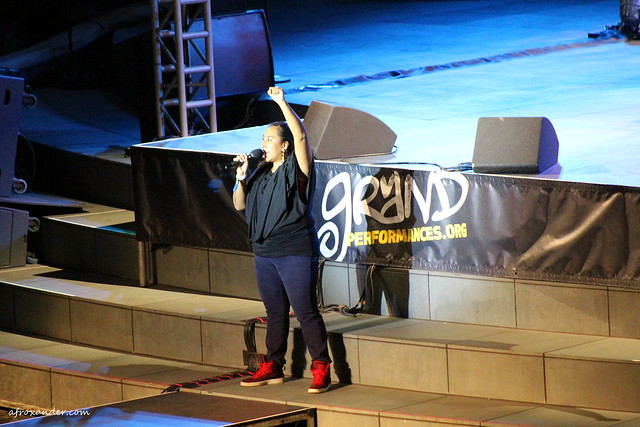
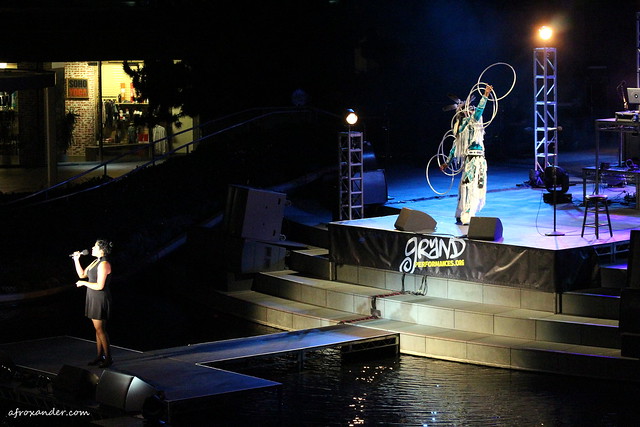
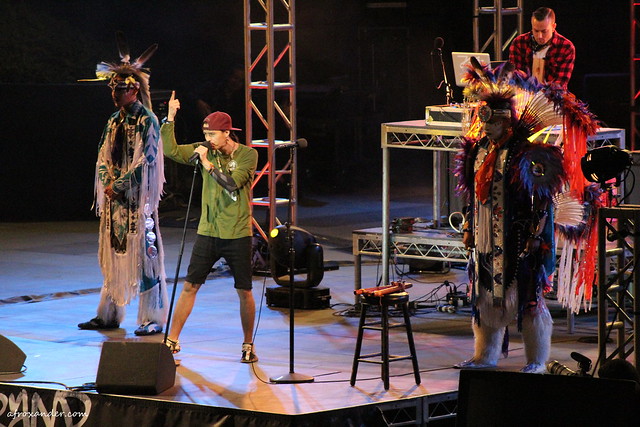
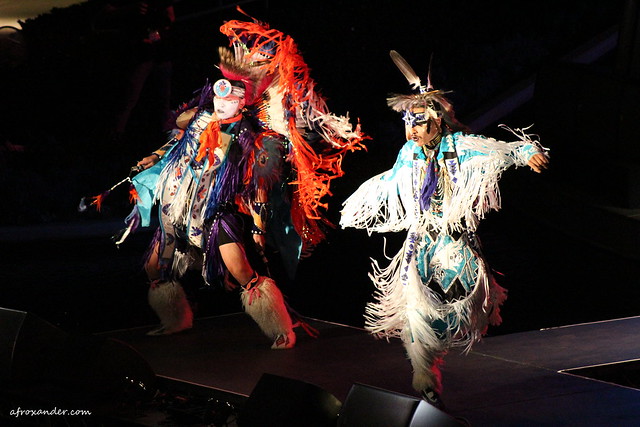
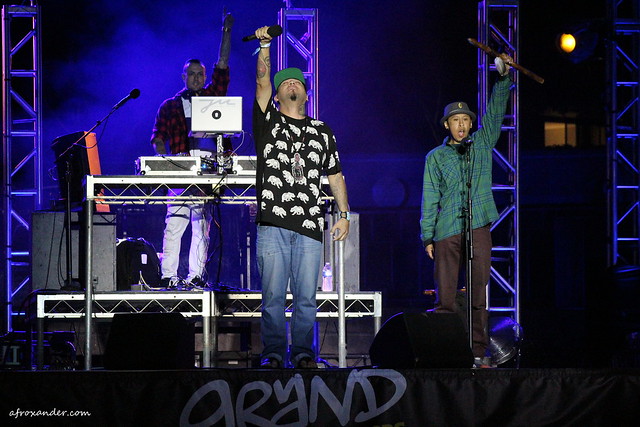
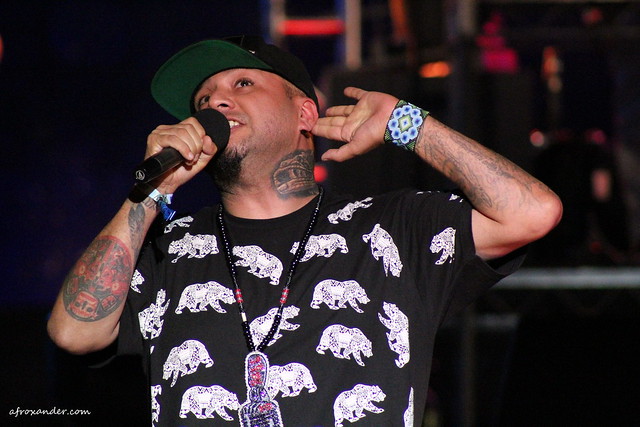
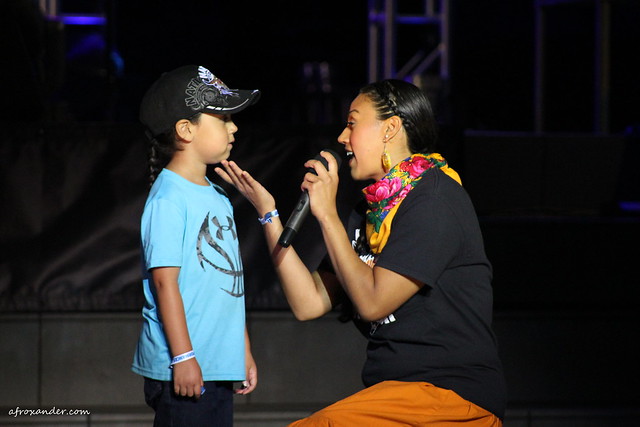
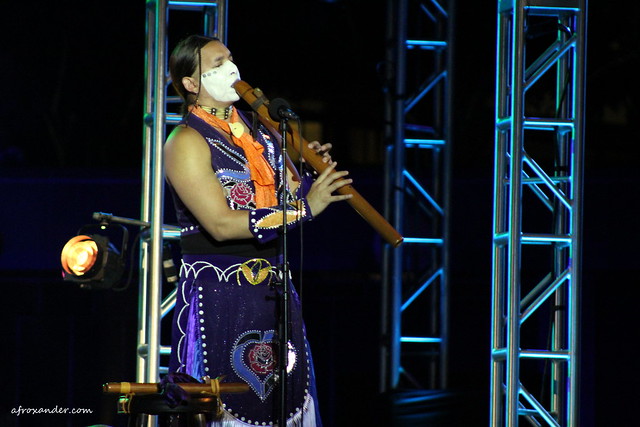
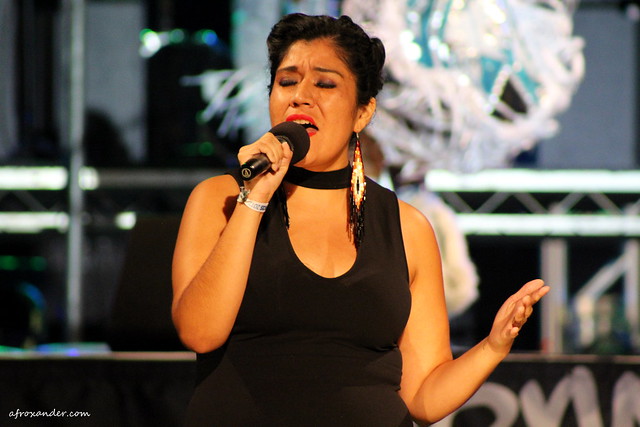
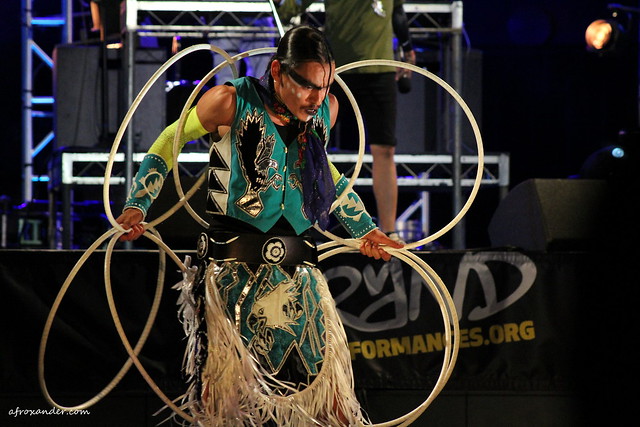
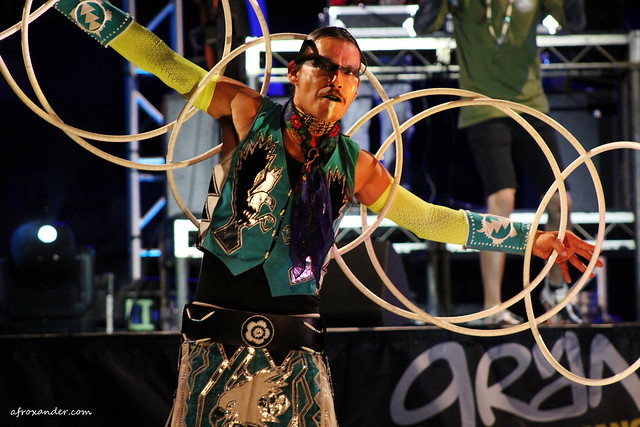
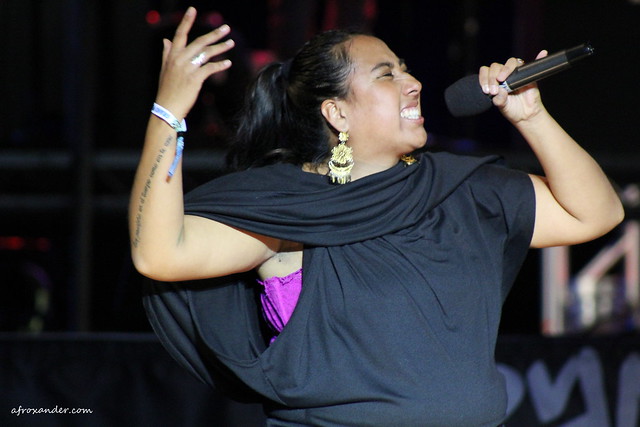
Indigenous artists have embraced hip-hop as a means to reclaim their cultural heritage after centuries of displacement, discrimination, and genocide. The folks at Grand Performances brought out a number of these artists to share their music, dances, and stories.
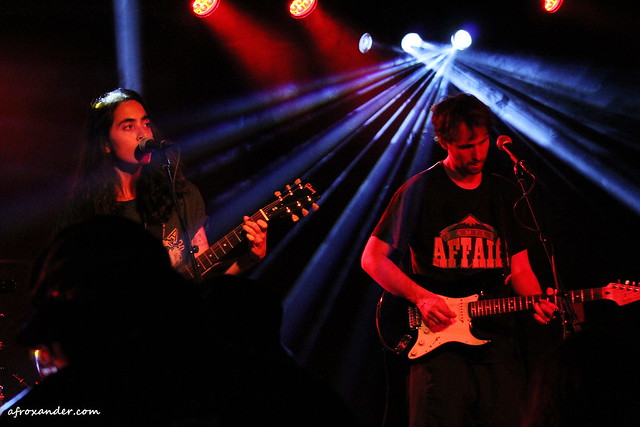
Below are some of my favorite photos of the night. The rest are at my flickr.
The links between hip-hop and indigenous people aren’t obvious at first. What could pop-locking, graffiti-tagging sneaker heads possibly have in common with peoples whose cultures date back centuries in the Western hemisphere?
But as some of the artists performing at the Hip-Hop: First Peoples, New Voices event at Grand Performances explain it, the links and parallels are abundant in the music, the art, the narratives and the dances. Most important, hip-hop is a channel for these artists to reclaim their people’s culture and heritage by building up their communities with their own voices.
The Saturday, July 1, event will feature performances by Jessa Calderon (Tongva/Chumash/Mexica), Frank Waln (Sicangu Lakota), The Sampson Brothers (Mvskoke Creek/Seneca), Tanaya Winder (Southern Ute/Duckwater Shoshone/Pyramid Lake Paiute), MC RedCloud (Huichol) and Mare Advertencia Lirika (Zapoteca).
A.Chal (aka Alejandro Salazar) is a tall dude who cuts an imposing figure, filling every room he steps into with silent intensity. His voice carries as much weight as the booming bass he produces for his music, but he’s soft-spoken during our interview, rarely speaking above a murmur. There’s an interesting duality to his persona as a singer, rapper, producer and solo artist, which continues to evolve on his latest release, On Gaz.
On Gaz, A.Chal’s third release and first mixtape, arrived on June 2, four years after his debut EP Ballroom Riots and just one year after his first full-length album, Welcome to Gazi. On the latter release, the Peruvian-American artist was the self-aware party boy who sought self-reflection and self-critique after debaucherous nights out on the town. On this new release, which features appearances by French Montana and A$AP Nast, he confronts his feelings of guilt after his insecurities convinced him to destroy numerous personal relationships in the months leading up to the release of Welcome to Gazi.
A.Chal sharpened his skills as a songwriter while living in New York, but friends urged him to head west to Los Angeles. Since moving here, he’s been better able to find inspiration and outlet for his creativity, resulting in an album, a mixtape and songwriting credits for the likes of Rita Ora, Max Martin and Jennifer Lopez.
Would you say it’s a political record or simply a reaction to the times?
I think it’s a reaction to the times. It’s done what I’ve always done. I’ve called myself the court jester of the band. I’ll give you a bunch of fucking riddles and they’re not always going to be so immediately-in-front-of-your-face. There’s going to be a lot of word associations, there’s going to be a lot of combinations of words that will paint images that will come back to haunt you later and [you’ll] go, “Maybe he means this or maybe he doesn’t mean that.”
To this day, I still think about what an “ecto-mimed bison” could be [from The Mars Volta’s “The Haunt of Roulette Dares”]. [Laughs] I mean, I can break that down for you, but it’d be so stupid! It’s the ghost of something extinct haunting you, you know? And now that I say that, like, why didn’t I just say it that way? No, I’m not going to say it that way! I’ve had a grip of art school teachers invalidate me as a kid. If I don’t say it like I say it, it’s like coloring within the lines.
When did the band decide to write new music? You were shutting down rumors until last January’s announcement about a new tour and new music.
We just wanted to make sure that it came out right, we wanted to make sure that everyone was down to do it, and we wanted to make sure that it didn’t come off half-cocked. It takes a lot of planning to do something that you hadn’t done together in 17 years. You’re figuring out if it can be done, you’re figuring out what does the band remember that they liked, what are we trying to say, what are we trying to do, and it takes time — since 2012 actually! Some of those songs from 2012 ended up on the record. It’s a human quality that people perceive which, naively and romantically, I think that’s what people like about the band. We’re not pushing spacebars and we’re not a Las Vegas act. If we have a bad show, you’re going to see it. If we have a bad song, you’re going to fucking hear it — but you gotta let us be humans.
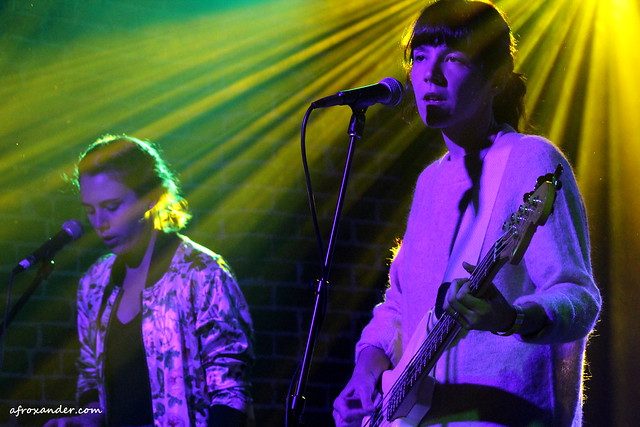
Las Ligas Menores (The Minor Leagues) are an Indie Rock group from Buenos Aires, Argentina who performed at the 2017 Coachella Valley Music & Arts Festival. The quintet performed at a few venues in the week between their weekend sets including this set at Romano’s in Riverside, CA where they opened for Quitapenas, who also made their Coachella festival debut this year.
It’s been a little over two months now since President Trump took the oath of office. His first week in office saw numerous protests worldwide, with people of all backgrounds blocking highways in Los Angeles, anarchists punching trust-fund Nazis in the face, and millions of women marching in defense of their rights with the power of the knitted pussy hat.
The protests have dwindled since then (though anarchists punching Nazis is still a regular thing), which leaves one wondering: What comes next after the resistance and the protests? One possible answer lies in Quetzal’s latest album, The Eternal Getdown.
“It’s actually a line … on a song called ‘Critical Time’ (Tiempo Crítico),” explains Martha González of the album title. “It’s one of the lines toward the end of the song, which is: How do we initiate our people to get down? … [For] people who are involved in social justice and the struggle in general, how can we not lose momentum and initiate new people? Social movements aren’t just about putting out fliers but also about creating generative practices, things that also give us energy and don’t just take from us all the time. We’re fighting against something but also creating new things.”
Henry D’Arthenay sits in the living room of his new apartment in Mexico City, thousands of miles from his hometown of Caracas, Venezuela. We’re a few weeks shy of four years from when the singer-guitarist for Latin rock group La Vida Bohème spent two hours with me on Skype, explaining the massive protests in Caracas after an election placed the deceased Hugo Chavez’s chosen successor, Nicolás Maduro, in the presidential seat. Neither of us could have predicted then the upheaval he and his bandmates would endure in order to complete their latest album, La Lucha.
“It was like a month after we talked, actually. After we talked, everything changed!” he says, explaining the earth-shattering abruptness of it all with a snap of his fingers. Their homeland began its political deterioration with continued inflation and devaluation of the bolivar, international airlines abandoning the country, lower oil production and food shortages. The band made a last-minute decision to remain in Mexico City after their appearance at Vive Latino in 2014. D’Arthenay’s mother died in Caracas from cancer the following year.
“I really understand, now that we’re in Mexico City, how closed we were from everything else, from everyone and everything happening, because the country started to build a fence around itself,” he explains of life back home. “For me as a human being, returning to my country right now is not a possibility. For me to make a living there, there’s no future I can bring for myself there, and the only way I can bring a future for my country is by making my art.”


















 Afroxander (aka Iván Fernández)