Here are seven haikus I wrote. I wrote the first three during the pandemic in 2020. The rest are more recent, spread out over the years since 2021.
I learned about haikus years ago in…elementary school (?) but did not learn how to truly appreciate the process of writing one until I took a course in Philosophy at San Diego State University. I am thankful for the tutelage of Prof. Wawrytko in Non-Western Aesthetics. I have found that the creative process of writing a haiku, for me, is a type of meditation that calms and heals me.
Haiku #1
Waves attack the shore The next morning’s sun will also Shine on the same sand
Haiku #2
She rests while I write A moment shared like flowers Sharing the sunshine
Haiku #3
A photograph The memory of kindness Remains eternal
Haiku #4
Serenity floats as a miniature blue dam What are emotions?
The Leagues Cup has finally come and gone after what felt like an eternity. I have plenty of thoughts about the Super League style tournament (and they’re not positive ones either) but I’ll save that for another day. For now, my hat-trick of articles (sponsored content, actually!) of coverage of three of LAFC’s four Leagues Cup games will suffice.
La Fiera dominated the Black And Gold across the two game stretch of the CONCACAF Champions League final. I put together a short piece & photo essay for LA Taco of the second & final leg hosted by LAFC this past Sunday June 3.
I have been a fan and reader of The Objective since it’s launch in 2020 and enjoy their coverage, interviews, and critiques of the journalism and media industry. Unsurprisingly, I leaped (metaphorically speaking!) at the opportunity to contribute to their organization when it arose.
That opportunity came late last year and is now available for everyone to enjoy/hate on/be ambivalent about!
My article for The Objective is a critique on the old adage of “less is more,” the warning of the dangers of superflous writing a la Marcel Proust but more “meaningless, uncomfortable meandering” than “poetic pretentiousness.”
My critique stems from a book review of “Smart Brevity: The Power of Saying More With Less” published last year by the creative trio that founded Politico and Axios. The latter media company prides itself on carrying the “less is more” trope into the digital age.
From my piece:
Smart Brevity is the name the trio gave their company’s version of “less is more.” It’s also the title of their 2022 book, subtitled The Power of Saying More With Less. The trio spends a little over 200 pages explaining what smart brevity is, how it came to be and, more importantly for the purposes of growing their brand, how everyone can utilize it in multiple settings. Apparently, every TED talk, boardroom, classroom, email newsletter, and presentation can benefit from speaking and writing with as few words as possible!
The unexamined problem with brevity in this case is who suffers, and how, when important information is oversimplified. The act of curating information for an audience is also the act of gatekeeping information. The more information is simplified, the more an audience should ask itself what information has been sacrificed for their convenience and why.
Though Marshall McLuhan I am not, there are much juicier quotes in there (I promise!) concerning the oversimplification and gatekeeping of information based on perceived audience expectations and the medium through which it receives that information.
My latest article for KCET is available to read and enjoy. It’s a deep dive into Coras USA, aka Coras de Los Angeles, a local soccer team that existed for 50 years in southern California. The team was a cultural umbilical cord for Mexicans in Mexico and the US and later became a gateway for young players hoping to become professionals.
What began as a fun ritual for the weekend grew into a family legacy of community-building that lasted half a century. During its existence, Coras USA united working-class, immigrant families from Nayarit and other regions of Mexico in Los Angeles and provided youth players a pathway towards a professional career during its final years in the city of Riverside.
“Its original name is Deportivo Coras USA,” explained Lopez of the team founded by his father and uncles. “The first name that it had was Coras de Los Angeles. Along the years, it had a couple of name changes like Deportivo Nayarit [and] Deportivo Coras Nayarit. It’s always been Coras but it’s been known for Coras de Los Angeles because it branched out of Coras de Tepic.”
Another October/November brought another Día de Muertos festival at the Hollywood Forever Cemetery. This year’s edition was my first time attending since 2017. The event was packed with people, but not as dense since it was split in half:a daytime festival focused on cultural, family events and a nighttime festival focused on live music.
As in years past, the altars were amazing, the food was delicious and the music was incredible. It was great to finally watch Ed Maverick perform live in concert after years of being a fan of his work. Here is an excerpt I wrote about Maverick and the festival:
Maverick didn’t have too much to say between songs and let his music do most of the talking. However, when he did speak to the crowd, he had to pause with a smile and wait for the lull between screaming and cheering fans to be heard. He ended the night with a lengthy guitar solo that cemented his newfound status as a rock star and new king of the sad boys.
Café Tacvba arrived to town this past weekend and it was one of the best concert performances I’ve seen in my entire life. I wrote a short recap of the night for LA Taco.
Here’s an excerpt:
After eight songs, all classics re-envisioned for acoustic performance, Jerzaín Vargas (trumpet) and a brass band joined them on stage for a trio of songs, starting with “La Muerte Chiquita.” Gustavo Santaolalla also made an appearance to play a charango during “Olita de Altamar.” The gasps and applause that emanated from the audience when the stage lights revealed his face would have one believe that royalty had mysteriously coagulated from mist.
La tercera es la vencida. The third time’s the charm.
As all the paisas know, this Saturday, September 17th will mark the third and final time Saúl “Canelo” Álvarez will face Gennadiy Gennadyevich Golovkin, aka GGG, in the ring. For Canelo, la tercera needs to be a statement win: either by knockout or a clear victory through 12 rounds, as he clearly put it during a media day at the House of Boxing in San Diego two weeks ago.
“My objective is to win by knockout starting in the first round,” he told L.A. TACO. “My goal is to end the fight before the third round. It’s going to be a difficult and complicated fight, but that’s my goal and what I intend to do from the first round.”
And that’s thanks to your truly! Yes, Howler has returned from the ashes in a web-only format for the time being and I was invited to write up a fun story about the most famous Welshman’s arrival to California.
For example:
[Imagine] Bale behind the steering wheel, his family in tow, checking his options on Google Maps as to whether he should take the 405 south to the 10 to the 5 or head further south on the 405 to the 91 to the 5.
As a historian I know that pointing to one thing as the ultimate source of something sounds silly and inaccurate, but I need you to believe me that this statement is probably more true than not.
Romeo Guzman
Courtesy Sybil Press
Author, historian and professor Romeo Guzmán offers the above bit of wisdom as the second introductory line to his latest publication: Pocho Blues. The chapbook is a short reflection of his own life as a Mexican-American raised in the US and in Mexico.
The body of work in literature and pop culture about & by Mexican-Americans is plenty and filled with successful and (too many!) unsuccessful portrayals of this particular diasporic group within the US. Perhaps it’s a sign of my age but I have grown accustomed to being let down by simplistic fables that boil down to the same lament of ní de aquí, ní de alla. I have reached a point where I physically brace myself before consuming any media related to the matter.
Pocho Blues fits into the successful side thanks to Guzmán’s creative talent as a writer and to his critical eye as a historian. He begins with the “ultimate source” that served as the catalyst for this work: the death of his grandfather in 2011 and the death of his father two years after. As the member of the family gifted with creative and academic muscles, he was tasked with providing the eulogies at both funerals.
It was this experience that sparked a desire to write stories that needed to be told. I think Pocho Blues tries to make sense of what it means to be a child of Mexican migrants and to provide a glimpse into a universe of Mexicans making their way through life on and off the soccer pitch.
Romeo Guzmán
These stories are collected in three chapters that run up to a short 48 pages, yet there is much that is said, shared and to be learned from in such a relatively short length.
The first story, “My Father’s Charrería, My Rodeo: A Paisa Journey” is centered on a belt buckle that belonged to Guzmán’s late father. The author claimed it as his own in his teens and concocted a romantic story of how his father rode his first bull to earn it. The truth of how he actually earned it came as a total surprise to Guzmán and it is this revelation that serves as a MacGuffin into an investigation of his family’s multiculturality via migration, the bracero program, rodeos and charrería.
Guzmán draws a thoughtful throughline from the horseback-riding colonists of Nueva España to the separate, but parallel, evolutions of the cowboy in Mexico and in the US, as represented by Vicente Fernandez and Clint Eastwood, to his father’s belt buckle, which he wore in many a failed attempt to fit in at numerous paisa parties.
The buckle, a mundane everyday object designed with a single specific utility, thus becomes a symbol of a “complex and nuanced narrative” linking Guzmán, his father, and his father’s father and their relationships with Mexico and the US.
Courtesy Sybil Press
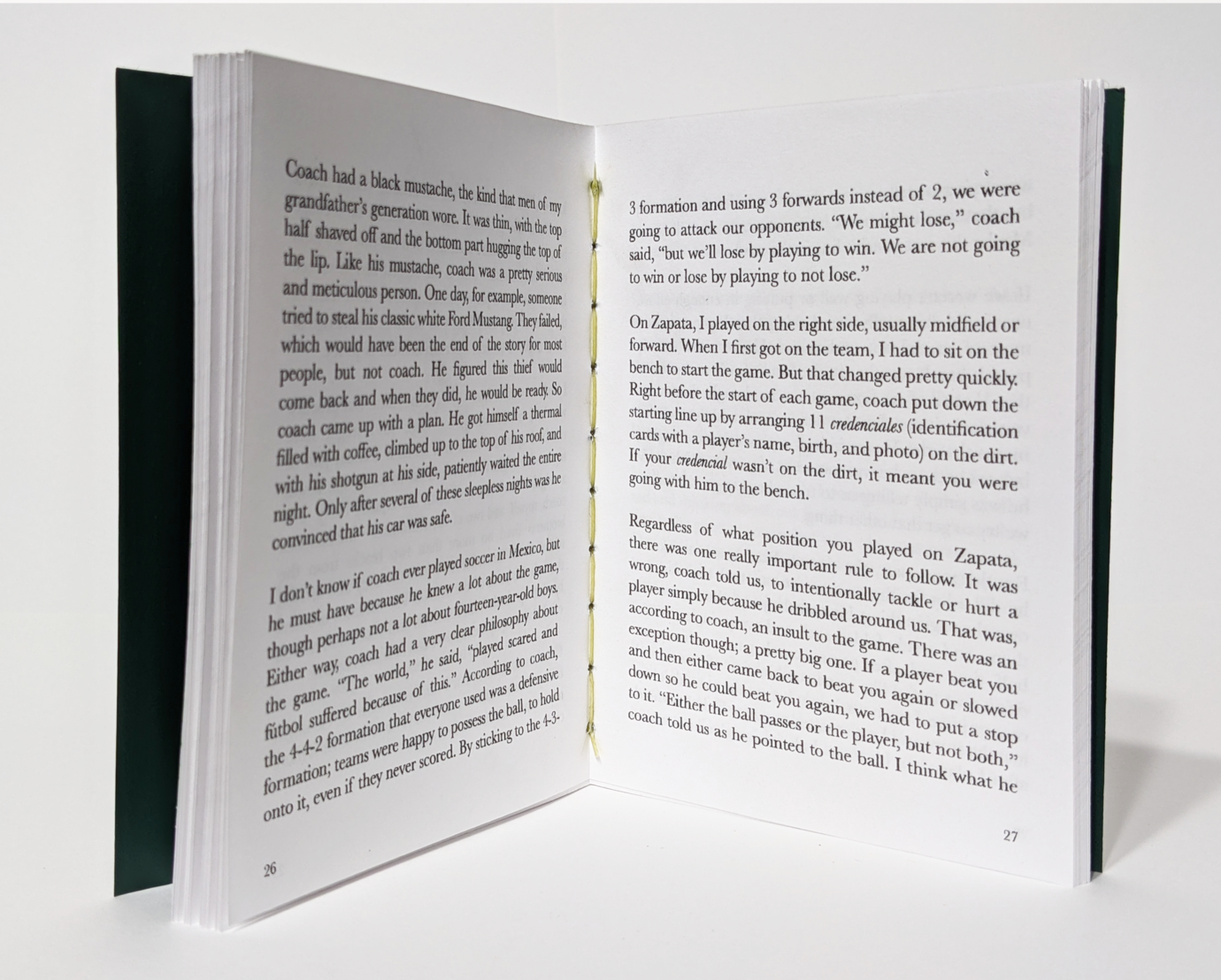
Soccer takes center stage in the second and third stories, “Team Zapata” and “Lobo”. The former finds Guzmán pondering on his days playing soccer as a teen with a neighborhood team called Team Zapata, before joining Chino Spirit in a different city. He tried to juggle playing at both, but ultimately elected to leave Zapata for Spirit. The anecdotes are humorous but the story ends on crushing terms.
While still at Zapata, the unnamed coach shared the terrible news that a teammate would no longer be joining them because he was fatally hurt defending himself after being assaulted. Some time after leaving Zapata, Guzmán learned that the son of his former coach, who also played on the team, was arrested and locked up in jail “for doing something he wasn’t supposed to.” The specific details of both events are never divulged.
With the death of his father, Guzmán’s connection to coach was also lost, leaving him with many unanswered questions.
A story like this typically draws insight from the actions on the field to provide a moral lesson off it, but Guzmán finds it difficult to do so. Perhaps, sometimes there are no larger lessons or deeper meanings in the stories of our lives; only “what-ifs” and a lifetime to consider what happened and what could have been otherwise.
Courtesy Sybil Press
The final story is named after Guzmán’s uncle Manuel who received the nickname Lobo for some unknown reason. Without revealing too much, suffice it to say that the man is quite a character. A cousin of Guzmán refers to him as Don Quixote at one point. Funnily enough, the oddball uncle ends up playing soccer at a park with his nephews who have just been challenged to play against a team of older paisas.
Guzmán and his cousins put up a good fight in their expensive cleats and modern jerseys emblazoned with the names of their favorite European clubs, but end up losing by a wide margin to older men dressed in “erzat jerseys” and “cheap rubber cleats.” The paisas had something he and his diasporic family members didn’t: the paisa hustle, which he recognized in his late father and other immigrant Mexican/Latino working-class men.
Their effort on the pitch mirrored their daily life and everyday struggles. Our fathers, at one point, were migrants, and paisas, too. They’d played soccer and done their fair share of balling on Santa Barbara’s soccer fields. We inherited their skills, but on this occasion at least, we forgot to incorporate the paisa hustle.
Romero Guzmán, Pocho Blues
Guzmán ends the story unable to shake the thought that he and his cousins have “lost something along the way.” It is never revealed what that “something” is or could be and, as a diasporic Mexican-American myself, I would not be surprised if that something has remained elusive to this day.
Reading Pocho Blues reminded me of one of my favorite quotes from the late scholar Stuart Hall, who described himself as the product of two diasporas:
Cultural identity…is a matter of “becoming” as well as of “being.” It belongs to the future as much as of to the past. It is not something which already exists, transcending place, time, history and culture. Cultural identities come from somewhere, have histories. But like everything which is historical, they undergo constant transformation. Far from being eternally fixed in some essentialised past, they are subject to the continuous “‘play”‘ of history, culture and power. Far from being grounded in mere “‘recovery”‘ of the past, which is waiting to be found, and which when found, will secure our sense of ourselves into eternity, identities are the names we give to the different ways we are positioned by, and position ourselves within, the narratives of the past.
There is plenty of diasporic content that traps itself within an identity without a sense of becoming. Rigid notions of identity have consistently plagued Mexican-Americanness within a struggle of seemingly eternal displacement voiced in the aforementioned aphorism of ní de aquí, ní de alla (admittedly, something I’m guilty of repeating in the past). Within this trap, a diasporic Mexican is doomed to never be their whole self, doomed to be split, 50/50, between two nationalities, cultures and countries, or, worse, doomed to be shunned by both, forcing the subject into a life of eternal cultural exile.
It would be a mistake to ignore the events and conditions that led to this specific identity formation. There was, and still is, a constant “othering” based on class, ethnicity and race that brought us to this point and there is no lack of literature and content on this subject. But it’s also a mistake to remain mired in the swamp of conflict at the heart of this particular duality. To do so would be to ignore the complex and nuanced narratives that provide said identity with its past and disconnect it from the multiple positions of the present that can provide shape to its future.
Guzmán’s Pocho Blues is refreshing to read because it isn’t a conflict between here or there. It is an understanding of here and there. It is a reconciliation between and acceptance of both as simply “being.”


 Afroxander (aka Iván Fernández)