Jack Kirby needed to make a statement; a loud one clear in its message and intention.
22,000 people had rallied at Madison Square Garden on February 20, 1939 at what became the largest gathering of Nazis in the USA. One block away at Fleischer Studios, Kirby, born Jacob Kurtzberg to Austrian-born Jewish immigrants, partnered with fellow Jewish-American Joe Simon to respond to the growing anti-Semitic and fascist menace at home. Their response arrived on December 1940 with the publication of Captain America Comics, featuring the titular star-spangled superhero making his debut by cracking Adolf Hitler’s jaw with a flying haymaker.
A copy of the original and iconic comic book sits behind a protective case inside the Skirball Cultural Center as part of the Jack Kirby: Heroes and Humanity exhibit, currently on display through 2026.
The exhibit treats visitors through a walking tour of Kirby’s life and work, from his upbringing in Manhattan’s Lower East Side to his artistic career in New York and California as a comics artist/writer, ending with a reflection on his continuing influence on millions worldwide more than three decades after his death.
The schism that divides Major League Soccer commissioner Don Garber’s vision for the league (and the sport in general) and the sport’s too-often-forgotten-by-design history was on full display on September 25, 2024 thanks to a cup trophy double-header in the USA.
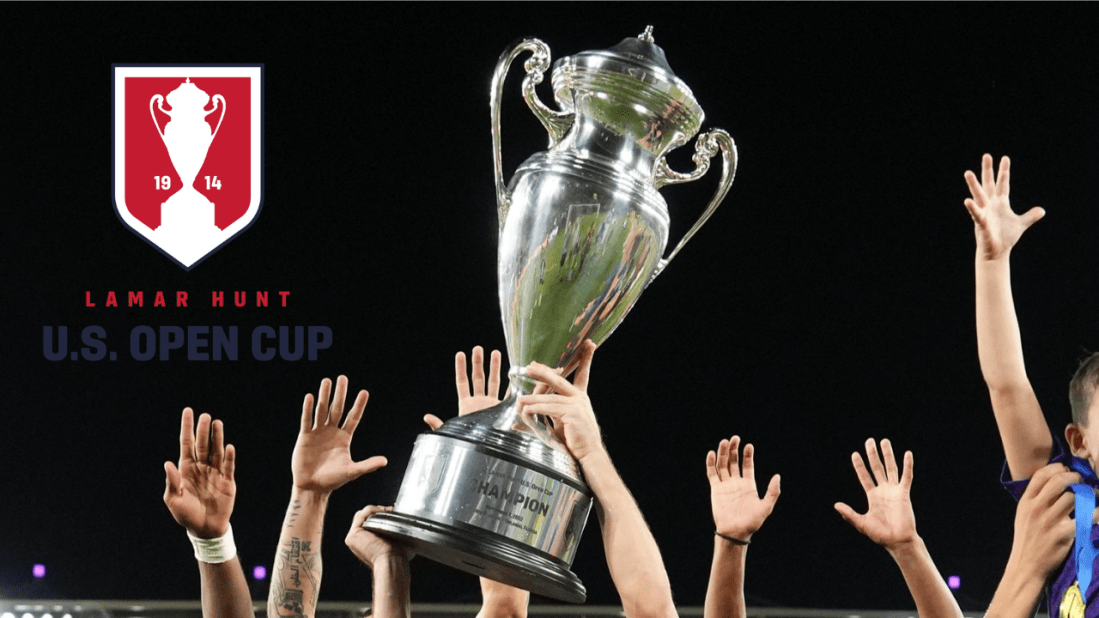
The day began with Club América of Liga MX lifting the Campeones Cup trophy after defeating the Columbus Crew of MLS. Hours later, Los Angeles FC lifted the US Open Cup title at home in an overtime thriller against Sporting Kansas City.
The former is one of the tournaments invented by long-running MLS commissioner Don Garber. The Campeones Cup pits the winner of Liga MX’s Copa de Campeones Cup and the MLS league winner. This one-off game spawned the separate, month-long Leagues Cup, which is an all MLS vs all Liga MX affair and the latest in big ideas of Garber’s lifelong escapades in US and CONCACAF (and soon-to-be global?!) soccer.
The antithesis to these ideas is the US Open Cup. Founded in 1913, the tournament has hosted US teams from every division and continues to do so today…and that’s in spite of Garber’s attempted meddling in all facets of US soccer.
It was around this time last year that MLS announced that it would not field any teams in the US Open Cup and would instead send in the MLS reserve sides to the tournament. The pushback was swift, but only eight of 29 MLS teams decided to continue competing as normal. The others were replaced by their MLS Next Pro counterparts.
How will they comply w/ Art.II.a.ii of US Soccer's Pro League Standards, which require DI outdoor leagues to play in all U.S. Soccer competitions for which they are eligible. Isn't the Open Cup a U.S. Soccer competition? Are they sending MLSNP rosters under the MLS teams' names? https://t.co/DbxCkodRdvpic.twitter.com/hUw0OSzpnz
My latest article for KCET is available to read and enjoy. It’s a deep dive into Coras USA, aka Coras de Los Angeles, a local soccer team that existed for 50 years in southern California. The team was a cultural umbilical cord for Mexicans in Mexico and the US and later became a gateway for young players hoping to become professionals.
What began as a fun ritual for the weekend grew into a family legacy of community-building that lasted half a century. During its existence, Coras USA united working-class, immigrant families from Nayarit and other regions of Mexico in Los Angeles and provided youth players a pathway towards a professional career during its final years in the city of Riverside.
“Its original name is Deportivo Coras USA,” explained Lopez of the team founded by his father and uncles. “The first name that it had was Coras de Los Angeles. Along the years, it had a couple of name changes like Deportivo Nayarit [and] Deportivo Coras Nayarit. It’s always been Coras but it’s been known for Coras de Los Angeles because it branched out of Coras de Tepic.”
As a historian I know that pointing to one thing as the ultimate source of something sounds silly and inaccurate, but I need you to believe me that this statement is probably more true than not.
Romeo Guzman
Courtesy Sybil Press
Author, historian and professor Romeo Guzmán offers the above bit of wisdom as the second introductory line to his latest publication: Pocho Blues. The chapbook is a short reflection of his own life as a Mexican-American raised in the US and in Mexico.
The body of work in literature and pop culture about & by Mexican-Americans is plenty and filled with successful and (too many!) unsuccessful portrayals of this particular diasporic group within the US. Perhaps it’s a sign of my age but I have grown accustomed to being let down by simplistic fables that boil down to the same lament of ní de aquí, ní de alla. I have reached a point where I physically brace myself before consuming any media related to the matter.
Pocho Blues fits into the successful side thanks to Guzmán’s creative talent as a writer and to his critical eye as a historian. He begins with the “ultimate source” that served as the catalyst for this work: the death of his grandfather in 2011 and the death of his father two years after. As the member of the family gifted with creative and academic muscles, he was tasked with providing the eulogies at both funerals.
It was this experience that sparked a desire to write stories that needed to be told. I think Pocho Blues tries to make sense of what it means to be a child of Mexican migrants and to provide a glimpse into a universe of Mexicans making their way through life on and off the soccer pitch.
Romeo Guzmán
These stories are collected in three chapters that run up to a short 48 pages, yet there is much that is said, shared and to be learned from in such a relatively short length.
The first story, “My Father’s Charrería, My Rodeo: A Paisa Journey” is centered on a belt buckle that belonged to Guzmán’s late father. The author claimed it as his own in his teens and concocted a romantic story of how his father rode his first bull to earn it. The truth of how he actually earned it came as a total surprise to Guzmán and it is this revelation that serves as a MacGuffin into an investigation of his family’s multiculturality via migration, the bracero program, rodeos and charrería.
Guzmán draws a thoughtful throughline from the horseback-riding colonists of Nueva España to the separate, but parallel, evolutions of the cowboy in Mexico and in the US, as represented by Vicente Fernandez and Clint Eastwood, to his father’s belt buckle, which he wore in many a failed attempt to fit in at numerous paisa parties.
The buckle, a mundane everyday object designed with a single specific utility, thus becomes a symbol of a “complex and nuanced narrative” linking Guzmán, his father, and his father’s father and their relationships with Mexico and the US.
Courtesy Sybil Press
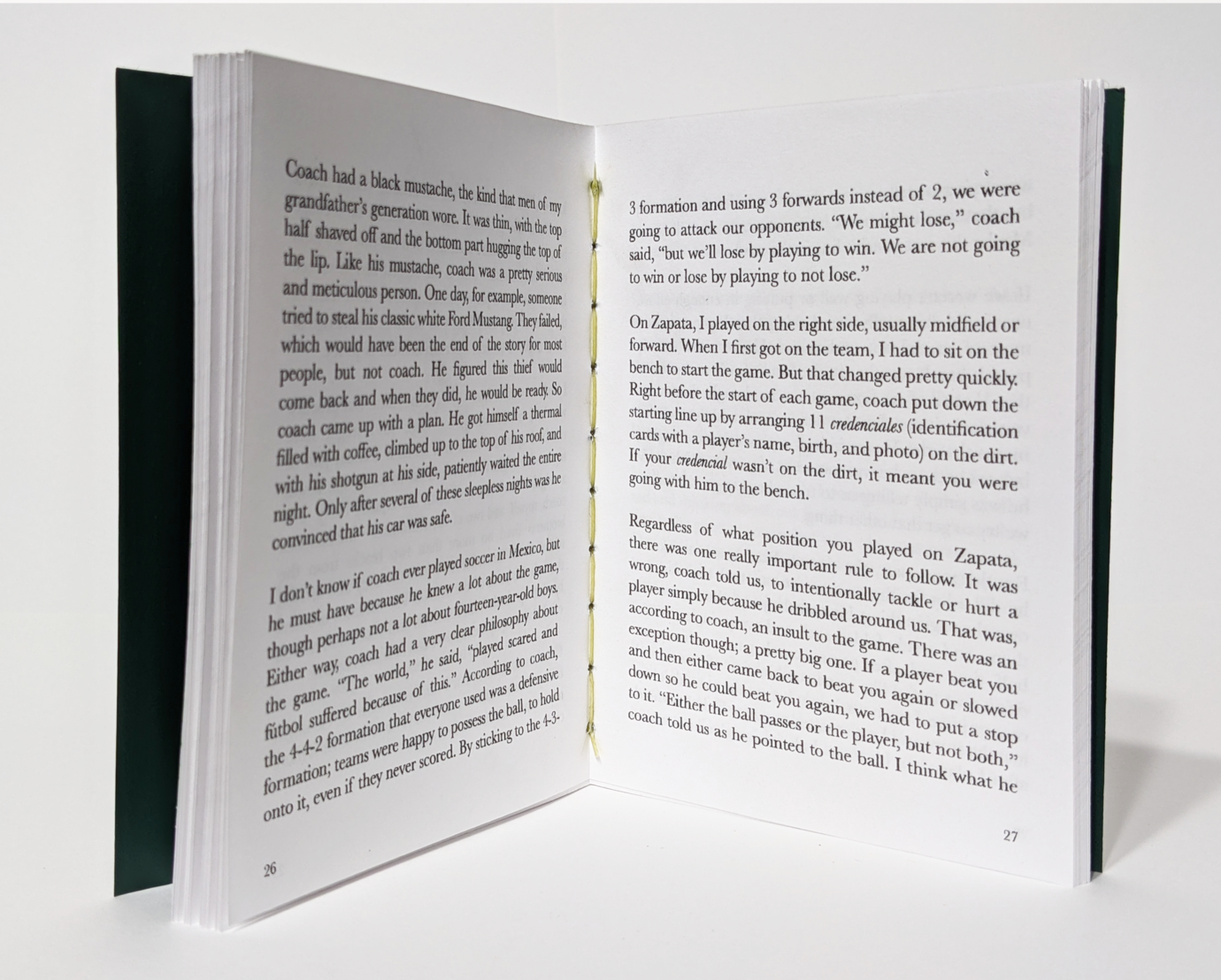
Soccer takes center stage in the second and third stories, “Team Zapata” and “Lobo”. The former finds Guzmán pondering on his days playing soccer as a teen with a neighborhood team called Team Zapata, before joining Chino Spirit in a different city. He tried to juggle playing at both, but ultimately elected to leave Zapata for Spirit. The anecdotes are humorous but the story ends on crushing terms.
While still at Zapata, the unnamed coach shared the terrible news that a teammate would no longer be joining them because he was fatally hurt defending himself after being assaulted. Some time after leaving Zapata, Guzmán learned that the son of his former coach, who also played on the team, was arrested and locked up in jail “for doing something he wasn’t supposed to.” The specific details of both events are never divulged.
With the death of his father, Guzmán’s connection to coach was also lost, leaving him with many unanswered questions.
A story like this typically draws insight from the actions on the field to provide a moral lesson off it, but Guzmán finds it difficult to do so. Perhaps, sometimes there are no larger lessons or deeper meanings in the stories of our lives; only “what-ifs” and a lifetime to consider what happened and what could have been otherwise.
Courtesy Sybil Press
The final story is named after Guzmán’s uncle Manuel who received the nickname Lobo for some unknown reason. Without revealing too much, suffice it to say that the man is quite a character. A cousin of Guzmán refers to him as Don Quixote at one point. Funnily enough, the oddball uncle ends up playing soccer at a park with his nephews who have just been challenged to play against a team of older paisas.
Guzmán and his cousins put up a good fight in their expensive cleats and modern jerseys emblazoned with the names of their favorite European clubs, but end up losing by a wide margin to older men dressed in “erzat jerseys” and “cheap rubber cleats.” The paisas had something he and his diasporic family members didn’t: the paisa hustle, which he recognized in his late father and other immigrant Mexican/Latino working-class men.
Their effort on the pitch mirrored their daily life and everyday struggles. Our fathers, at one point, were migrants, and paisas, too. They’d played soccer and done their fair share of balling on Santa Barbara’s soccer fields. We inherited their skills, but on this occasion at least, we forgot to incorporate the paisa hustle.
Romero Guzmán, Pocho Blues
Guzmán ends the story unable to shake the thought that he and his cousins have “lost something along the way.” It is never revealed what that “something” is or could be and, as a diasporic Mexican-American myself, I would not be surprised if that something has remained elusive to this day.
Reading Pocho Blues reminded me of one of my favorite quotes from the late scholar Stuart Hall, who described himself as the product of two diasporas:
Cultural identity…is a matter of “becoming” as well as of “being.” It belongs to the future as much as of to the past. It is not something which already exists, transcending place, time, history and culture. Cultural identities come from somewhere, have histories. But like everything which is historical, they undergo constant transformation. Far from being eternally fixed in some essentialised past, they are subject to the continuous “‘play”‘ of history, culture and power. Far from being grounded in mere “‘recovery”‘ of the past, which is waiting to be found, and which when found, will secure our sense of ourselves into eternity, identities are the names we give to the different ways we are positioned by, and position ourselves within, the narratives of the past.
There is plenty of diasporic content that traps itself within an identity without a sense of becoming. Rigid notions of identity have consistently plagued Mexican-Americanness within a struggle of seemingly eternal displacement voiced in the aforementioned aphorism of ní de aquí, ní de alla (admittedly, something I’m guilty of repeating in the past). Within this trap, a diasporic Mexican is doomed to never be their whole self, doomed to be split, 50/50, between two nationalities, cultures and countries, or, worse, doomed to be shunned by both, forcing the subject into a life of eternal cultural exile.
It would be a mistake to ignore the events and conditions that led to this specific identity formation. There was, and still is, a constant “othering” based on class, ethnicity and race that brought us to this point and there is no lack of literature and content on this subject. But it’s also a mistake to remain mired in the swamp of conflict at the heart of this particular duality. To do so would be to ignore the complex and nuanced narratives that provide said identity with its past and disconnect it from the multiple positions of the present that can provide shape to its future.
Guzmán’s Pocho Blues is refreshing to read because it isn’t a conflict between here or there. It is an understanding of here and there. It is a reconciliation between and acceptance of both as simply “being.”
My latest story is available to read now at dot.LA. It’s about a joint project between California State University Los Angeles and the University of Southern California to digitize their respective archives of Mesoamerican and Spanish Colonial artifacts and photographs.
EXCERPT:
“We’re hoping to do some 3D printing on campus of some of the objects,” said Ramirez. “It’s supposed to be a teaching collection in many ways but, obviously, many of the artifacts are very delicate so we don’t want people accidentally dropping them. We’re hoping to 3D print some of them so that it’s feasible and students can actually handle some of them because we have a Mesoamerican Studies minor on our campus.”
The photography collection also includes nearly 10,000 images printed on 35mm slides. The images are dated from the 1950s to the 1980s and feature Mesoamerican objects held in museums in Italy, Spain, Germany, France, the US, and South America. Of these, Cunningham has digitized 4,500 of them.
Cunningham uses a different camera and process to digitize physical objects such as statues and jars. He uses a Phase One XF camera with a 100-megapixel Phase One IQ3 digital back. Normally, he shoots 32 images of each item from one of three angles for a total of 96 images to create a single 3D render of an object. The 3D render is processed using Agisoft Metashape.
The first is about the Hola Mexico Film Festival. 2020 marks its 12th year and founder Samuel Douek had to make numerous changes to move the festival to an online format.
Next is my conversation with Adriana Astorga-Gainey and Jesenia Gardea of the Pacifico Dance Company. The Los Angeles-based non-profit company takes a serious approach to folklorico dance that centers on training professional dancers.
Below is a link to a research paper I wrote last year that I’ve uploaded to my Academia page. It concerns research into the growth of gridiron football (NFL-style), baseball, and basketball in the US and why association football (a.k.a. soccer) failed to grasp the country’s imagination as the other three.
Most importantly, “the game in America badly lacked willful leadership…Plenty of athletic departments and administrators may have thought soccer was vaguely a good thing, yet none seemed to possess the eagerness and ambition to lift it to greater prominence” (Wangerin “Distant” 32).
The main issue facing the leagues across the nation was the lack of a governmental body to enforce a set of rules agreed upon by all. Leagues played according to their own sets of rules, which put them at odds with each other and the fanbases they catered to. A league in St. Louis, for example, “played halves of 30 minutes instead of 45” (Wangerin, “Soccer” 29).
The AFA, founded, ironically enough, by a group of British expatriates made the first to attempt to unify the country’s leagues in the late 19th century. Unfortunately, any and all attempts at unification became power struggles between British and American leaders of the sport who “engaged in petty rivalries and internecine organizational struggles that only helped to preserve their narrow fiefdoms and the status quo at the expense of creating an institutional structure that might have been able to disseminate the sport to the vast majority of the American public” (Markovits “Offside” 53).
Below is a link and an excerpt of a paper I wrote a few months ago for a course in Mexican history. It is a historiography on the development of the San Diego/Tijuana region of southern California + Baja California as separate territories with an emphasis on people’s understanding of the territory as a separate & unified territory.
Early writings and writings of the San Diego/Tijuana (or vice-versa depending on which side of the literal fence one stands from) border region’s early history after the Mexican-American War illustrate the growth of the region as the emergence of two distinct zones that lures the citizens on each side with different promises. This non-symbiotic relationship between the two nations then steadily changes into a symbiotic one as scholars and academics begin to study the region’s evolution from a pair of separate and individual states to a pair of separate and strongly interconnected states. This interconnection occurs on multiple levels but is most typically understood via socio-cultural and economic lenses.
In recent years, new understandings of the border region have come from the experiences of people, Mexicans and Americans, whose daily lives consist of nearly equal time spent on each side of the US/Mexico border. Some of the writings on this topic began with the analysis of the flow of workers and consumers of both regions that began blending the flow of each country’s economics and labor with one another. Beyond this phenomenon, scholars have also recently defined the experiences of some of these citizens as a “ transborder/transfronterizo” persons who have experienced a lifetime of bi-nationality, that is, a lived experience of traversing a physical, international barrier that begins in childhood and extends into adulthood. Finally, activist groups that understand the border region from a highly politicized lens have also established their own framework of thinking about the border region in SD/TJ as well as other borderland areas.
I spent nine days in Barcelona this past April. This is the first of a few posts about that trip.
I began my second, full day in the city at the Plaça de Catalunya, which is the beginning and ending point of the Spanish Civil War walking tour. Nick Lloyd created the tour nearly a decade ago and offers it multiple times a week with the aid of Catherine Howley, who was the guide for my group.
The Spanish Civil War walking tour traverses the Plaza and part of the area across the way in and around Las Ramblas covering various important locations and events of the era. You can read more about the tour at the official site.
All photos taken with my ZTE Z983 and edited on PSCC19.
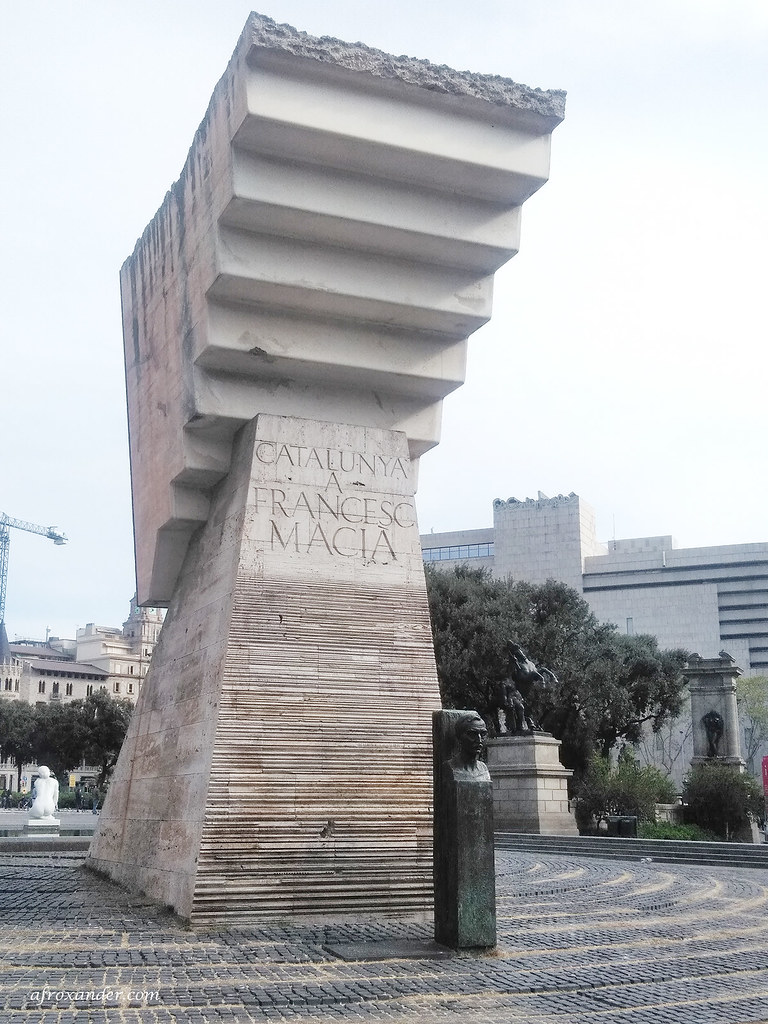
The tour begins with quick introductions at Café Zurich across from Plaça de Catalunya where the history lessons begin at the monument dedicated to Francesc Macià, president of the re-established Generalitat de Catalunya of 1931.
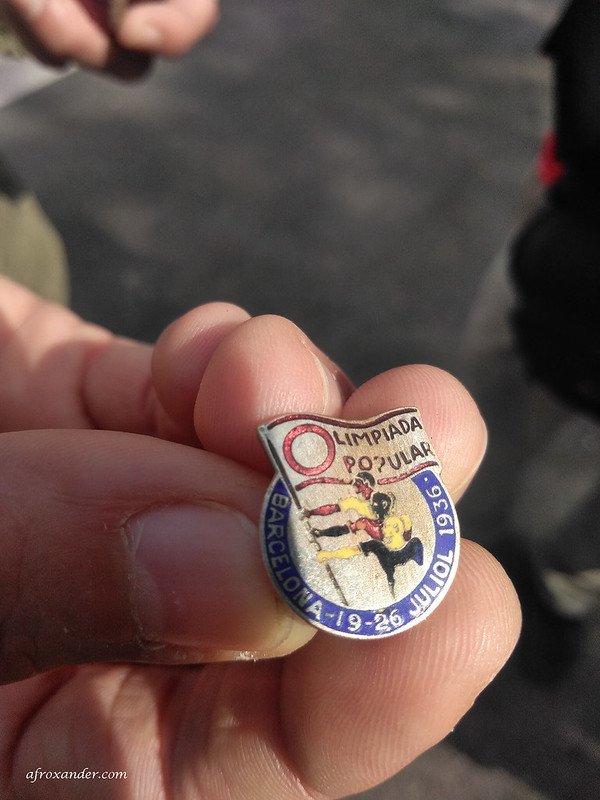
Above is a pin promoting the Olimpiada Popular (People’s Olympiad) of 1936. The event was a response and protest against the official 1936 Summer Olympics hosted by Germany and the Third Reich. Thousands of athletes from 22 countries were set to compete under the watchful eyes of Catalans and journalists from all over the world on July 19th when war broke out on July 17th.
A view of Las Ramblas as we walked over to…
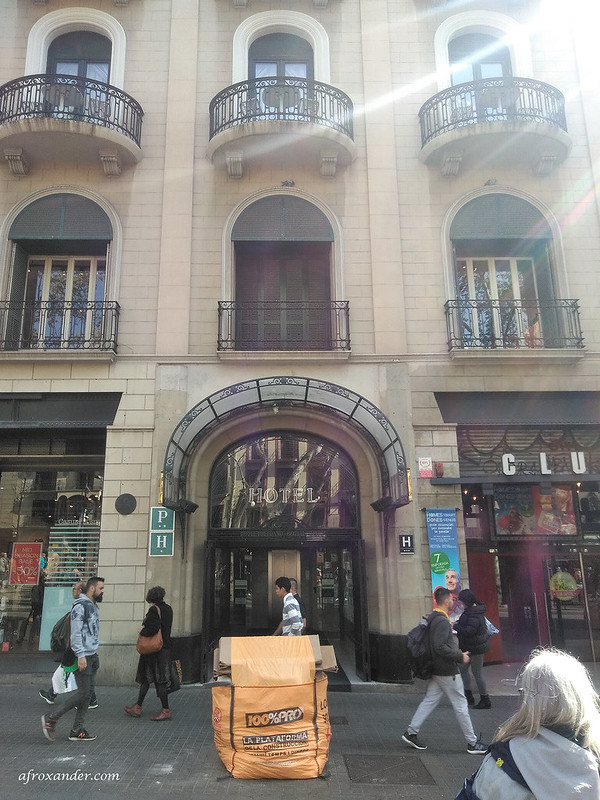
…the Hotel Continental! George Orwell (Eric Arthur Blair) stayed here multiple times during the civil war and included it in Homage To Catalonia.
One of the many narrow streets around Las Ramblas.
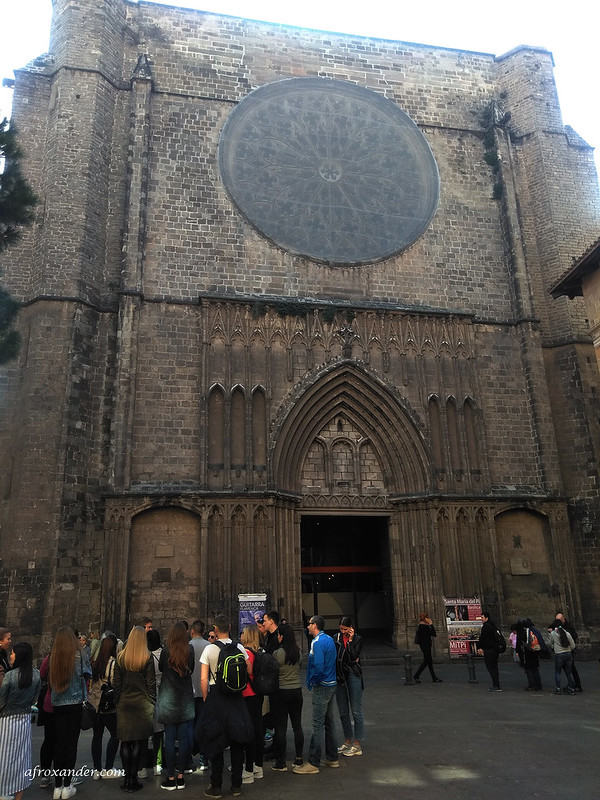
The Santa Maria del Pi church. The large, circular window is new as it was destroyed during the civil war.
An art store across from the church.
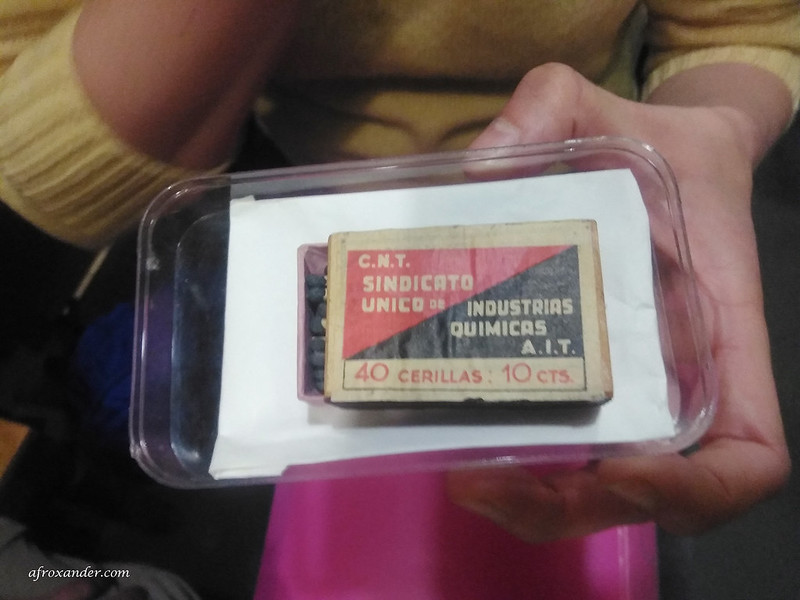
A box of matches featuring the logos of the CNT, Confederación Nacional del Trabajo, and the AIT, Asociación Internacional de los Trabajadores.
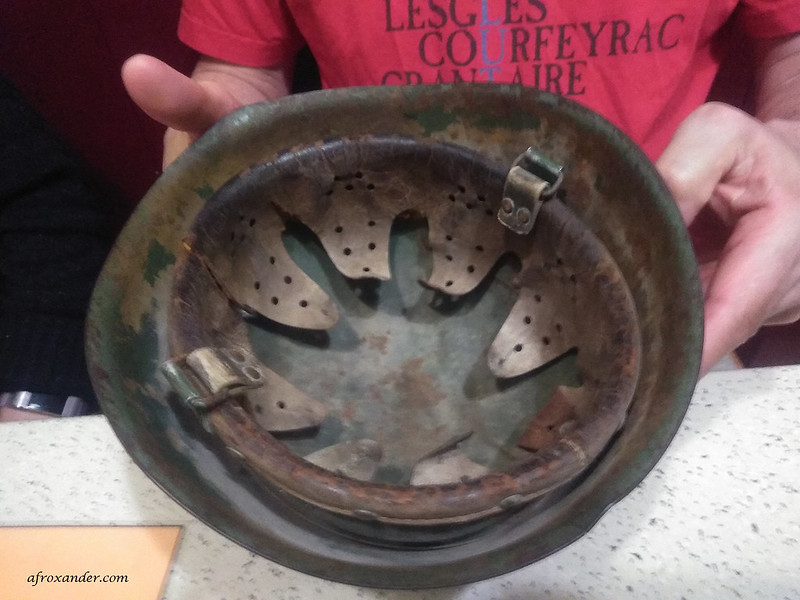
A combat helmet of the era.
And a gas mask of the era!
The remains of a case of a rocket-propelled grenade.
STRONG CONTENT WARNING for the next photo!
.
.
.
.
.
.
.
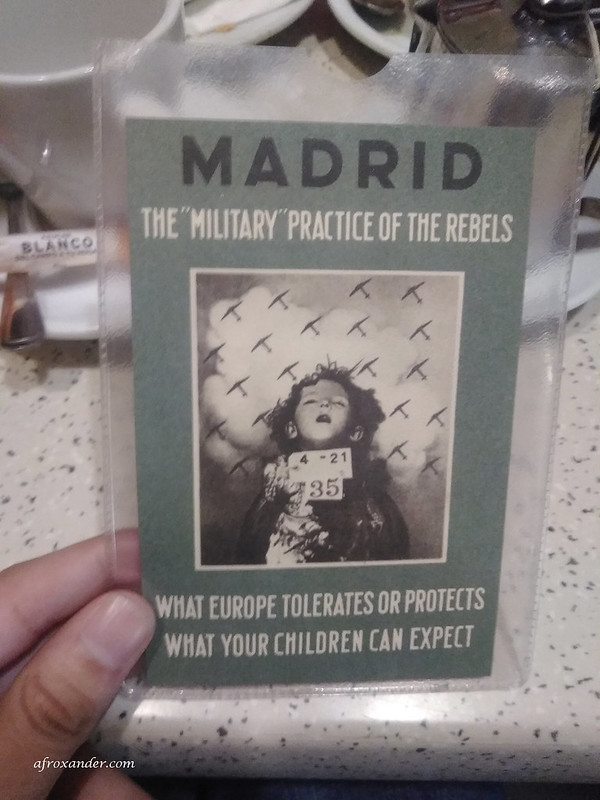
Spanish Republicans published this image as part of its propaganda campaign against Francisco Franco and the Nationalists. The child in the image was killed in an air raid.
First aid bandages.
A matchbook.
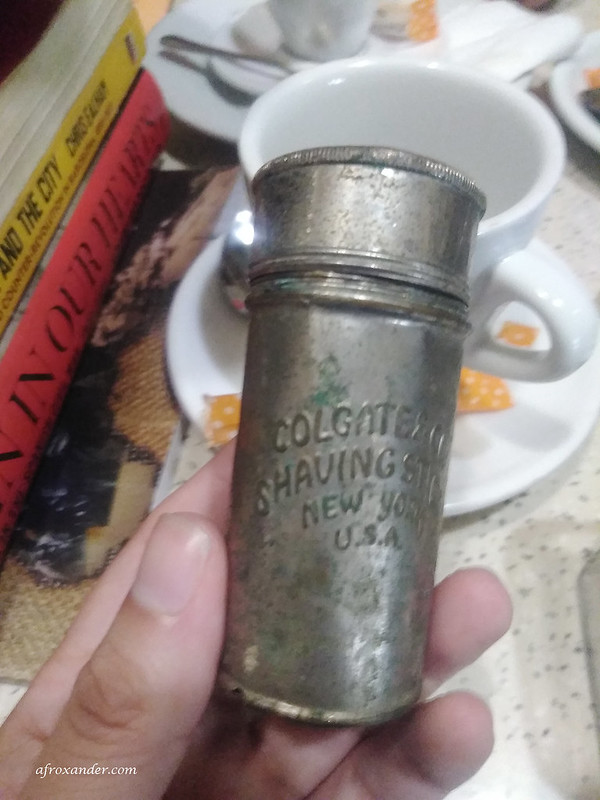
A shaving kit.
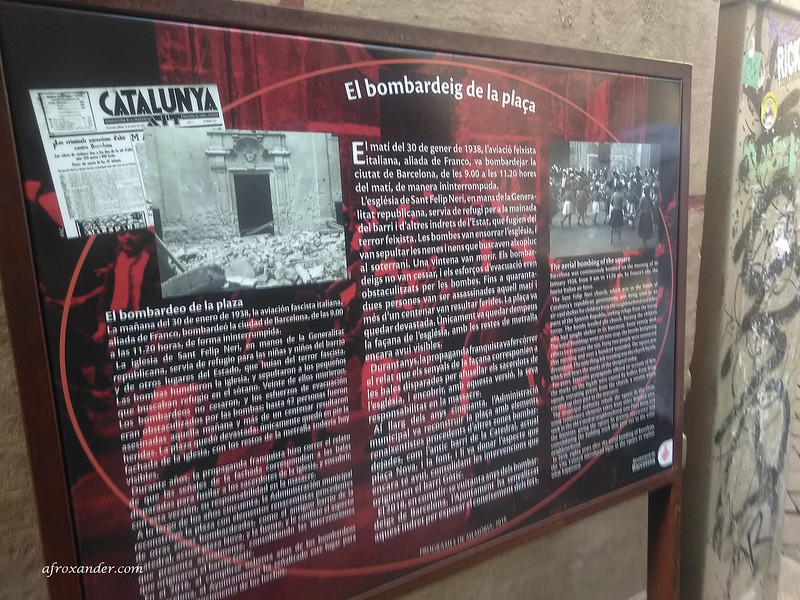
The above two photos are from the Plaça Sant Felip Neri. The façade of the church remains scarred by damage from the shrapnel of two bombs dropped onto the square during the war.
The sign outside the plaza (first photo) gives the details of the bombing: on January 30th, Italian fascists bombed Barcelona from 9am until 11:20am. The church in the plaza provided refuge to many children during the war and 20 of them died during the bombardment. Pro-Franco propaganda claimed that the damage to the building was the result of the slaughter of Catholic priests at the hands of anarchist firing squads.
A copy of the New York Times from January 31st, 1938 with an article about the bombing.
The Hotel Rivoli on Las Ramblas was once the headquarters of the POUM, Partido Obrero de Unificación Marxista, which Orwell was a member of.
This plaque is located on the Hotel Rivoli. It marks the date when POUM co-founder Andreu/Andrés Nin was kidnapped from the POUM’s office by pro-Stalinist Spanish Communists and disappeared, tortured and killed.
Orwell covers many of the events leading up to Nin’s capture in Homage to Catalonia and narrowly avoided being kidnapped by Stalinist forces himself.
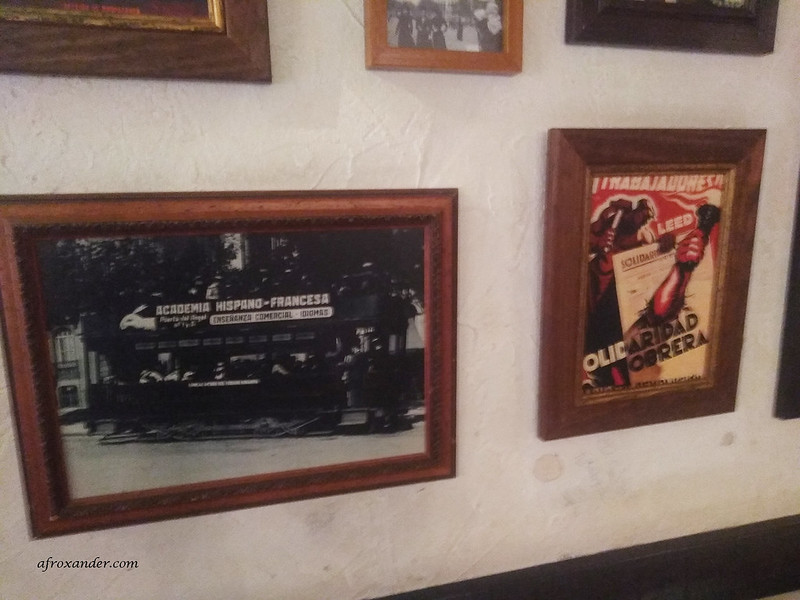
The final set of photos are from the interior of the Bar Llibertària. The bar features numerous artifacts connected with the POUM and CNT.
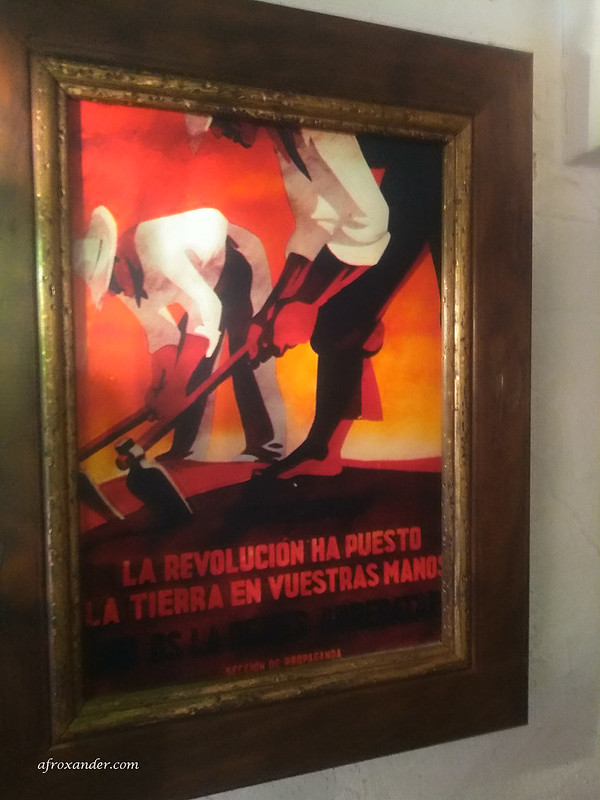
Above: “The Revolution Has Placed The Earth In Your Hands”
Above: “Comrade! Work and fight for the revolution.”
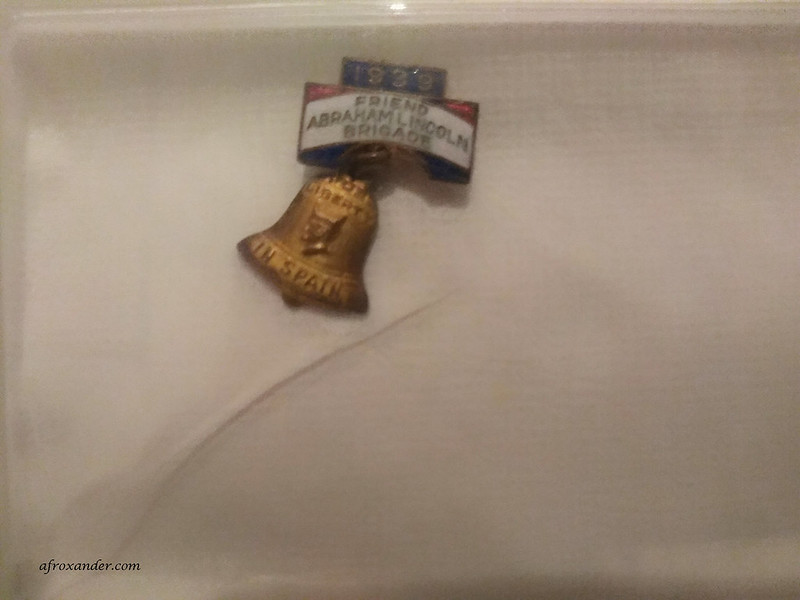
A pin of the Abraham Lincoln Brigade a.k.a. Lincoln Battalion, composed of hundreds of volunteers from the USA. The battalion was a member of the XV International Brigade, a brigade composed of foreign volunteers who fought alongside the antifascist/anti-Franco forces in Spain.
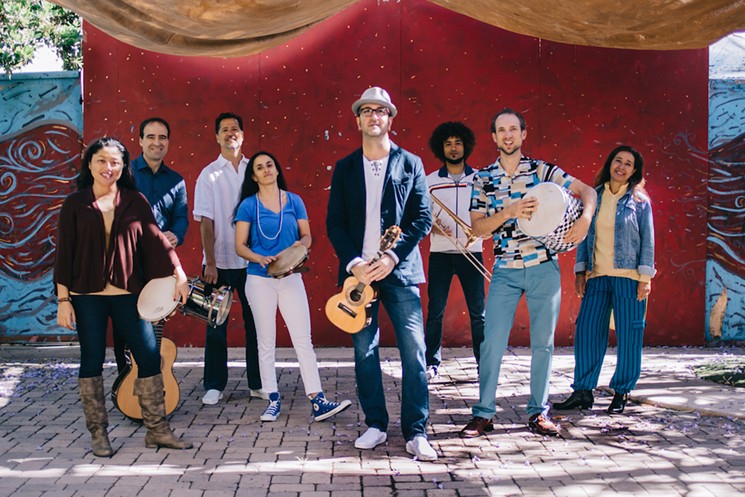
Brazilian-American musician Beto Gonzalez was too young to understand the country around him when his family returned to Brazil in the 1970s. It was only as he grew older, after coming back to the U.S., that he learned of how samba music became an important tool in the struggle against the country’s military dictatorship from 1964 to 1985.
Now, as the founder and artistic leader of Samba Society, Gonzalez hopes to share that history with a local audience during a time when the current political climates in the two countries he calls home have slid towards the types of attitudes that led to Brazil’s dictatorship.
Samba Society’s Brasil 70: Samba/Soul/Resistance, which they’ll perform this Friday at the newly restored Ford Amphitheatre, explores the rise of samba music in a decade marked by political censorship, repression, kidnappings and torture. Samba, forro and other genres of Brazilian music kept the spirit of resistance alive among the masses as the movement against the dictatorship grew, a resistance Gonzalez learned about during his studies at UCLA and in Rio de Janeiro as an ethnomusicology major.














 Afroxander (aka Iván Fernández)