
A few shots from QUITAPENAS’ album release party at La Cita hardly two weeks after that wonderful trip to Austin.
Full set at my flickr.


A few shots from QUITAPENAS’ album release party at La Cita hardly two weeks after that wonderful trip to Austin.
Full set at my flickr.
I’m happy to announce that I’ll be returning to Austin for SXSW this year with an added bonus: I’m travelling with a band!

I’ll be on the road photographing/partying with QUITAPENAS for a tour diary that will be published in Remezcla.
The band is a eight-piece cumbia tropical group from the Inland Empire. It’s their first performance at SXSW and first show outside of California. Stay tuned!!!
It didn’t take long to find my new favorite band of 2013. I’ve been obsessed with the music of Él Mató a un Policía Motorizado (He Killed A Motorcycle Cop) since late December. My obsession grew worse after the band released its second full-length album, La Dinastía Scorpio (The Scorpio Dynasty), on Spotify about a month ago.

The band hails from La Plata, a district of Buenos Aires, the capital province/city of Argentina and features Santiago Motorizado on bass/vox, Doctora Muerte on drums, Pantro Puto and Niño Elefante on guitars, and Chatrán Chatrán on keys. Él Mató, who got its name from a line in Die Hard, released its self-titled debut album in 2004 followed by a trilogy of EPs focused on the themes of birth (Navidad De Reserva, 2005), life (Un Millón De Euros, 2006) and death (Dia de los Muertos, 2008).
The group’s sound is similar to that of alternative/indie rock groups of the 1980s-1990s such as Pixies, Dinosaur Jr., Yo La Tengo, Guided By Voices, and Sonic Youth. The characteristic lo-fi sound of the genre is more prevalent in the earlier releases probably due to the fact that it was the best they could afford at the time.
That’s not to suggest that Scorpio sounds like a completely different beast altogether. The guitars are still distorted, the drums still layered enough to sound like there are four drummers in the studio playing simultaneously, and so on but, it’s all cleaner and more polished, an organized mess were no instrument drowns out another. Plus, Santiago’s vocal skills have improved greatly over the past decade.

The band released Scorpio in early December last year in its home country and shared it internationally on February this year. They’ll also make their SXSW debut next week at a few showcases. Listen to four tracks off Scorpio below including my two most favorite songs, “Mujeres Bellas Y Fuertes” and “Mas O Menos Bien.”
I spent only three weeks in Peru but one would think I were there for at least two months considering the amount of photos and videos I have archived. I have more time now to share the rest beginning with the country’s capital, Lima.
My friend and I stayed at Shablul hostel in the district of Miraflores. We were just a few blocks away from Parque Kennedy (Kennedy Park), which hosted a variety of events and festivals that we were lucky enough to partake in.


The Road To Machu Picchu is a four-part series that chronicles my exploits travelling form Cusco, Peru to the mountain of Machu Picchu, an ancient site built by the Incas that is preserved and protected by the government of Peru and UNESCO as a World Heritage Site.
Also read Day One, Day Two, and Day Three.
My alarm went off at 4:30 a.m. My things were packed and my change of clothes waited for me on my backpack. My group met downstairs in the lobby at 5 and we walked for a few minutes in the darkness to the bus station where we, along with hundreds of other tourists, were to catch one of many buses up to Machu Picchu. The thought of hiking to the entrance came across no one’s mind that morning for obvious reasons.
The ride up the hillside was a calm and soothing one. Our bus made its way up the road that snaked up the hillside of Machu Picchu with dawn’s first light following close behind.
It was sunny and slightly warm when we disembarked at the top of the mountain near the entrance to the city. There was already a long ling of tourists when we arrived.


There are a number of large plaques mounted on the stone walls just past the modern entrance (the one you see pictured above) of the city of Machu Picchu that commemorate the area as a UNESCO heritage site as well as the exploits of Hiram Bingham III. Bingham learned about “lost” Incan cities while a lecturer at Yale and is credited with finding Machu Picchu in 1911 with the aid of families who lived in the area.


The Road To Machu Picchu is a four-part series that chronicles my exploits travelling form Cusco, Peru to the mountain of Machu Picchu, an ancient site built by the Incas that is preserved and protected by the government of Peru and UNESCO as a World Heritage Site.
Catch up on Day One and Day Two.
Day three began with the realization that Viracocha was out to get me. The Incan rain god followed me to Santa Teresa and, once again, poured buckets of rain overnight. This wouldn’t have been a problem had I not hung one of my shirts on a clothesline to air out the stench of nicotine attached to it after a night out on the town. Luckily, Viracocha showed some pity and the rain stopped around sunrise. I had just enough time before breakfast to dry the shirt to a “slightly moist” level.
After breakfast, our group split in two and we each headed to different directions for the same exciting purpose: ziplining! We went to a park run by Canopy Peru/Cola De Mono for the excursion. We hiked up to the top of a hill where the first of six ziplines awaited us. I’ll let the picture and videos describe how it happened (I suggest turning the volume down, ziplines are pretty loud!):

The Road To Machu Picchu is a four-part series that chronicles my exploits travelling form Cusco, Peru to the mountain of Machu Picchu, an ancient site built by the Incas that is preserved and protected by the government of Peru and UNESCO as a World Heritage Site.
Catch up on Day One.
I awoke early Sunday morning thanks to the machine-gun patter of raindrops crash-landing around me. Damn, I thought, I should’ve showered last night. The restrooms were outdoors in a separate area and two of the three showers available were showerheads installed in rectangular grass huts. I fell asleep again with visions of my flip-flops splashing through mud puddles on my way to and from the outdoor showers.
I awoke again a few hours later to an overcast but rainless sky and immediately took advantage of the situation. One cold, refreshing shower later and I was ready for breakfast.
Day two of the tour began with a lesson about some of the local critters, pictured below.


Afterwards, Ricardo informed us of the day’s activities: hiking, hiking, hiking, and hiking ending with a dip at the Aguas Termales (hot springs) of Cocalmayo and dancing at a nightclub or two (assuming one could still walk after a day spent hiking) at Santa Teresa.
Ricardo also gave us a lesson about achiote (bixa orellana), a plant native to tropical regions in America. The plant has a number of food and medical uses including sunblock. Ricardo opened a few seed pods, ground the berries into a paste in a small bowl and painted each of our faces with some Incan (and some not-quite-Incan) designs.

The Road To Machu Picchu is a four-part series that chronicles my exploits travelling form Cusco, Peru to the mountain of Machu Picchu, an ancient site built by the Incas that is preserved and protected by the government of Peru and UNESCO as a World Heritage Site.
My Machu Picchu adventure began in the city of Cusco on the chilly Saturday morning of October 12th. The city is a huge tourist destination thanks to its proximity to Machu Picchu and architectural heritage. Many pre-Colombian streets and buildings are still in use today such as various Incan ruins and a small alleyway known as Loreto where one can touch the foundation of a building laid down by Incans centuries ago.
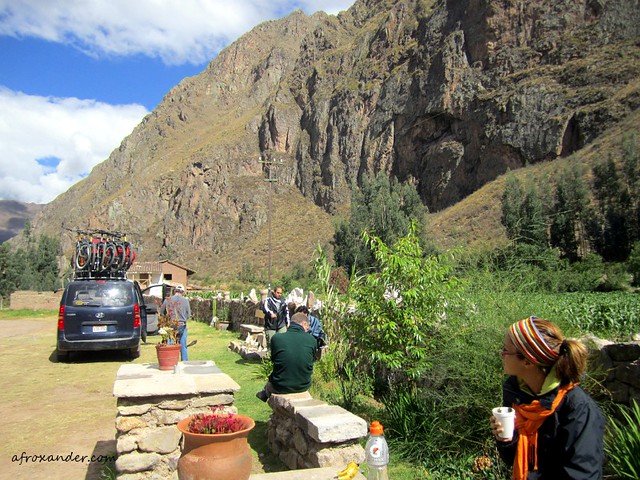
My friend and I woke up incredibly early, grabbed our bags and were escorted out the door by our Couchsurfing host Willy. Willy helped us set up our trip to M.P. through the Inka Jungle Trail, a four-day, three-night hike from Cusco to Machu Picchu and back. Luckily for us, our host was also an employee of a travel agency and took care of everything we needed for our trip other than the fee.
We met our tour guide Ricardo who introduced us to our group before we hopped in the van and took off to the town of Ollantaytambo.

I spent a good portion of my time in Cusco, Peru admiring the work created by art students of the Escuela Superior Autonoma de Bellas Artes. My favorite piece was a large installation by Victor Salvatierra Laime, Oscar Alberto Llalla Cordova, Elio Pumasupa Solano, and Mario Gamarra Valdez. The piece illustrates the famous battle at Cusco between the Incas and the Chankas.

The Chankas was a indigenous tribe in Peru primarily located in the Andahuaylas (modern-day Apurimac) region and consisted of two separate tribes: the Hanan Chankas and the Uran Chankas.
In 1438, Hanan Chanka leader Anccu Hualloc led an army of 40, 000 strong, including warriors from the Ayamarca tribe, and invaded the city of Cusco. Incan prince Cusi Yupanqui led the resistance with allies from the Canas tribe and regained control of Cusco. The battle led to the formation of the Incan empire, known in Quecha as Tawantinsuyu, by Yupanqui who became Pachacutec.
There are more photos of student art at my photoset at Remezcla, From Graffiti To Pre-Columbian Art: Peru Photo Series.


I returned from Peru (more posts about my trip coming soon, I promise!) with one weekend to recover and prepare for a number of Halloween/Day of the Dead-related events. The first two stops on Oct. 30th were at Los Globos for Indio beer-sponsored event Hola Indio feat. Mexicans With Guns, Toy Selectah, and Them Jeans followed by La Cita for La Chamba’s album release party.


More pictures can be found on my flickr account.
 Afroxander (aka Iván Fernández)