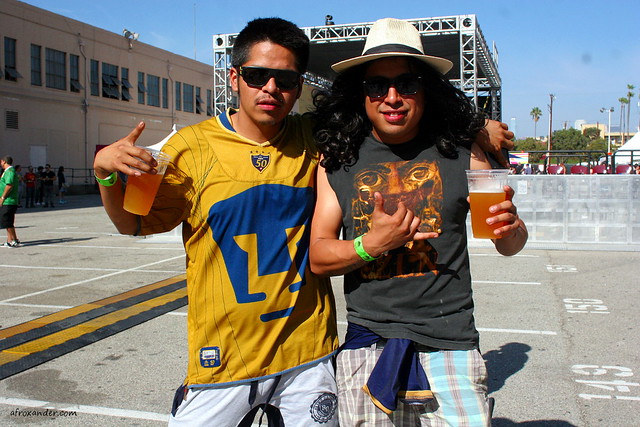
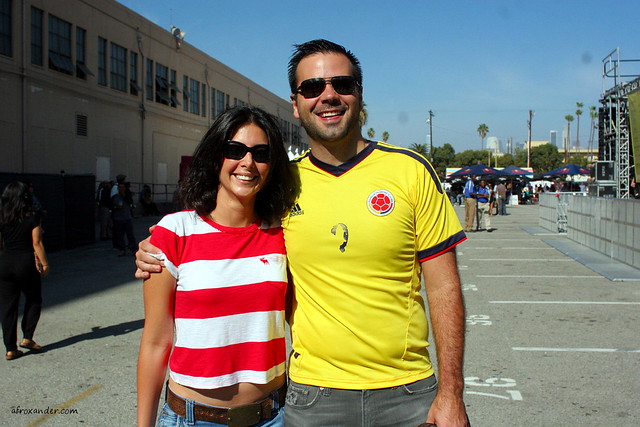
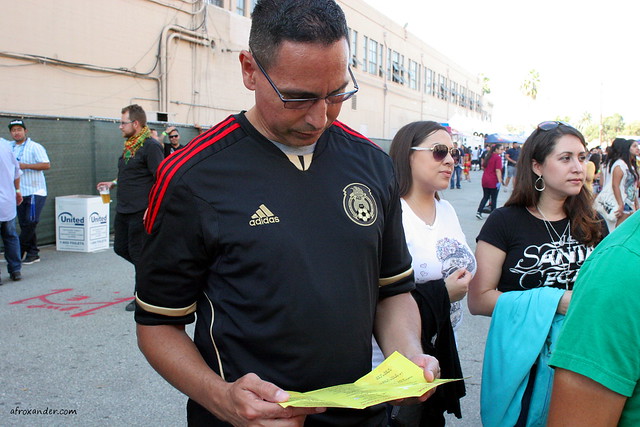
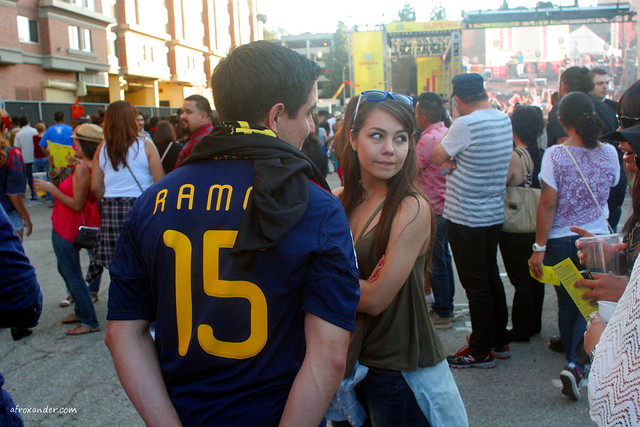
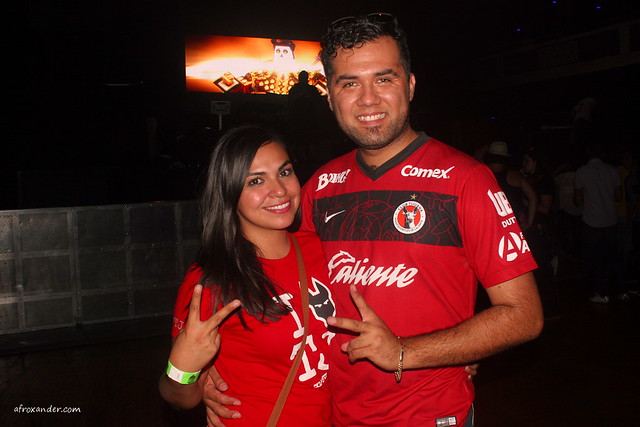
I guess it’s no surprise that a festival that catered to a Latino audience would result in a crowd dressed in a variety of football jerseys from local clubs and national teams, as was the case at last weekend’s Supersonico Festival. I photographed as many as I could as a personal project.
Category: Sports
UFC 178 Q&A at Club Nokia
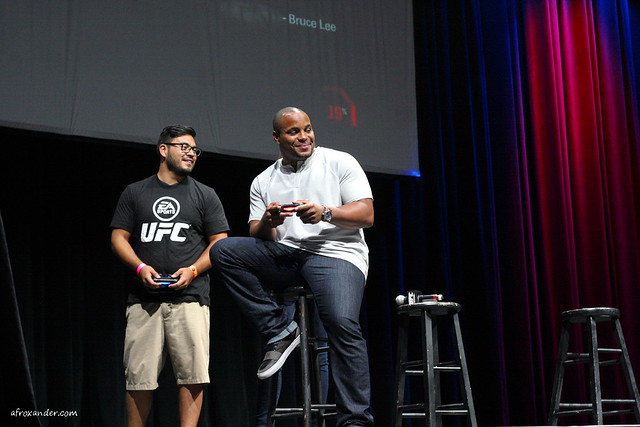
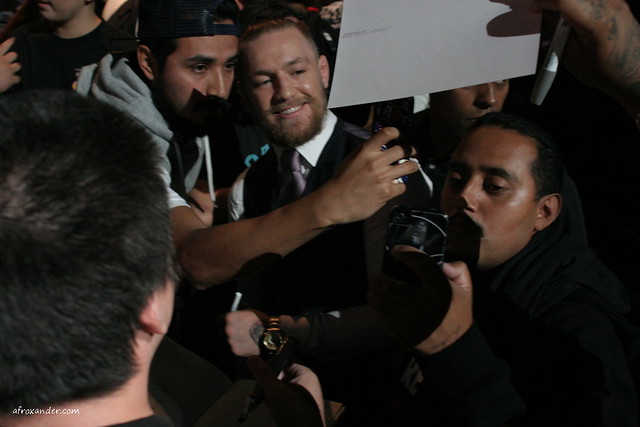
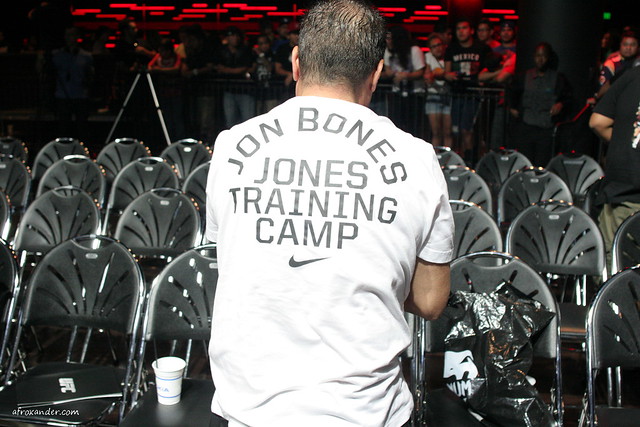
UFC 178 is less than two months away and the powers-that-be are hyping the fight up with a number of media events around the country. Fighters Jon Jones, Daniel Cormier, Conor McGregor, and Dustin Poirier spent some time at Club Nokia in Los Angeles for a Q&A session with the fans.
There was plenty of trash-talk and two fans won an opportunity to play the new UFC video game against Cormier and Jones. Alistair Overeem also made an appearance.
The World Cup Reader
The World Cup is less than two weeks away and I’ve found myself neck-deep in compelling and insightful stories/articles about the event, the sport, and host nation Brazil.
I’m going to share my favorites in this post. Bookmark this link because I’ll be updating it with new stories as I come across them.
- Brazil’s Poor Stage an Alternative to World Cup: Rio de Janeiro favela hosts People’s Cup for communities affected by FIFA restrictions, evictions and home demolitions.
- The Messi Scandal: From Charity Soccer to Money Laundering Accusations
- Fixed Soccer Matches Cast Shadow Over World Cup: A New York Times investigation of match fixing ahead of the last World Cup gives an unusually detailed look at the ease with which professional gamblers can fix matches.
- ‘There will have been no World Cup’: The World Cup has become the focal point of Brazilians’ anger over corruption, poverty and social injustice.
- Why Is Blackwater Helping to Train Brazil’s World Cup Security?
- Will Brazil’s World Cup Stadium in the Middle of the Amazon Pay Off?: The city of Manaus hopes that a new soccer stadium, built for the World Cup, will become a post-tournament boon to the economy
- Brazil’s Dilma Rousseff defends World Cup organisation
- The 1950 World Cup in Brazil in pictures: major upsets and unfinished stadiums
- This mind-controlled exoskeleton will let a paralyzed teen kick the 1st ball at the World Cup
- Hard Evidence: what is the World Cup worth?
- Police fear rise in domestic violence during World Cup
The Politics of Identity and the Chavez/De La Hoya Fight
Back in February, I spoke with artist Ernesto Yerena for an interview that appeared in Remezcla.
One interesting tidbit that I was unable to include in the article was a portion about the boxing match between Julio Cesar Chavez and Oscar de la Hoya in 1996. Yerena talks about how the fight exposed him to the complexities of identity among Mexicans on both sides of the US/Mexico border, which he lived near in El Centro, CA.
Listen to the audio below:
When The MLShit Hits The Fan
Major League Soccer’s (MLS) 2014 season will kick off this Saturday and, as expected, the league has been hard at work hyping up opening weekend. Unfortunately for the league, a few factors are looking to rain on the MLS parade: renewed competition from the North American Soccer League (NASL) and, more urgently, the impasse between MLS’s Professional Referee Organization (PRO) and the Professional Soccer Referees Association (PSRA).

PRO announced this morning that they have decided to lock out referees from the PSRA this opening weekend. The league will resort to its backup plan of non-union (re: scab) referees composed of foreign referees, former MLS officials, and refs from other leagues. The PRO even held a mini-camp for potential temporary replacements last week. Things could go well enough with no one noticing any changes…or they could be utterly disastrous.
Members of the PSRA voted 64 – 1 in favor of a strike back in February and talks on the group’s first collective bargaining agreement with the PRO earlier this week failed. The PSRA also filed charges with the National Labor Relations Board claiming bad-faith bargaining and accusing members of PRO with making threats against members of the PSRA.
From Dave Zirin at The Nation:
The Professional Soccer Referees Association, otherwise known as the refs union, has been attempting to negotiate their first collective bargaining agreement in league history. The amount of money that separated the two parties is not vast, estimated between $440,000 and $1 million for the lifetime of the deal. The main financial issue was that in recent years, MLS mandated far more trainings for referees to improve the quality of officiating. The refs, however, were not compensated for the extra hours.
The greater issue, however, was political. It was the fact that the refs union refused to sign a no-strike pledge. As the MLS league negotiator Peter Walton said, “Since they will not give us a guarantee they will not go on strike immediately prior to our match we are left in a position where we must use replacement officials.”
Some of the more cynical comments about this situation that I’ve read in various articles claim this was a move by the PRO for publicity. All publicity is good publicity and the issue will be resolved in due time but only after a good amount of publicity about this situation makes a few rounds.
Steven Goff has provided the best coverage of the situation in his Soccer Insider column at the Washington Post.
On a smaller but potentially larger problem down the road, NASL commissioner Bill Peterson called out Garber and the MLS for some questionable moves regarding the league’s expansion fever.
Just a few days ago, MLS commissioner Don Garber hyped up Texan cities Austin and San Antonio as a possibility for the home of a future MLS team. That news came weeks after David Beckham announced plans for his own MLS franchise in Miami, Florida, all of which prompted a few comments from NASL commissioner Bill Peterson during a press conference call early last week.

The NASL has teams in San Antonio, Atlanta, Minneapolis, New York City and Miami…all cities where MLS will expand or has looked into expanding. MLS will likely be at 24 teams total by 2020.
Peterson originally announced that the reborn NASL (the original league folded in 1984) would not compete directly with MLS and, instead, focus on building its own separate fan base and focus on creating a system of promotion/relegation after some growth.
His tune changed immediately last week when MLS began digging footholds in his league’s turf.
From Franco Panizo of Soccer By Ives:
“Can somebody tell me, is he going to have 32 teams or 42 teams?” Peterson asked rhetorically of Garber without mentioning him by name. “How many is he going to have? Every day he announces another city. I’ve got to send him an update of where we’re going so he can announce that next.”
What few, if anyone, persons have pointed out is how this expansion echoes the past. The original NASL was a closed league (as MLS is today) that eventually fell apart due to rapid expansion among other factors…including some that are beginning to appear in MLS (expansion, union disputes, etc.).
Naturally, there’s been plenty of speculation of where this road will eventually lead to; a second American Soccer War, an implosion of the MLS, a temporary setback to MLS domination, etc. Whatever the final result may be, we’ll look back at 2014 as simply a pebble in MLS’s shoe or the first sign of the levee breaking.
Fans Irate After ESPN2 Misses USMNT’s Opening Goal Against South Korea
The US national team started 2014 with a bang as forward Chris Wondolowski opened the match with a goal at the four-minute mark. Unfortunately, Team USA fans watching on ESPN2 missed it. The station continued to show the final minutes of college basketball match between Clemson and Florida State.
Seven minutes into the game and the station finally switched over. As you can expect, this didn’t sit too well with USMNT fans who watched the game on ESPN2.
https://twitter.com/chiieddy/status/429737193087987713
https://twitter.com/chiieddy/status/429738080355237888
https://twitter.com/lukeicejones/status/429745280268128257
https://twitter.com/deepblueseahors/status/429741056481964033
https://twitter.com/Mrs_Lady_B/status/429740456381915136
The game wasn’t a official FIFA matchday and not an incredibly important one in general besides it being a warm-up/team tweak for the World Cup. However, it’s a sad state of affairs at ESPN when a college basketball game is considered more important than a soccer game featuring the national team, especially in light of the team’s very successful 2013 campaign.
What does it mean when Spanish-language UniMas shows the same game from beginning to end when English-language ESPN doesn’t? This on top of the fact that ESPN/NBC lost viewers in its MLS coverage while UniMas actually gained viewers:
The Spanish-language audience on UniMas increased almost 6 percent from last year’s audience to 514,000 viewers, more than double what they were only three years ago on another Univision network, Galavision.
The numbers are consistent with the trend during the 2013 regular season. Univision reported that the average viewers on UniMas’ MLS regular-season broadcasts (223,000) topped those on ESPN2 (181,000).
Sports Business Daily had reported that the average viewership dropped 29 percent on ESPN/ESPN and 8 percent to 112,000 on NBCSN (which had benefited in 2012 from usually high viewerships due to lead-ins from its London Olympics coverage).
Courtesy Soccer America.
The rise of El Tri-Levisa and the war for Mexico’s football federation
This story originally appeared on Voxxi.

As the Mexican national team took out its World Cup qualifying frustrations on low-ranked New Zealand last week, Sports Illustrated journalist Grant Wahl took to Twitter to describe the months-long drama as “the best telenovela ever.” He may be more correct than he realizes if sports journalist Miguel Pazcabrales is right.
Pazcabrales has outlined in his column Los Demonios Del Deporte what he believes is the return of Televisa’s hand in controlling the Federacion Mexicana de Futbol Asociacion (FMF).
Much like the return of the Partido Revolucionario Institutional (PRI) to power, the conglomerate is the ousted hand of power that has returned to rock the cradle.
“I no longer believe that it’s a coincidence,” exclaims Pazcabrales, “that every time the World Cup draws near, Mexico is always at risk of not qualifying.”
He cites as evidence El Tri’s rescue at the hands of Javier Aguirre from the failures of Sven Gorak-Eriksson and Enrique Meza and the intervention of Manuel Lapuente in the run-up to the World Cup ‘98.
The current managerial crisis that has seen four managers take over El Tri in a little over a month is an exaggerated, almost cartoon-like version of Televisa’s past attempts at creating drama on a national scale with football as its main protagonist.
Through shrewd, opportunistic maneuvers, the largest multimedia company in Mexico (and second largest in Latin America) has worked behind the scenes to “rescue” the federation and the national team on various occasions, purposefully creating a real-life soap opera surrounding the country’s pastime in order to advance their profits by controlling broadcasting rights and bombarding Tri fans with merchandise, advertisements, and more.
The current version of this manufactured crisis begins in 2011 with the appointment of Jose Manuel de la Torre.
Two successful years as coach came to an end in 2013 after a dismal record in the CONCACAF qualifiers and the Confederations Cup.
Luis Fernando Tena took over for one game and Victor Manuel Vucetich lasted two games before being forced out by the FMF (the circumstances of which are incredibly suspicious) in favor of current coach Miguel Herrera.
Herrera, his coaching staff, and his squad of Club America players were loaned to the FMF by its owners to secure Mexico’s place in the World Cup. Unfortunately, this telenovela has more groan-inducing twists than every film by M. Night Shyamalan combined.
Plot twist #1: Televisa owns Club America.
Plot twist #2: FMF president Justino Compean is a former employee of Televisa with stints as head of Club Necaxa and, the cradle of Mexico’s soccer universe, the Estadio Azteca. He was promoted to the biggest seat in the FMF thanks to the collusion of Televisa and its competitor TV Azteca in a bid to protect their mutual interests in football revenue.
Plot twist #3: Billionaire Carlos Slim, owner of TelMex and America Movil, has made numerous maneuvers into Televisa’s territory. He recently purchased Estudiantes Tecos as well as shares in C.F. Pachuca and Club Leon. This gives him extra clout in the FMF (league owners have a vote/say in the FMF’s operations) and the broadcast rights for their games, drawing the ire of Televisa and TV Azteca who were the league’s broadcasting duopoly for many years.
Plot twist #4: Jorge Vergara is the owner of Chivas de Guadalajara, Club America’s fiercest rival. It was long-rumored that Slim was interested in purchasing Chivas plus a few of his other properties. Vergara’s revolving door record with his club’s coaches mirrors the current situation with the FMF.
Plot twist #5: De La Torre coached Chivas (2005 – 2007) before his stint with El Tri.
Plot twist #6: Vergara was Herrera’s most vocal supporter as Vucetich’s replacement.
Mexico’s greatest footballer Hugo Sanchez said it best in a recent column for El Universal where he spoke out against the owners and higher-ups of the FMF for treating his beloved sport as nothing more than a toy for them to make money off of.
“The saddest part of this story…is that people are oblivious,” he said, “and they continue being manipulated and conditioned into believing that the players and the coaches are to blame for this crisis we have befallen. They are absolutely mistaken.”
Unfortunately for Sanchez and Tri fans everywhere, only Televisa knows how this telenovela will end.
The Soccer Reform Trilogy
Soccer in the USA is a little different compared to other countries for a variety of reasons including its closed-league system. Major League Soccer operates in the same manner as the National Football League, Major League Baseball and the National Hockey League with only bankruptcy forcing teams out of the league while the rest of the world (sans Australia) follows a multi-league system that promotes and relegates teams between divisions depending on their performance.
Enter Ted Westervelt, founder and head honcho of Soccer Reform. Westervelt has been fighting the good fight for years to bring promotion/relegation to MLS. He’s not alone in this fight and, as much as MLS and the US Soccer Federation try to drown Westervelt and like-minded individuals out, his voice continues to be heard across the nation.

I had the opportunity to interview Westervelt a few months ago. Our hour-plus long conversation covered numerous enlightening topics into the history of US soccer (all 100 years of it!) and the forces at work in the US soccer federation and in the business interests who have deep hands in the sport that are preventing MLS from switching to an open-league system similar to that found in countries around the world.
“Soccer was a global market before there were a whole lot of global markets,” said Westervelt, “but here we are still pretending that it’s not a global market.”
The interview was published in Voxxi in three parts:
Centennial: Filling The Gaps In U.S. Soccer History
Soccer Reform: Building A Better Soccer League In The U.S.
Soccer Reform: Barriers To Promotion & Relegation In U.S. Soccer
What’s A Superclásico? Football Rivalries In Latin America
I’ve been working on a monthly column for Remezcla titled Your Guide to Clásicos De Fútbol Rivalries. Since February, I’ve been writing about the rivalry between a pair of teams in Latin America (with one exception for the FC Barcelona/Real Madrid F.C. rivalry in Spain) and delve into their history, crazy fans and more.
The archive of stories can be found HERE and so far include:
- FC Barcelona vs. Real Madrid F.C. (Spain)
- Atlético Independiente vs. Racing Club De Avellaneda (Argentina)
- Chivas vs. América (Mexico)
- Flamengo vs. Fluminense a.k.a. Fla-Flu (Brazil)
- Nacional vs. Peñarol (Uruguay)
- Boca Juniors vs. River Plate (Argentina)
I still have PLENTY of more rivalries to write about. My next column will focus on a rivalry from Costa Rica in anticipation of this month’s CONCACAF Champions League match between LA Galaxy and C.S. Cartaginés in L.A.
Mexico vs. Panama Gold Cup Match at The Rose Bowl
This past Sunday was the much anticipated first set of CONCACAF Gold Cup matches between Mexico and Panama. Canada vs. Martinique was played before in a double-header but I skipped it in order to partake in all the free food at the tailgate parties.

I covered the game for Remezcla where you can see photos (including the above) and read a bit about the madness. See more HERE.
I also uploaded a bunch more photos on Flickr that were unused. Here are a few of my favorites that were cut:
The foul that lead to…
…Panama’s first goal.
There are more on my flickr.