RIP LA Weekly

I wanted to write something about what happened last week at LA Weekly.

Much of the details can be found in this article by Jack Denton for Pacific Standard. The short version of the story is that a gaggle of libertarians bought the company and fired most everyone last Wednesday. The new EIC Brian Calle doesn’t have a clue what he’s doing or what he wants to do and neither do the owners as the site has yet to be updated with any new content other than a post introducing the new investors and since-deleted tweet offering unpaid work.

That’s not to mention the jaw-dropping ignorant statements that Calle and his investors have vomited out in recent days.

I contributed to the LAW for seven years with these past three years the best out of those seven thanks to everyone I worked with especially former music editor Andy Hermann who also wrote me a wonderful letter of recommendation as part of my application to San Diego State University.

The past three years were definitely something special. The four years before then felt like dangerous, shifting waters that threatened to sink LA Weekly with a revolving door of cuts and editorial staff. Then, somehow, the ship and waters stabilized and all went well again.

Until November 29th.

Some of my peers from LAW are fighting Calle and his ilk to prevent them from being able to do anything under LAW’s name. I’m not sure what will come of it but the new owners are off to a terrible start and many important names, retailers, and organizations in the city have joined a boycott against them.

I do believe it’s possible to save LA Weekly. I hope we can soon.
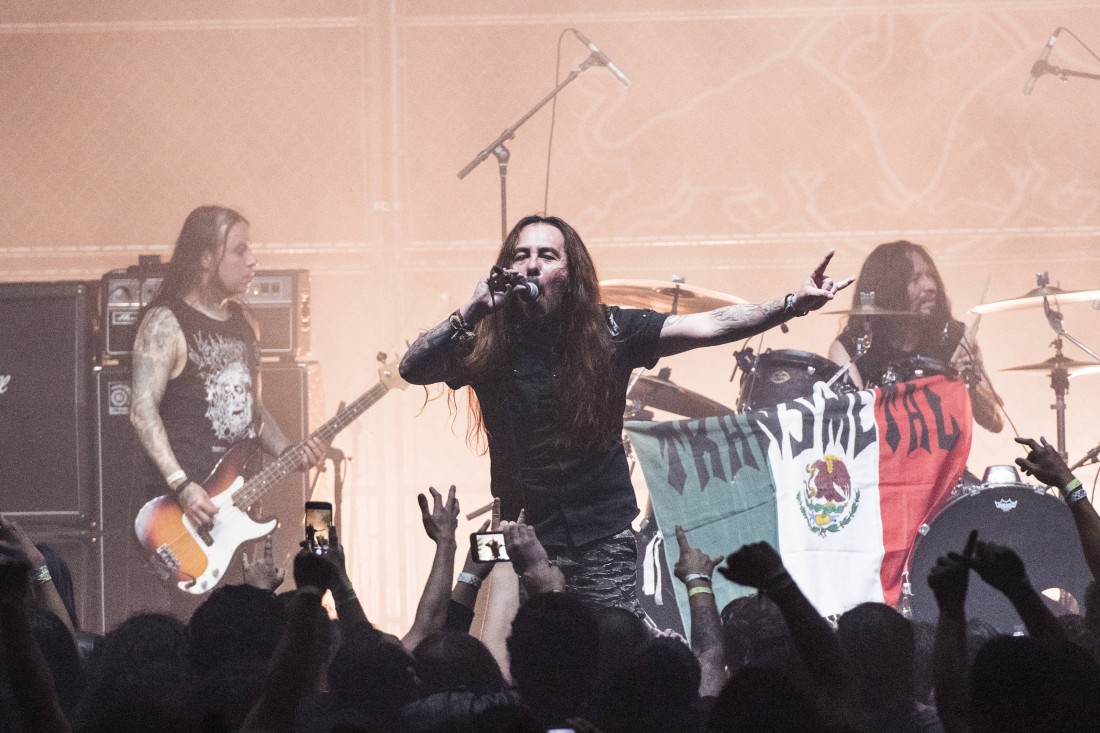
For L.A.’s Mexican-American Metal Fans, Todo Es Metal Was a Lineup for the Ages

transmetal_drew_gurian
Transmetal at Los Angeles Theater. Drew Gurian/Red Bull

The Los Angeles Theatre on Broadway first opened its doors in 1931 with the world premiere of Charlie Chaplin’s City Lights. No one who attended that opening night could ever in their wildest dreams have imagined that the 2,000-person capacity venue would, decades later, host an event like Red Bull Music Academy Festival’s Todo Es Metal showcase this past Saturday, Oct. 21.

The event united rock bands from Mexico with their long-haired peers of the American diaspora for a night of thrash, grind, death, black and heavy metal. Southern Californian acts Mictlantecuhtli, XLesionsX, Scrapmetal, Blue Hummingbird on the Left, Volahn, Letum Ascensus, Sadistic Intent, and Terrorizer L.A. shared the bill with Thanatology, Disgorge and Transmetal from Mexico.

Read the rest at LA Weekly.

How Helado Negro’s “Young, Latin and Proud” Became a Generational Anthem

helado_negro_horizontalphoto_by_chona_kasinger

There will be a point this coming Thursday night when Helado Negro, the musical alter ego of Roberto Carlos Lange, will kick up a wave of high-pitched sounds off his synthesizer and lead the crowd at the Regent Theater into a chorus about being “young, Latin and proud.” The song, which turns 2 years old this summer, continues to serve as an anthem for a generation of Latinos growing up in Trump’s America, a development Lange never expected.

“Absolutely, it caught me by surprise,” the multitalented Lange admits over the phone. “The song was made for me and was more of an intimate song. We had a few shows and, kind of the way the world works in trying to get people to know that you have a new show coming up, we thought it would be a good idea to release a new song, and I thought, ‘Oh, this would be a great song for summertime.’”

Lange released “Young, Latin and Proud” just as candidate Trump was calling Mexican immigrants rapists and criminals. “A lot of people have commented to me that they found the song to be somewhat of a reinforcement of an anti-Trump idea,” he says. But he insists the song wasn’t intended as a response to Trump: “It was just music that I was making that I’ve always made since day one, since the first record. A lot of my music has been covering the same themes. People pick up on it later in time.”

Read the rest at LA Weekly.

The Future of SoCal Indie Music Looks Bright — and Latino — at Viva! Pomona

cuco_guitar_tzopelic
Cuco is the future!

If it ain’t broke, don’t fix it, and there’s nothing about Viva! Pomona that needs to be fixed. Founder Rene Contreras celebrated the sixth birthday of his little festival that could in Pomona this past weekend with yet another stellar lineup of local and international independent artists that struck a perfect balance between Latino artists and everyone else.

The annual two-day festival brought a range of artists from different genres, with acoustic weirdos such as Juan Wauters and Tall Juan sharing floor space with their musical opposites like punk group The Coathangers and fuzzy surf-rock duo Surf Curse. It’s a formula that has worked since the festival’s inception, a depiction of the diverse tastes of Contreras and others like him.

The two worlds that the festival brings together have always coexisted well, although the disparity between the two seemed stronger this year than it has at past Viva! Pomonas. It was far from a Bloods and Crips or greasers and socials situation, but the line between the Latino segment of the festival and the rest stood out more than it had in other years.

One reason for the disparity was the star power behind some of the new names on the bill — specifically, Omar Banos, whose musical alter ego Cuco is more insanely popular than anyone who isn’t a teenage Latino from L.A. obsessed with emo and romantic ballads realizes.

Read the rest at LA Weekly!

A.Chal Infuses His Hypnotic R&B With His South American Roots

achal_anand_sheth

A.Chal (aka Alejandro Salazar) is a tall dude who cuts an imposing figure, filling every room he steps into with silent intensity. His voice carries as much weight as the booming bass he produces for his music, but he’s soft-spoken during our interview, rarely speaking above a murmur. There’s an interesting duality to his persona as a singer, rapper, producer and solo artist, which continues to evolve on his latest release, On Gaz.

On Gaz, A.Chal’s third release and first mixtape, arrived on June 2, four years after his debut EP Ballroom Riots and just one year after his first full-length album, Welcome to Gazi. On the latter release, the Peruvian-American artist was the self-aware party boy who sought self-reflection and self-critique after debaucherous nights out on the town. On this new release, which features appearances by French Montana and A$AP Nast, he confronts his feelings of guilt after his insecurities convinced him to destroy numerous personal relationships in the months leading up to the release of Welcome to Gazi.

A.Chal sharpened his skills as a songwriter while living in New York, but friends urged him to head west to Los Angeles. Since moving here, he’s been better able to find inspiration and outlet for his creativity, resulting in an album, a mixtape and songwriting credits for the likes of Rita Ora, Max Martin and Jennifer Lopez.

Read more at LA Weekly.

“You Gotta Let Us Be Humans”: Cedric Bixler-Zavala on At the Drive-In’s New Album

atdi_bandpic_hires1

Would you say it’s a political record or simply a reaction to the times?
I think it’s a reaction to the times. It’s done what I’ve always done. I’ve called myself the court jester of the band. I’ll give you a bunch of fucking riddles and they’re not always going to be so immediately-in-front-of-your-face. There’s going to be a lot of word associations, there’s going to be a lot of combinations of words that will paint images that will come back to haunt you later and [you’ll] go, “Maybe he means this or maybe he doesn’t mean that.”

To this day, I still think about what an “ecto-mimed bison” could be [from The Mars Volta’s “The Haunt of Roulette Dares”].
[Laughs] I mean, I can break that down for you, but it’d be so stupid! It’s the ghost of something extinct haunting you, you know? And now that I say that, like, why didn’t I just say it that way? No, I’m not going to say it that way! I’ve had a grip of art school teachers invalidate me as a kid. If I don’t say it like I say it, it’s like coloring within the lines.

When did the band decide to write new music? You were shutting down rumors until last January’s announcement about a new tour and new music.
We just wanted to make sure that it came out right, we wanted to make sure that everyone was down to do it, and we wanted to make sure that it didn’t come off half-cocked. It takes a lot of planning to do something that you hadn’t done together in 17 years. You’re figuring out if it can be done, you’re figuring out what does the band remember that they liked, what are we trying to say, what are we trying to do, and it takes time — since 2012 actually! Some of those songs from 2012 ended up on the record. It’s a human quality that people perceive which, naively and romantically, I think that’s what people like about the band. We’re not pushing spacebars and we’re not a Las Vegas act. If we have a bad show, you’re going to see it. If we have a bad song, you’re going to fucking hear it — but you gotta let us be humans.

Read more at LA Weekly Music.

Quetzal Urge Artists in the Era of Trump: “Say Something That Means Something”

quetzal-fred-knittel-smithsonian
Quetzal (Fred Knittel/Smithsonian Folkways)

It’s been a little over two months now since President Trump took the oath of office. His first week in office saw numerous protests worldwide, with people of all backgrounds blocking highways in Los Angeles, anarchists punching trust-fund Nazis in the face, and millions of women marching in defense of their rights with the power of the knitted pussy hat.

The protests have dwindled since then (though anarchists punching Nazis is still a regular thing), which leaves one wondering: What comes next after the resistance and the protests? One possible answer lies in Quetzal’s latest album, The Eternal Getdown.

“It’s actually a line … on a song called ‘Critical Time’ (Tiempo Crítico),” explains Martha González of the album title. “It’s one of the lines toward the end of the song, which is: How do we initiate our people to get down? … [For] people who are involved in social justice and the struggle in general, how can we not lose momentum and initiate new people? Social movements aren’t just about putting out fliers but also about creating generative practices, things that also give us energy and don’t just take from us all the time. We’re fighting against something but also creating new things.”

Read more at LA Weekly.

For Venezuelan Rockers La Vida Bohème, La Lucha (“The Struggle”) Continues

la-vida-boheme-nacional-records
La Vida Boheme. Courtesy of Nacional Records.

Henry D’Arthenay sits in the living room of his new apartment in Mexico City, thousands of miles from his hometown of Caracas, Venezuela. We’re a few weeks shy of four years from when the singer-guitarist for Latin rock group La Vida Bohème spent two hours with me on Skype, explaining the massive protests in Caracas after an election placed the deceased Hugo Chavez’s chosen successor, Nicolás Maduro, in the presidential seat. Neither of us could have predicted then the upheaval he and his bandmates would endure in order to complete their latest album, La Lucha.

“It was like a month after we talked, actually. After we talked, everything changed!” he says, explaining the earth-shattering abruptness of it all with a snap of his fingers. Their homeland began its political deterioration with continued inflation and devaluation of the bolivar, international airlines abandoning the country, lower oil production and food shortages. The band made a last-minute decision to remain in Mexico City after their appearance at Vive Latino in 2014. D’Arthenay’s mother died in Caracas from cancer the following year.

“I really understand, now that we’re in Mexico City, how closed we were from everything else, from everyone and everything happening, because the country started to build a fence around itself,” he explains of life back home. “For me as a human being, returning to my country right now is not a possibility. For me to make a living there, there’s no future I can bring for myself there, and the only way I can bring a future for my country is by making my art.”

Continue reading at LA Weekly

How His Grandfather’s Death and Mexico City Inspired AJ Davila’s New Sound

img_8172
AJ Davila. Photo by Kristina Bakrevski

There comes a time when most every old punk decides to grow up, at least to some degree. Though AJ Dávila, the heavy-drinking, all-night-partying, cigarette-huffing former member of Puerto Rican garage-rock sensation Davila 666, hasn’t settled into a cubicle or swapped any of his favorite beers for cans of V8 and protein shakes, he is, as he tells it, looking forward to the future and working on his music in ways he hadn’t before.

“I named it The Future for a few reasons,” says Dávila of his upcoming third LP, El Futuro, speaking by phone from Mexico City where he’s lived for over two years now. “I write about my experience. Most of our experiences are heartbroken shit or fucked-up shit, you know, so I said to myself, ‘You always have to look toward the future.'”

Dávila’s new outlook on life and music beyond the “heartbroken” and “fucked up shit” didn’t arrive easily.  He was in the middle of touring the United States when he received a phone call from his mother. His grandfather, who Dávila was very close to, had passed away. Dávila’s mother, however, urged him to not end his tour to attend the funeral.

“My mother told me, ‘Don’t come to the funeral,” he recalls. “‘He wouldn’t want you to be here … to see him in a coffin. So don’t come, just go to the tours.'”

Head to LA Weekly to read the rest.

Finally, a Celebration of Afro-Latino Music That Doesn’t Ignore Hip-Hop

kahlil
Kahlil Cummings is one of many performers scheduled at AfroLatino. Photo by Safiya Dawuni.

The sounds and rhythms of West African drums, the sharp slaps on the djembe and the cavernous thumps on the dunun, will echo and bounce out of the recently reopened John Anson Ford Theatres and off into the hills surrounding the Cahuenga Pass this Saturday, Sept. 10. Those drums will mark the first lesson of many in a two-hour session about the long history of musical collaboration between the African and Latino diasporas that continues today in Los Angeles.

“AfroLatino – A Celebration of the African and Latino Diasporas” is a dive into understanding the Afro-Latino identity with an ethnomusicological twist. Numerous artists from L.A. and beyond will trace the history of African people in the Western hemisphere through the impact and influence of their music.

Continue reading at LA WEEKLY.