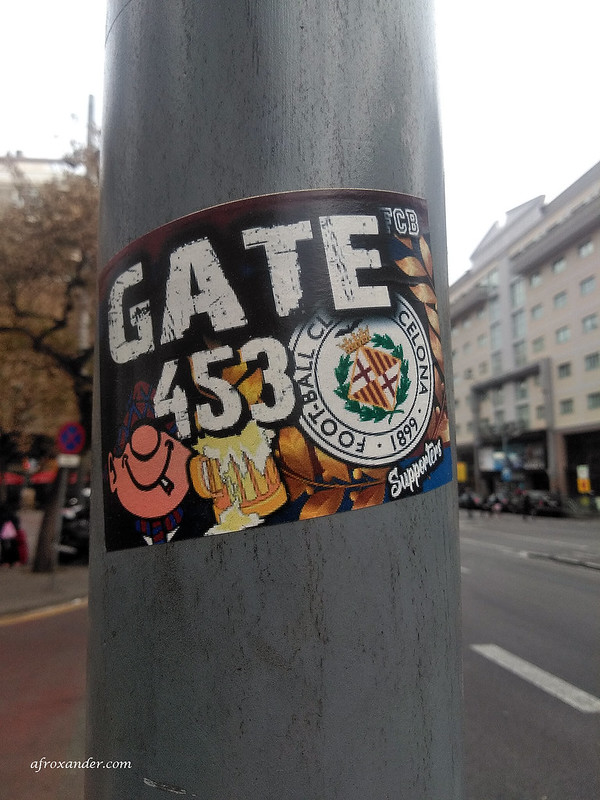
Barcelona: The Spanish Civil War Tour

I spent nine days in Barcelona this past April. This is the first of a few posts about that trip.

I began my second, full day in the city at the Plaça de Catalunya, which is the beginning and ending point of the Spanish Civil War walking tour. Nick Lloyd created the tour nearly a decade ago and offers it multiple times a week with the aid of Catherine Howley, who was the guide for my group.

The Spanish Civil War walking tour traverses the Plaza and part of the area across the way in and around Las Ramblas covering various important locations and events of the era. You can read more about the tour at the official site.

All photos taken with my ZTE Z983 and edited on PSCC19.
civil war tour 001

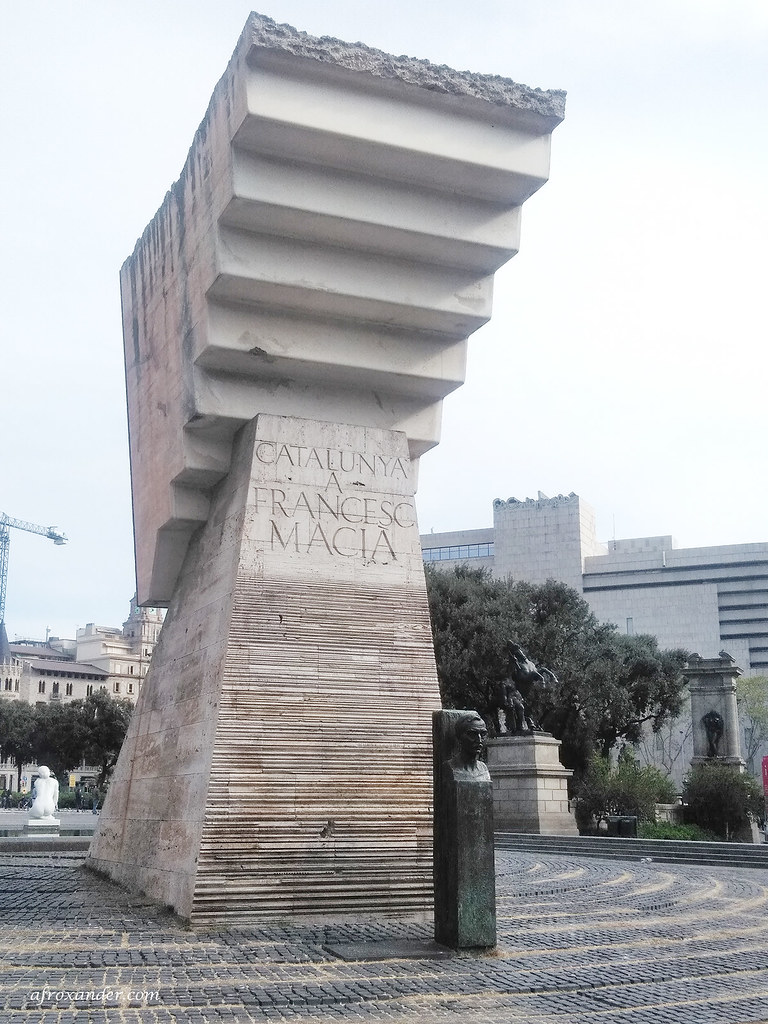
The tour begins with quick introductions at Café Zurich across from Plaça de Catalunya where the history lessons begin at the monument dedicated to Francesc Macià, president of the re-established Generalitat de Catalunya of 1931.
civil war tour 002

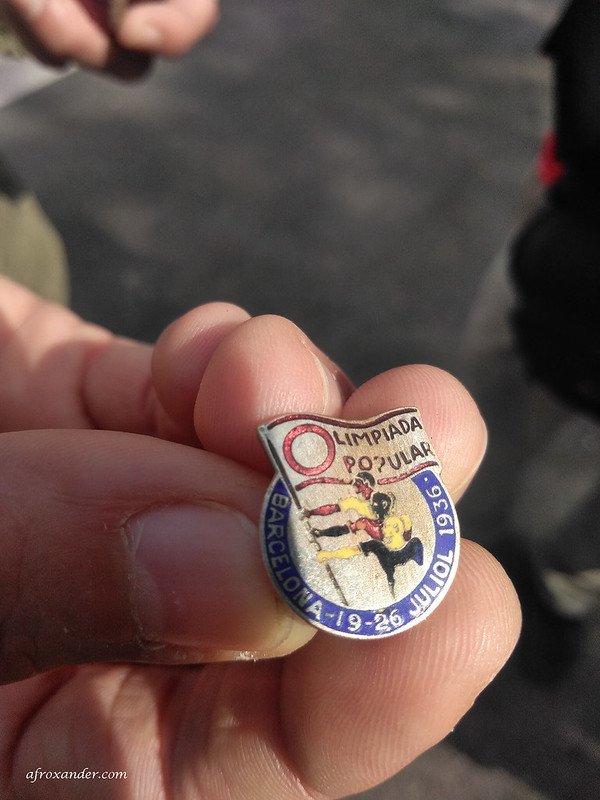
Above is a pin promoting the Olimpiada Popular (People’s Olympiad) of 1936. The event was a response and protest against the official 1936 Summer Olympics hosted by Germany and the Third Reich. Thousands of athletes from 22 countries were set to compete under the watchful eyes of Catalans and journalists from all over the world on July 19th when war broke out on July 17th.

civil war tour 003

A view of Las Ramblas as we walked over to…
civil war tour 004

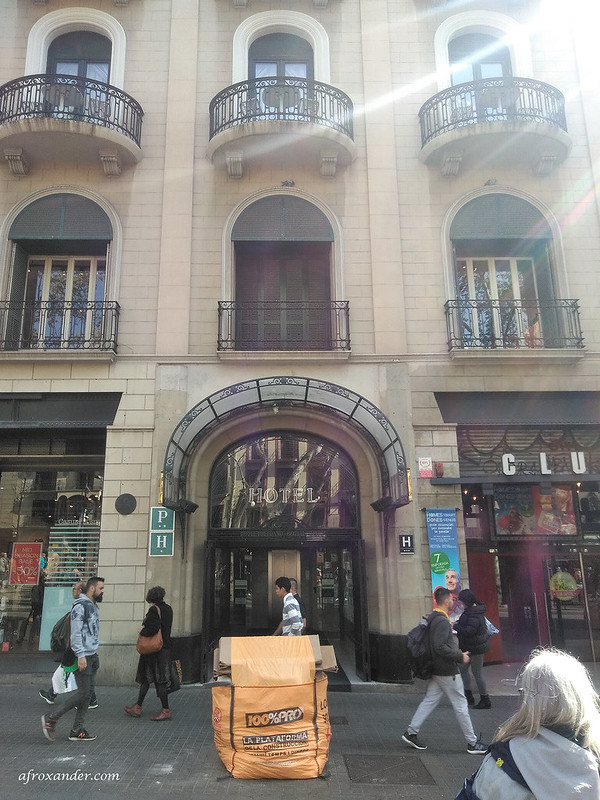
…the Hotel Continental! George Orwell (Eric Arthur Blair) stayed here multiple times during the civil war and included it in Homage To Catalonia.

civil war tour 005

One of the many narrow streets around Las Ramblas.
civil war tour 006

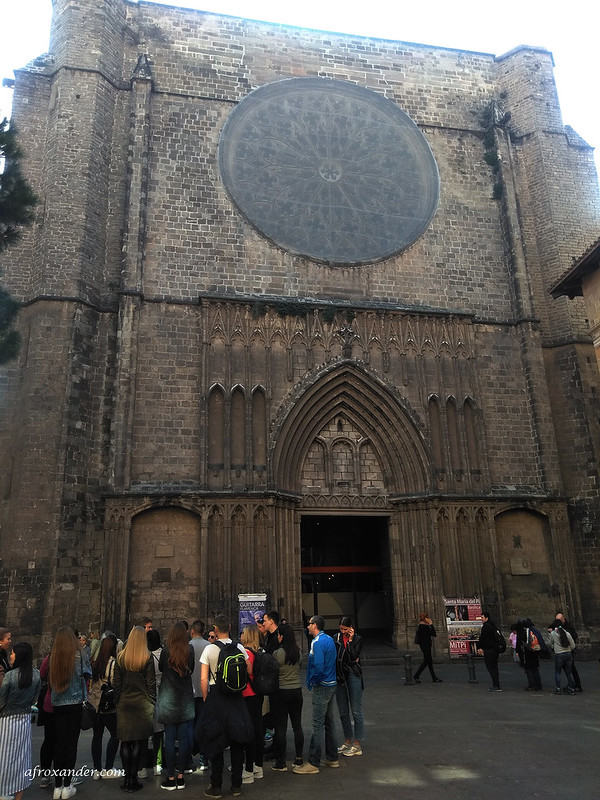
The Santa Maria del Pi church. The large, circular window is new as it was destroyed during the civil war.

civil war tour 007

An art store across from the church.

civil war tour 009

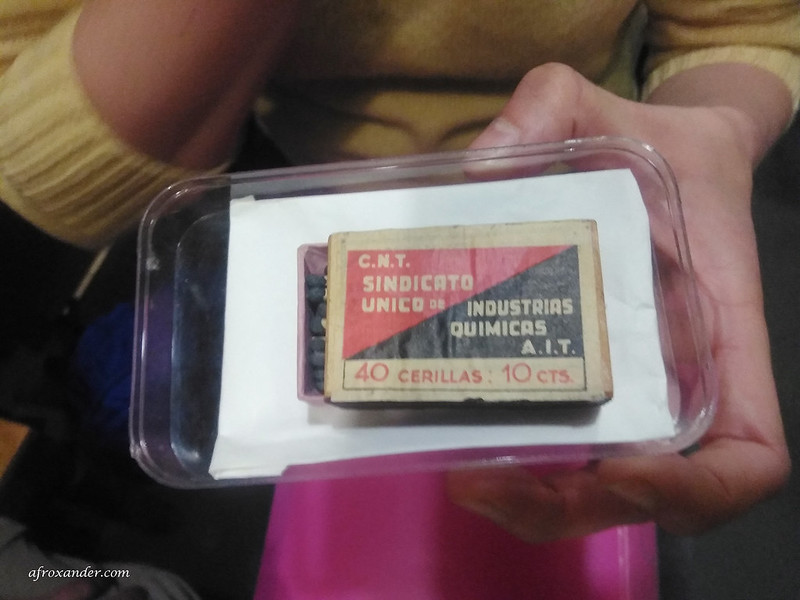
A box of matches featuring the logos of the CNT, Confederación Nacional del Trabajo, and the AIT, Asociación Internacional de los Trabajadores.
civil war tour 010

civil war tour 011

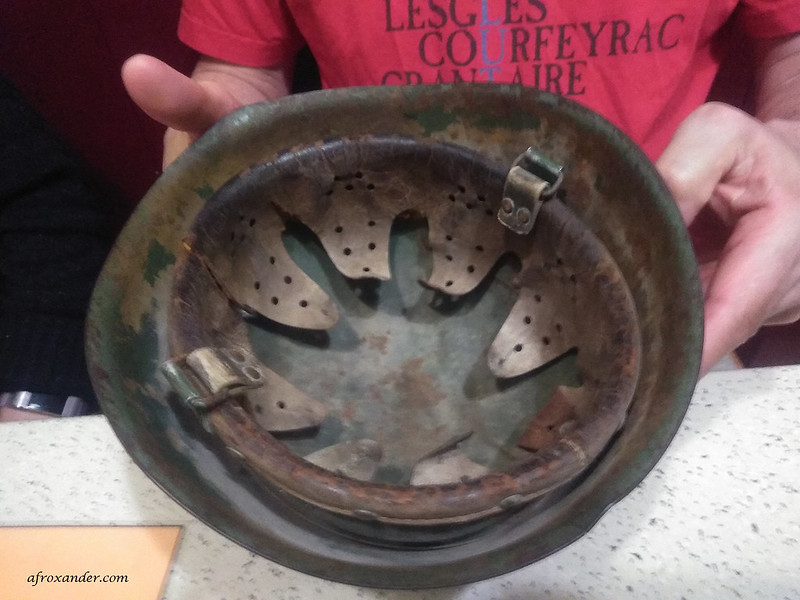
A combat helmet of the era.

civil war tour 012

And a gas mask of the era!

civil war tour 013

The remains of a case of a rocket-propelled grenade.

STRONG CONTENT WARNING for the next photo!

.

.

.

.

.

.

.
civil war tour 014

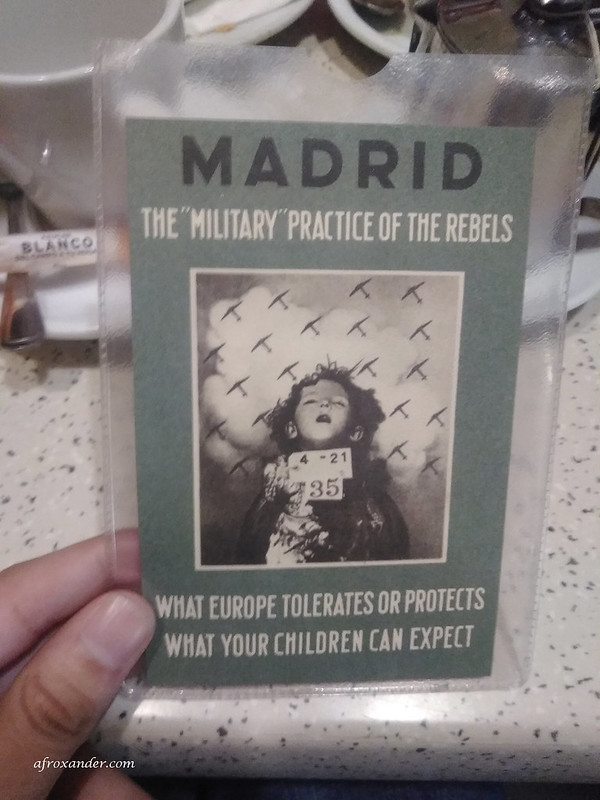
Spanish Republicans published this image as part of its propaganda campaign against Francisco Franco and the Nationalists. The child in the image was killed in an air raid.

civil war tour 015

First aid bandages.

civil war tour 016

A  matchbook.

civil war tour 017

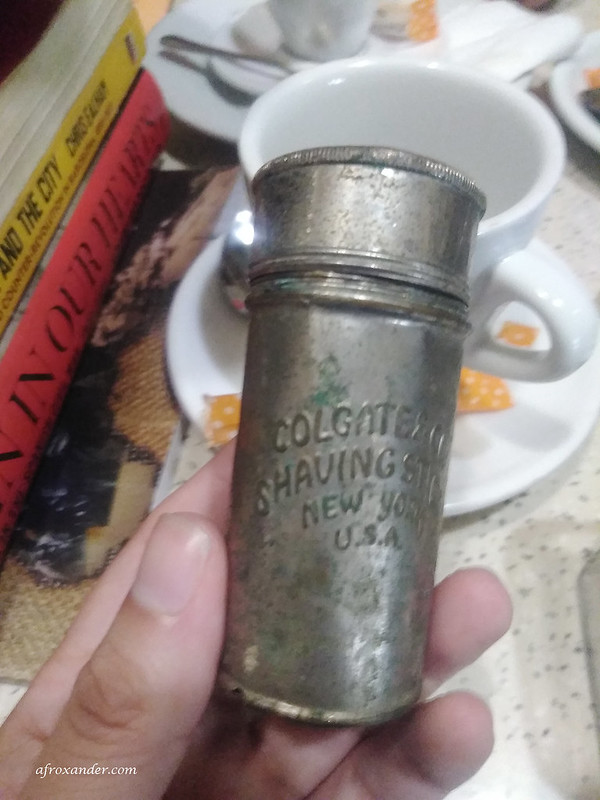
A shaving kit.

civil war tour 018

civil war tour 019

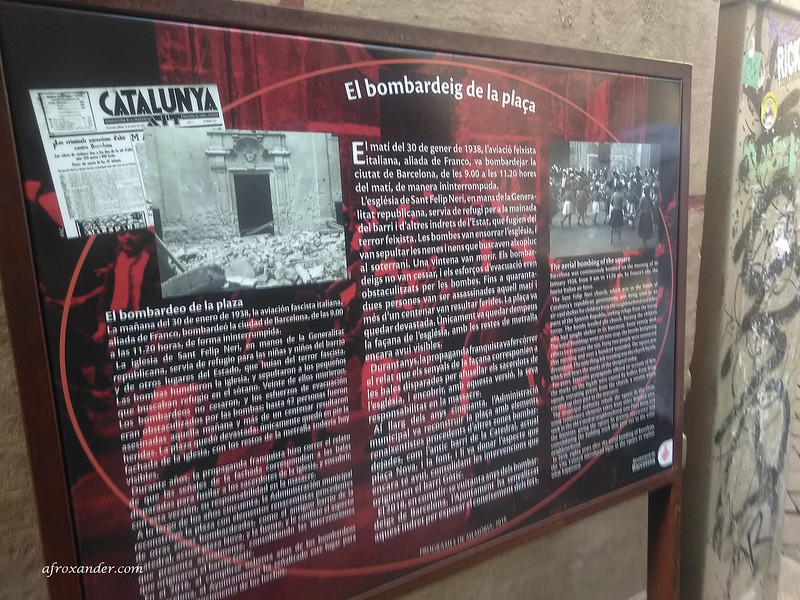
The above two photos are from the Plaça Sant Felip Neri. The façade of the church remains scarred by damage from the shrapnel of two bombs dropped onto the square during the war.

The sign outside the plaza (first photo) gives the details of the bombing: on January 30th, Italian fascists bombed Barcelona from 9am until 11:20am. The church in the plaza provided refuge to many children during the war and 20 of them died during the bombardment. Pro-Franco propaganda claimed that the damage to the building was the result of the slaughter of Catholic priests at the hands of anarchist firing squads.

civil war tour 020

A copy of the New York Times from January 31st, 1938 with an article about the bombing.

civil war tour 021

The Hotel Rivoli on Las Ramblas was once the headquarters of the POUM, Partido Obrero de Unificación Marxista, which Orwell was a member of.

civil war tour 022

This plaque is located on the Hotel Rivoli. It marks the date when POUM co-founder Andreu/Andrés Nin was kidnapped from the POUM’s office by pro-Stalinist Spanish Communists and disappeared, tortured and killed.

Orwell covers many of the events leading up to Nin’s capture in Homage to Catalonia and narrowly avoided being kidnapped by Stalinist forces himself.

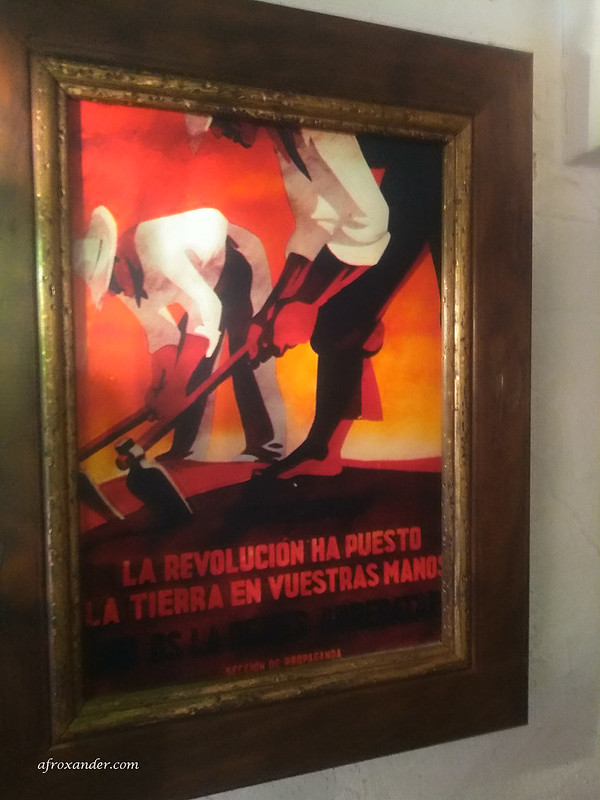
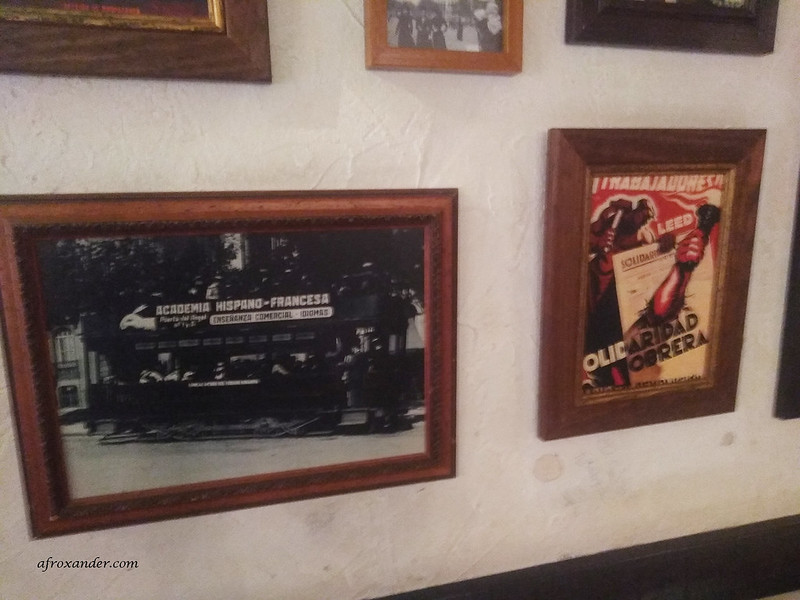
The final set of photos are from the interior of the Bar Llibertària. The bar features numerous artifacts connected with the POUM and CNT.
civil war tour 023

Above: “The Revolution Has Placed The Earth In Your Hands”

civil war tour 024

Above: “Comrade! Work and fight for the revolution.”
civil war tour 025

civil war tour 026

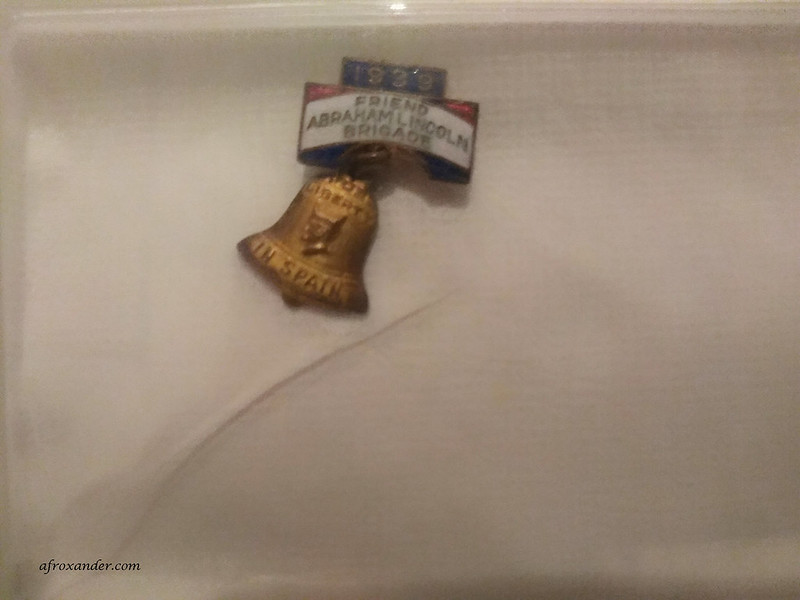
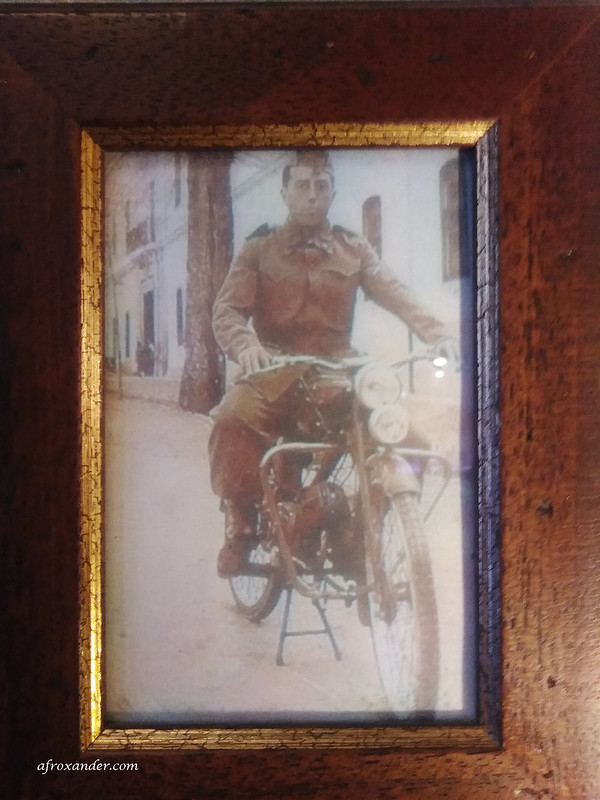
A pin of the Abraham Lincoln Brigade a.k.a. Lincoln Battalion, composed of hundreds of volunteers from the USA. The battalion was a member of the XV International Brigade, a brigade composed of foreign volunteers who fought alongside the antifascist/anti-Franco forces in Spain.
civil war tour 027

A framed portrait of Buenaventura Durruti.

A Las Barricadas: Los Muertos De Cristo’s Atheist-Anarchist Punk Music

maxresdefault

Spanish Punk music has long had an anarchist as well as atheist tradition. Los Muertos De Cristo were no different in this regard as they wore their atheism on their sleeve…or in this case their band name (Christ’s Dead).

Lorenzo Morales (singer), Antón Tochi (lead guitar), Jesus “Mosti” Mosteiro (rhythm guitar), Ignacio “Chino” Gallego (bass), and Maniel “Lolo” Borrego (drums) came together in 1989 in Utrera, Sevilla, Spain. The quintet chose its name for three reasons. First, as a direct challenge to censorship and free speech laws in their country (of which they provided many challenges). Second, as a reflection of the band’s atheism. Third, to commemorate the millions of people killed in the name of religion throughout history.

LMDC self-released its debut EP, Punk’s Not Dead ’91, in 1991 and unveiled its full-length debut album, A Las Barricadas (To The Barricades) in 1995. The 12-song album includes the band’s Anarcho-Punk version of “¡Ay Carmela!/El Paso Del Erbo,” a classic song originally written during the War of Spanish Independence in 1808 and used by the Spanish Republican Army during the Spanish Civil War. LMDC’s version changes the lyrics to reflect their antifascist stance with lines such as “solo es nuestro / acabar con el fascismo (our only wish / is to end fascism).”

The band remained true to its Anarchist roots throughout the entirety of its existence. They self-published/distributed six of their nine albums with A Las Barricadas, Cualquier Noche Puede Salir El Sol (The Sun May Rise On Any Night), and Los Pobres No Tienen Patria (The Poor Have No Homeland) the exceptions. The band also created their own label, Odisea Records, which still exists today to promote their work as well as the work of Anarcho-Punk group El Noi Del Sucre.

Speaking of which, the seeds of LMDC’s impending demise were first planted in 2001. Morales first referred to himself as El Noi (The Boy) on the band’s live album Bienvenidos Al Infierno (Welcome To Hell). Morales wanted to start a new Anarcho-Punk group from scratch but not before ending LMDC on good terms with his bandmates.

LMDC announced their inevitable dissolution during their performance at the BaituRock festival in the summer of 2006. The group’s farewell tour lasted well into 2008 and they released their final album, Rapsodia Libertaria Vol. III, in 2009. Morales launched El Noi Del Sucre (The Boy From Sugar/The Sugar Boy), named as an homage to Catalonian anarchosyndicalist Salvador Seguí, that same year. Mosti and Chino of LMDC joined him in this new endeavor with the latter leaving the group in October of this year in order to focus on his work at Odisea Records.

Los Muertos De Cristo reunited this year to celebrate their 25th anniversary, touring as El Noi Del Sucre & Los Muertos De Cristo.

The band’s entire discography is available for download at this site.

Spanish Post-Punk & New Wave

The past few weeks of work for Remezcla have yielded a wonderful surprise: a revival of post-punk music at the hands of Spanish musicians.

Bands such as Antiguo Régimen are bringing back tracks with thick, metallic bass lines:

That’s a bass line that could’ve come from a long-forgotten Joy Division song! These groups also mix a few elements of New Wave and Goth. For example, there’s El Último Vecino whose debut album is as 80s as you can get without the buckets of hair spray.

Then there’s Triángulo De Amor Bizarro whose name is a Spanish translation of Bizarre Love Triangle. The band’s music varies from one song to the next switching from post-punk to HEALTH-style noise-rock. They tend to keep it slightly old-school with a mix of post-punk and shoegaze.

The latest addition to this group is Despotismo Ilustrado who have yet to release any official recordings other than a few demos recorded during their rehearsals.

For old times sake, here’s Capitán, who I wrote about last year:

Alerta Antifascista: The Anarcho-Punk Sounds of Sin Dios

Sin Dios was a hardcore-punk band from Madrid, Spain that existed from 1988 – 2006. The group released eight original lp’s plus a handful of ep’s during those years that outlined their anti-fascist, anti-authoritarian and anti-capitalist anarchist beliefs.

The band wore its politics on its sleeve much the same way Morrissey wears his emotions as a badge of honor. The album titles say it all: Sin Dios…Ni Amo (No God or Masters), Ruido Anticapitalista (Anticapitalist Noise), Alerta Antifascista (Be Alert Antifascist), Guerra A La Guerra (Wage War On War), Solidaridad (Solidarity), Ingobernables (Ungovernable), Odio Al Imperio (Hatred Against the Empire), and Recortes De Libertad (Snippets of Liberty). The albums were packaged with booklets filled with commentary that explained the topics and themes behind the songs.

They followed the autogestion/worker self-management model were no one member held authority over the group and decisions were made and agreed upon democratically. As such, they operated without the aid of managers or agents. They self-produced and distributed all their works through their own label, Difusión Libertaria La Idea, or with the assistance of other independent anti-commercial labels such as PHC and Queimata. The band sold their albums at popular, rather than competitive, prices.

Sin Dios maintained dedicated groups of fans in Spain, Europe and Latin America despite its underground status (I’m talking pre-internet days). They also worked with a number of anarchist groups in other countries, most notably Mexico’s Juventud Antiautoritaria Revolucionaria (Revolutionary Antiauthoritarian Youth), who assisted the band in its tour of Mexico in 1999 as well as helped publish/distribute its albums in Mexico, and Brazil’s União Libertária da Baixada Santista – U.L.B.S. (Libertarian Union of Baixada Santista – libertarian in the original meaning of the word, anarchist liberty, not the modern Ron Paul/Mises redefinition), who the band supported via a benefit album.

No reason was given for the split in 2006 but the members announced they would continue their political activities via other means. It’s believed two of the members were, and possibly still are, also members of the Confederación Nacional del Trabajo (National Confederation of Workers).

The group’s library is also available as a free download/stream on its website. Click on an album then right-click a song title and select “save link as.”

Bigott’s a Funny, Elusive Guy With a Huge Mustache

As I mentioned last week, Spanish folk/pop artist Bigott made his L.A. debut last week following his trip to SXSW. I was able to meet with him and his impressive facial hair (hence the name Bigott after “bigote” [mustache]) afterwards for a brief interview. He didn’t divulge much (something he’s famous for) but there were plenty of laughs to be had.

Did you swing by L.A. because you were in SXSW a few days ago?

That’s it. We were close by and thought we’d swing by Los Angeles or Charlie or St. Raphael or whatever.

When did you arrive? Saturday?

Yes, Saturday. Well, I’m a little confused as to exactly when but I think it was Saturday.

And what have you done so far here in L.A.? Did you go to the beach?

Yeah, we rented some bikes here in the Venice of L.A.! Venice is the name of the beach. We were all over the place. Continue reading “Bigott’s a Funny, Elusive Guy With a Huge Mustache”

The Trials of Baltasar Garzón

Spanish magistrate Baltasar Garzón continues to sit on the opposite side of the bench inside  Spain’s supreme court. Garzón, lauded globally as a defender of human rights, is currently defending himself in his second trial where he is accused of breaking an amnesty law passed in 1977, two years after dictator Francisco Franco’s death, that prevents any probe into Franco-era crimes via a general pardon.

Baltasar Garzón. Photographer unknown.

Judge Garzón launched a probe in 2008 into the disappearances of over 100,000 persons while Franco was in power. Family members of the victims have spent years, some even decades, trying to discover where their loved ones were buried.

From The Telegraph UK:

The first witness, Maria Martin, recalled how in 1936 when she was just six, her mother was one of three women and 27 men shot dead and their corpses dumped into a mass grave on the side of a road.

Supported by a Zimmer-frame and speaking in a voice cracked with emotion, the 81-year-old said her family had fought to recover the remains of her mother for a proper burial ever since.

“Until the day he died in 1977 my father wrote to the local authorities to try to recover the body. They told him: ‘Go away, leave us in peace or we will do to you what we did to her’,” she told the Supreme Court.

Garzón first appeared in court last week to defend himself from allegations that he’d overstepped his jurisdiction when he authorized police to wiretap conversations between lawyers and their clients in what’s known as the Gürtel case. The case involves charges of corruption against members of the Partido Popular, which currently holds power in Spain.

A date for the third case, which centers around allegations that Garzón dropped an investigation against the president of Banco Santander in exchange for payments for a course sponsored by the bank at New York University, has not been set yet.

El Pais has a detailed analysis of each case.

Garzón became famous worldwide in 1998 when he ordered the arrest of Chile’s former dictator Augusto Pinochet for crimes against humanity. Pinochet was extradited from London to Santiago, Chile where he lived under house arrest during his trial. The arrest led to “the Garzón effect” throughout Latin America.

That was just the first in a number of high-profile cases he led including:

  • the conviction of former Interior Minister José Barrionuevo Peña for leading state-terrorist group Grupos Antiterroristas de Liberación (GAL)
  • many cases against members of Basque separatist group Euskadi Ta Askatasuna (ETA)
  • an investigation into whether the Bush Six ( Alberto Gonzales, John Yoo, Douglas Feith, William Haynes II, Jay Bybee, and David Addington) violated international law by justifying the use of torture at Guantanamo Bay

Garzón risks losing his role as Investigative Magistrate for up to 20 years if he is convicted in any of the trials.

Below is a lengthy interview Garzón gave to Democracy Now:

Five Favorite Things From 2011

5) Remezcla

I began freelancing for Remezcla on a regular basis in May. Since then, I:

My work there continues to expose me to many artists I would never hear of otherwise, such as Quiero Club whose song, “Dias Perfectos,” is my favorite of 2011:

My last interview of 2011 (with Rodrigo of Rodrigo y Gabriela) will be my first published interview in 2012. It can only get better from here!

4) Sargent House

Sargent House is an artist management company (don’t call it a record label!) in L.A. that is home to the types of bands larger labels are too timid to promote.

I met SH founder Cathy Pellow and her staff of dedicated musicphiles in October 2010 when I covered the Omar Rodriguez-Lopez Group/Le Butcherettes concert for LA Weekly. It was immediately obvious that they were the real deal and not some stereotypical Hollywood character archetype.

2011 was a busy year for everyone involved with SH. Every band on the roster toured at some point. Le Butcherettes, Omar Rodriguez-Lopez Group, And So I Watch You From Afar, Zechs Marquise, Hella, Gypsyblood and others released an album (two in the case of Boris). Big Sir, Fang Island, This Town Needs Guns and others spent the year working on new material.

One of the highlights of the year was the company’s SXSW showcase, which featured the U.S. debut of Adebisi Shank. This leads to point three…

3) SXSW

You always remember your first! I traveled to Austin, TX for my first SXSW experience. My trip there was brief (two days/two nights) but memorable and fun thanks to the new friends and contacts I met and all the great music that surrounded me.

SXSW_2011_039
Just one of many "entrances" to SXSW.

I was really struck by the diversity of genres and styles represented by the performers at the festival. I remember turning a corner and hearing a country band perform in the patio. Two doors down, an indie-rock band had people dancing while, next door, an independent hip-hop artist made some new fans. By the time I hit the other end of the street, I’d heard punk, metal and latin music as well.

2) Spain

pamplona053
Festival de San Fermin (Running of the Bulls)

This was another “first” for me: my first time in Europe and Spain. I lived/studied in Valladolid for the month of July and visited Pamplona, Salamanca, Segovia, Santander and San Sebastian (mostly north/central Spain). I hope to return and visit the coastal areas.

1) My niece

I returned home from Spain to be greeted by my newborn baby niece:

Adventures in babysitting!

Planking Across Spain

I don’t recall exactly the “how” or even the “why” this began but for some odd yet humorous reason I ended up planking a number of sites during my trip to Spain. What began as a simple one-time joke became a long-running gag funny in its silliness and pointlessness. The photos were taken by various friends who were more than happy to oblige (and egg me on!)

VALLADOLID:

Valladolid_plank_01

Valladolid_plank_02

The wall is one of the original borders of the city of Valladolid still left standing.

restaurant_plank_01

restaurant_plank_02

Everyone was upset during our group dinner as it was our last week together…so I cheered them up with a plank!

VITORIA-GASTEIZ:

Vitoria_Pamplona_plank_01

PAMPLONA (Iruña):

Pamplona_plank_01

Apologies to Ernest Hemingway and family! Continue reading “Planking Across Spain”