I spent a good portion of my time in Cusco, Peru admiring the work created by art students of the Escuela Superior Autonoma de Bellas Artes. My favorite piece was a large installation by Victor Salvatierra Laime, Oscar Alberto Llalla Cordova, Elio Pumasupa Solano, and Mario Gamarra Valdez. The piece illustrates the famous battle at Cusco between the Incas and the Chankas.
The battle of Yawarpampa, “el campo de sangre” (the field of blood)
The Chankas was a indigenous tribe in Peru primarily located in the Andahuaylas (modern-day Apurimac) region and consisted of two separate tribes: the Hanan Chankas and the Uran Chankas.
In 1438, Hanan Chanka leader Anccu Hualloc led an army of 40, 000 strong, including warriors from the Ayamarca tribe, and invaded the city of Cusco. Incan prince Cusi Yupanqui led the resistance with allies from the Canas tribe and regained control of Cusco. The battle led to the formation of the Incan empire, known in Quecha as Tawantinsuyu, by Yupanqui who became Pachacutec.
People protest the church of Scientology in the now famous mask.
The mask is modeled after Guy Fawkes whose face became famous the world over after the release of the Wachoski Bros. 2006 film V For Vendetta. The film is an adaptation of the graphic novel by the same name by Alan Moore and David Lloyd which centers on a mysterious figure named V who fights government oppression (as an anarchist in the book; as a freedom fighter in the film) while wearing the Fawkes mask.
Neither medium delves deeply into the story of real-life figure Guy Fawkes other than noting the rhyme associated with his exploits:
Remember remember the fifth of November
Gunpowder, treason and plot.
I see no reason why gunpowder, treason
Should ever be forgot…
The following issue then arises: what are we supposed to remember and why should it never be forgot? The answer lies within the life and exploits of Guy Fawkes.
Defying the fury of the winds and the hunger of ship-eating monsters, Admiral Christopher Columbus set sail.
He did not discover America. The Polynesians had arrived a century previous, and the Vikings four centuries before that. And three hundred centuries before them all came the oldest inhabitants of these lands, people whom Columbus called Indians, believing he had entered the Orient by the back door.
Since he did not understand what they said, Columbus was convinced the natives did not know how to speak. Since they went about naked, were docile, and gave up everything in return for nothing, he believed they were not thinking beings.
Although he died insisting his travels had taken him to Asia, Columbus did begin to harbor doubts on his second voyage. When his ships anchored off the Cuban coast in the middle of June 1494, the admiral dictated a statement affirming that he was in China. He left written evidence that his crew agreed: anyone saying the contrary was to receive a hundred lashes, be fined then thousand maravedies, and have his tongue cut out.
At the bottom of the page, the few sailors who knew how to write signed their names.
Columbus deserves the credit or blame only for what he actually did: which was to discover a route that permanently linked the shores of the Atlantic and to contribute–more signally, perhaps, than any other individual–to the long process by which once sundered peoples of the world were brought together in a single network of communications, which exposed them to the perils and benefits of mutual contagion and exchange. Whether or not one regards this as meritorious achievement, there was a genuine touch of heroism in it–both in the scale of its effects and in the boldness which inspired it. There had been many attempts to cross the Atlantic in central latitudes, but all–as far as we know–failed because the explorers clung to the zone of westerly winds in an attempt to secure a passage home. Columbus was the first to succeed precisely because he had the courage to sail with the wind at his back.
…
So which was Columbus: hero or villain? The answer is that he was neither but has become both. The real Columbus was a mixture of virtues and vices like the rest of us, not conspicuously good or just, but generally well-intentioned, who grappled creditably with intractable problems. Heroism and villainy are not, however, objective qualities. They exist only in the eye of the beholder.
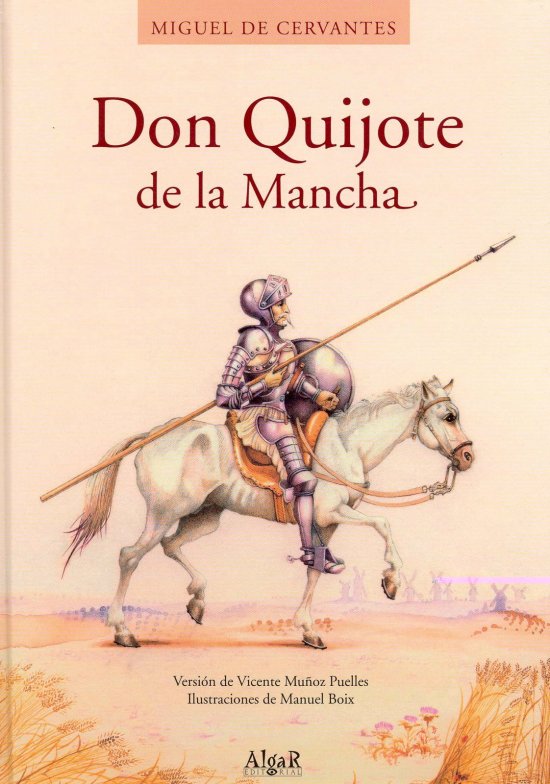
Museo Casa de Cervantes (House of Cervantes Museum) is a museum dedicated to the life and work of Spain’s greatest writer, Miguel de Cervantes Saavedra.
"Oh yeah...the guy who fought the windmill!"
The museum is the former home of Cervantes who lived in Valladolid with his family from 1604 – 1606. He completed his masterpiece, El Ingenioso Hidalgo Don Quijote de la Mancha, here and published it in 1605. Monarch Alfonso XIII and Archer Huntington, then-president of the Hispanic Society of America, purchased the property in 1912 and later donated it to the State. The building was officially inaugurated as the Museo Casa de Cervantes on April 12, 1948.
I wonder if History teachers in Spain toss their written materials out the window and book a field trip for their students in place of a lecture. It wouldn’t surprise me if this were the case considering the amount of living history and architecture contained, for example, in a city such as Segovia.
Segovia is home to many pieces of architecture that hold a significant spot in history, so much so that UNESCO declared in 1985 that a portion of the city to be a World Heritage site.
Segovia’s most notable piece of history is a Roman aqueduct that is nearly 2,000 years old and erected without the use of cement or mortar. The city is also home to a large Alcázar (castle) where various monarchs including Alfonso X El Sabio (Alfonso X The Learned/Wise), Los Reyes Católicos (The Catholic Kings), Felipe II (Phillip II) and Carlos III (Charles III) lived and exercised their power.
There is also an enormous Gothic cathedral that contains 23 chapels built in 1525 at the behest of Emperador Carlos V (Emperor Charles V).
Below are a number of photos of these monuments as well as other photos from my time in Segovia. All can be seen on my Flickr.
A highlight of my stay in Valladolid, Spain was my group’s trip to the city’s nationally-recognized museum of religious sculpture at Colegio de San Gregorio. The museum hosts an incredible collection of religious sculptures and paintings from the 15th – 18th centuries. Highlights from my visit are below and, as always, all photos from my visit (nearly 200!) can be seen on my Flickr.
It was on this day in 1936 when Francisco Franco (born Francisco Paulino Hermenegildo Teódulo Franco y Bahamonde, 4 December 1892 – 20 November 1975) led Spanish military forces in the Canary Islands in a coup d’etat against the Second Spanish Republic, Spain’s government at the time.
His Excellency, Generalisimo Francisco Franco (center, marching)
The coup failed and launched the Spanish Civil War were right-wing groups (Bando Nacional, FE de las JONS, CEDA, Carlistas) led by Franco fought and eventually overthrew the left-wing government of Spain (Frente Popular composed of PSOE, PCE, POUM, Banda Republicana) in 1939.
Spanish History Channel documentary La España de Franco (Franco’s Spain).
Franco then ruled Spain as dictator until his death in 1975.
It was fifty years ago today that author/journalist Ernest Hemingway committed suicide in his home in Ketchum, Idaho with the aid of one of his shotguns. Depression, alcoholism and a number of head injuries broke him into a state of disrepair.
Hemingway was infamous for his zest for life (or, rather, danger and excess). He was an avid athlete in high school and maintained a lifelong passion for boxing. He was also an avid sportsman who enjoyed fishing (re: Big Two-Hearted River, The Old Man and The Sea), hunting and the outdoors.
He volunteered for the Red Cross near the Italian front in the first World War where he suffered injuries from shrapnel, witnessed the bombing of Smyrna during the Greco-Turkish war, worked as a war correspondent in Spain during that country’s civil war where he wrote The Fifth Column in Madrid during the Siege of Madrid and was at the D-Day Landing and liberation of Paris in World War II. A bout of pneumonia kept him away from the front lines at the Battle of the Bulge. A few of these experiences formed the basis of his most famous novels A Farewell to Arms and For Whom The Bell Tolls.
George Orwell would have been 108 on June 25th 2011 had he somehow managed to kick tuberculosis in the yarbles and been one of the lucky few who live past 98.
George Orwell
Orwell (born Eric Arthur Blair) was a writer who, after many years struggling as a bookshop clerk, freelancer, BBC radio host and columnist, came to fame after the publication of his last novel 1984, an anti-utopian/dystopian tale of a totalitarian future. The book introduced the public at large to Orwell’s long-held political views of anti-totalitarianism:
Every line of serious work that I have written since 1936 has been written, directly or indirectly, against totalitarianism and for democratic socialism, as I understand it.
To mark the occasion, I’ve chosen my favorite quotes from his fiction and non-fiction novels (that I’ve read) to highlight his views as they matured over the course of his life and work.
Let’s skip past the obvious sombrero/sarape jokes and get straight to the point: far too many people have no clue what Cinco de Mayo is all about nor how it came to be. For the sake of brevity, I present a brief history cheat-sheet on the history and development of the Cinco de Mayo celebration.
From Francine Prose’s article, Savoring Puebla for Smithsonian Magazine:
Like the rest of Mexico, Puebla has had a troubled history marked by war, invasions and revolutions. Several important military confrontations took place there, most famously the Battle of the Fifth of May, Cinco de Mayo, commemorated in a holiday that has assumed great significance for Mexicans living outside their own country. At the battle, which occurred not far from Puebla’s center, on May 5, 1862, the Mexican Army defeated the French with the aid of local troops. Unfortunately, the French returned a year later and smashed the Mexican forces and occupied Mexico until they were defeated by Benito Juárez in 1867.
Artwork depicting the Battle of Puebla. Courtesy of diasdehistoria.com.ar. Artist unknown.




 Hemingway was infamous for his zest for life (or, rather, danger and excess). He was an avid athlete in high school and maintained a lifelong passion for boxing. He was also an avid sportsman who enjoyed fishing (re: Big Two-Hearted River, The Old Man and The Sea), hunting and the outdoors.


 Afroxander (aka Iván Fernández)